Relocation of Cape Town baboons to sanctuary ignites heated protests

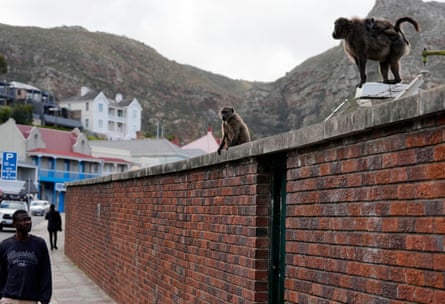
The relocation of a troop of baboons in Cape Town to a wildlife sanctuary has triggered furious protests by local people opposed to their capture, which officials argue is necessary to stop human-wildlife conflict in the city.
The 44-member Waterfall troop (named after the area they mainly inhabit) was captured in the southern seaside suburb of Simon’s Town on Friday and Saturday. A second, smaller Seaforth troop is also due to be moved.
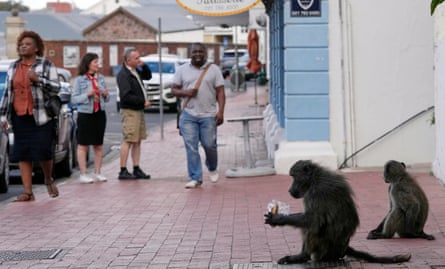
The growth in both baboon and human populations in Cape Town in recent years has led to increased conflict and more baboons dying as a result. Meanwhile, a heated debate has raged between people who believe that baboons and humans can coexist and those who argue that baboons in urban areas are in danger and in some cases need to be relocated. Some animal rights activists have compared authorities’ baboon management to apartheid.
During Friday’s relocation, outraged protesters tried to stop vehicles taking the baboons away. One person sprayed a fire extinguisher, according to the Daily Maverick, a local news outlet.
After the confrontation, the local Society for the Prevention of Cruelty to Animals branch urged those opposed to the baboons’ capture not to try to stop the vehicles. “Capture and transport are already stressful for the baboons,” it said in a statement. “Delaying their arrival prolongs their time in crates and risks adding to that stress – this is not fair on the baboons.”
It said that it remained opposed to the baboon’s relocation, adding: “Our presence did not imply support … our inspectors are present because the animals need someone looking out for them.”
On Sunday, dozens of people sat outside the wildlife centre in a silent protest, some tying flowers to the fence. Baboons from a different troop also gathered at the boundary, calling to the newly-captive animals, the Daily Maverick reported.
“We stand together for the Seaforth and Waterfall troops, for their freedom, their dignity and their right to live as wild animals,” Mandy Neal, the administrator of the Save Kogelfontein Baboons Facebook group, posted on Monday, calling for weekly Sunday silent protests. “ Our message is simple: CAPTIVITY IS NOT CONSERVATION.”
The City of Cape Town said in a statement on Sunday that the relocation had been successful, with the baboons being monitored 24/7 after being checked by vets and the females receiving contraceptive implants.
It said: “The Waterfall troop has been relocated due to the severity and persistence of human-baboon conflict in the Simon’s Town urban environment, the limited available natural low-lying habitat, the increasing risk to the baboons’ welfare, and public safety concerns … [and] as a very last resort after other interventions were evaluated and deemed ineffective, and as an alternative to culling.”
Prof Justin O’Riain, a behavioural ecologist at the University of Cape Town, said that the baboon management plan had undergone two years of public consultations. “It has thus been disappointing watching members of the public and select NGOs, many which did not engage in the stakeholder process, now compromising the safety and welfare of the baboons and people through violent actions directed at staff and baboons in transit.”
KioskNews shows a cleaned-up reading view extracted from the publisher’s page — the original always lives on their site, not ours.