Taipei faces double aging crisis: data
SPIRALING TREND: The departure of younger residents creates a demographic imbalance, while slow supply of new homes is reinforcing the trend, analysts said
By Hsu Yi-ping and William Hetherington / Staff reporter, with staff writer


Taipei is facing a double aging challenge, with nearly one-quarter of its population aged 65 or older and nearly three-quarters of its homes more than 30 years old, government statistics show.
In August, 24.76 percent of Taipei residents were aged 65 or older, the highest proportion among Taiwan’s 22 administrative regions. In the second quarter, 74.47 percent of the city’s homes were more than 30 years old, the second-highest proportion, real-estate professionals said.
A total of 17 of Taiwan’s 22 regions have become super-aged societies, where people aged 65 or older account for at least 20 percent of the population. Only Taoyuan, Taichung, Hsinchu City, Hsinchu County and Lienchiang County are yet to reach that threshold.
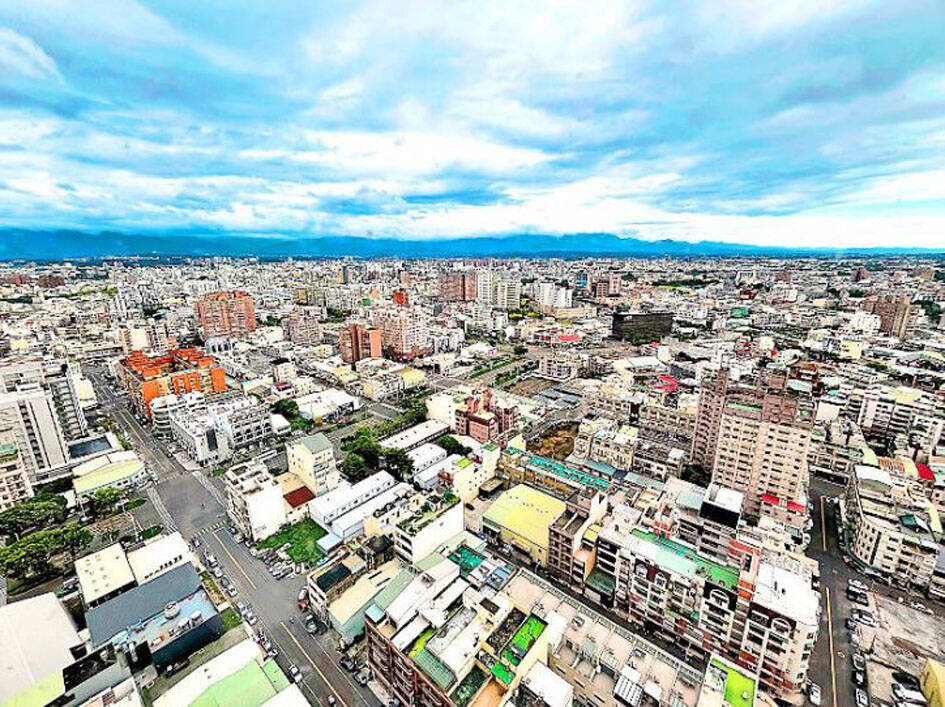
Commercial and residential buildings are pictured in Taipei in an undated photograph.
Photo: Taipei Times
Colliers International Taiwan head of occupier services Huang Shu-wei (黃舒衛) said that Taipei, one of the areas hardest hit by the double aging problem, must look beyond the age of its housing stock and address associated safety risks.
Policies that prioritize redevelopment benefits while overlooking critical social issues, including public safety and health, are inadequate, Huang said.
The aging of the city’s population is irreversible, and the departure of younger residents is creating a sharp demographic imbalance, he said, adding that current policy measures are producing diminishing returns.
The immediate priority is to move beyond a narrow real estate perspective and coordinate solutions across sectors, Huang said. The government should improve coordination among agencies and integrate measures such as reverse mortgages, senior-care trusts and insurance to turn equity tied up in aging homes into a source of income.
Rental management and housing exchange services could also help create a safer living environment for residents of all ages, he said.
Sinyi Realty research project manager Tseng Ching-te (曾敬德) said that Taipei developed earlier than many other areas and faces a particularly serious problem of older residents living in old buildings.
The government has in the past few years promoted elevator installations in apartment buildings to make access easier for older residents. However, not every building has enough space for an elevator, Tseng said, adding that the government should provide more assistance to affected residents.
Housing Trend Institute chief executive Ho Shih-chang (何世昌) said Taipei’s high housing prices have made it difficult for younger and middle-aged residents to buy homes in the city.
Resale apartments in Taipei average about NT$800,000 (US$24,609) per ping (3.3m2), while presale homes often cost more than NT$1 million per ping, Ho said.
As a result, many younger buyers look to Keelung, New Taipei City and Taoyuan, where transport links allow them to commute to Taipei, Ho said.
This is one factor contributing to the declining proportion of younger and middle-aged residents in the capital, he added.
Meanwhile, the Ministry of the Interior’s Real Estate Information Platform showed that the average age of homes nationwide reached 34.46 years in the second quarter.
Of Taiwan’s 22 regions, only Taoyuan, Hsinchu County and Kinmen had an average housing age of less than 30 years, meaning homes in the other 19 jurisdictions are at least three decades old on average.
The data showed that three areas have average housing ages exceeding 40 years: Yunlin County at 41.31 years, Chiayi County at 41.32 years and Penghu County at 44.33 years.
The figures point to a growing stock of aging homes, raising concerns among real estate professionals that more older adults in Taiwan would find themselves living in increasingly aging properties, critics said.
Huang said that the widespread aging of homes in urban areas reflects two major gaps in housing supply: the lack of mechanisms to phase out aging properties and a shortage of undeveloped land available for construction in metropolitan areas.
These constraints have slowed the supply of new homes, leaving too few newly built properties to replace older buildings and bringing the housing market’s renewal cycle to a near standstill, he said.
He added that older residents and aging homes are increasingly concentrated in prime urban districts, where jobs, healthcare and daily amenities are clustered in established neighborhoods.
Many seniors are reluctant to move after years of living in familiar surroundings, further reinforcing the trend of older people remaining in aging city centers, he said.
The challenges of living in aging homes — including safety risks, costly repairs and limited accessibility — have become widespread concerns among older adults, Ho said.
As a result, more seniors are opting to buy homes in elevator-equipped buildings, while walk-up apartments are gradually falling out of favor. This shift is widening the price gap between apartments without elevators and buildings with elevators in urban areas, a trend that is expected to spread from major metropolitan areas to the rest of Taiwan, he said.
KioskNews shows a cleaned-up reading view extracted from the publisher’s page — the original always lives on their site, not ours.