A look back at South-east Asia’s strongest fire and haze episodes
SINGAPORE – South-east Asia has faced multiple episodes of severe haze, with at least four of them coinciding with particularly strong El Nino years.
In 1982, 1997, 2015 and 2026, the fires in Indonesia were exacerbated by drier, hotter weather caused by the climate phenomenon.
The fires are largely caused by slash-and-burn agricultural practices used by farmers to clear land. This is illegal in Indonesia, but still often used as it is cheaper than using excavators.
The Straits Times traces the scorch marks of the fires compounded by strong El Nino events in recent history, including their impact on the region.
2026
The current episode is the worst haze crisis to affect the region in over a decade.
Smoky pollution from the forest fires in Indonesia has been detected as far away as the Philippines. Between late August and early September, Metro Manila’s air quality fell to acutely unhealthy levels, according to media reports.
Schools have been closed and flights grounded in affected parts of Malaysia and Indonesia. Respiratory cases in both countries have grown.
Indonesia has recorded more than 283,000 cases of acute respiratory infections in affected regions from Aug 18 to Oct 13, said its Health Ministry.
In parts of Kalimantan, the fires turned the sky an apocalyptic orange, and NASA imagery showed high levels of carbon monoxide blanketing South-east Asia due to the fires.
Singapore was also ranked the most polluted city for a few days in October by Swiss-based air quality monitor IQAir.
The Republic had registered 18 consecutive days of unhealthy air starting Oct 5, surpassing the 15 days in 2015. The highest 24-hour Pollutant Standards Index (PSI) reading during this period was recorded at 10am on Oct 18, when it hit 230 in the western region, in the very unhealthy range.
The situation improved on the afternoon of Oct 22, when the 24-hour PSI returned to the good to moderate range. However, the reprieve was likely due to favourable wind conditions, with satellite maps still showing hot spots in Sumatra and Kalimantan.
The months-long blazes have also taken a toll on Indonesia’s wildlife, particularly the critically endangered Bornean orang utan, as their habitats were razed.
In September, the International Union for Conservation of Nature warned that fires were burning in habitats containing 52 per cent of Borneo’s orangutan population.
Indonesia had rescued 232 wild animals as at Oct 8, including 76 proboscis monkeys and 71 orang utans in Borneo.
The persistent fires in Kalimantan and Sumatra have sparked unrest, with protests erupting across parts of Indonesia as frustration swelled over the government’s handling of the blazes. Demonstrators demanded stronger firefighting efforts, tougher action against companies responsible for the blazes and greater protection for affected communities.
Singapore has served legal notices under its Transboundary Haze Pollution Act to 10 companies, asking them to provide more information on fire prevention and suppression strategies.
2015
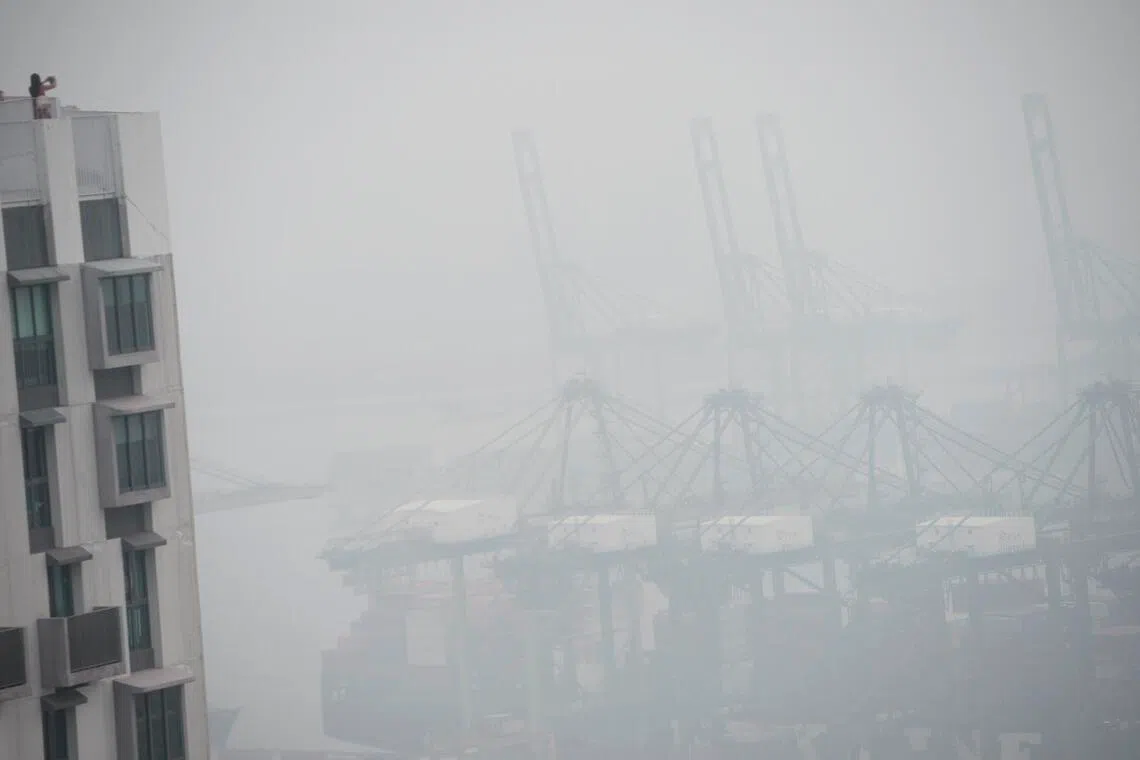
The haze provided its own filter as a woman takes a picture of the PSA from the viewing deck on the 50th floor of The Pinnacle@Duxton at around 6pm on Oct 18, 2015.
PHOTO: ST FILE
The haze episode in 2015 was declared the most severe on record.
The inferno was amplified by a strong “Godzilla” El Nino. A Harvard University study estimated that the 2015 crisis caused 100,000 premature deaths across Indonesia, Malaysia and Singapore.
According to the World Bank, Indonesia’s forest fires that year cost 221 trillion rupiah (S$15.6 billion), more than twice the amount spent on reconstruction efforts after the 2004 Aceh tsunami.
In Singapore, the economic cost of the haze was estimated at $1.83 billion, or 0.45% of the country’s gross domestic product, according to a 2021 report by researchers from Nanyang Technological University’s economics division.
Schools in Singapore closed on Sept 25 when the PSI exceeded 300, hitting the hazardous range.
The Indonesian forest fires released more carbon than the entire European Union, according to a 2016 study published in Scientific Reports. In September and October 2015, the blazes spewed around 11.3 million tonnes of planet-warming carbon emissions daily.
1997
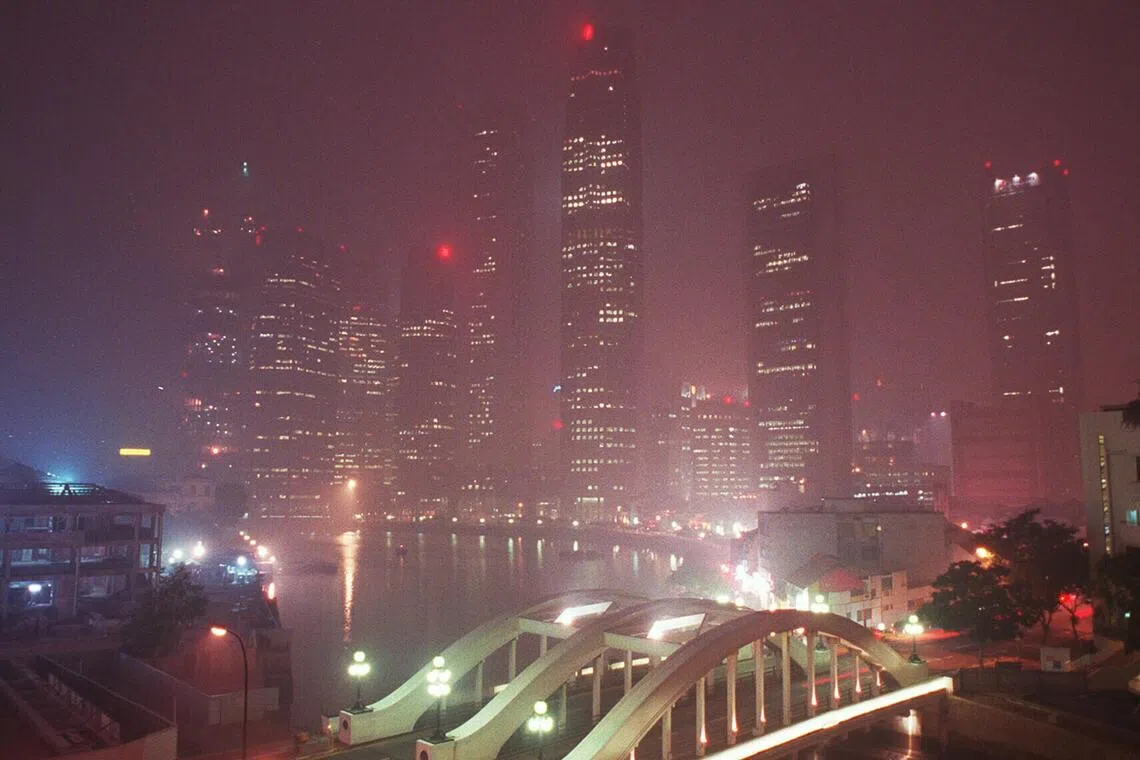
The central business district of Singapore shrouded in haze on the evening of Sept 18, 1997. The PSI reached a record 226 at 10pm.
PHOTO: ST FILE
The fires lasted four months from July to November and cost Singapore an estimated US$163 million (S$208 million).
This was compounded by the Asian financial crisis that year.
On Sept 18, the PSI hit an all-time high of 226 at 10pm, with visibility plummeting to a few hundred metres in the worst-hit western region.
The haze crisis cost the region – including Brunei, Indonesia, Malaysia, the Philippines, Singapore and Thailand – more than US$9 billion in economic, social and environmental losses, according to the ASEAN website.
The persistent burning released an estimated one billion to two billion tonnes of carbon into the atmosphere.
Across the region, more than 40,000 people were hospitalised for respiratory and other haze-related ailments. Flights were grounded because of visibility concerns, leading to declines in tourism.
The haze also affected wildlife and pets, with dogs sneezing and songbirds going silent.
The 1997 crisis prompted the region to sign the legally binding ASEAN Agreement on Transboundary Haze Pollution in 2002. It obligates member states to take legislative and administrative measures to prevent and control land and forest fires.
1982
The 1982 to 1983 episode was the first documented large fire and smoke episode in the second half of the 20th century in Indonesia, according to the UN Food and Agriculture Organization.
The vast fires on Borneo – dubbed the Great Fire of Borneo – were sparked by extreme drought and extensive slash-and-burn land clearing, and it has been estimated that more than five million ha of land was burned across the island, which includes East Kalimantan.
Many complained of eye irritation, and Singapore’s then anti-pollution unit detected 300 micrograms of fine suspended particles in the air.
The PSI was not used in Singapore until the 1990s.
A 2020 paper published in the Journal of International Studies found that Singapore did not consider haze pollution a health risk until 1994, when the PSI system was adopted alongside health indicators.
KioskNews shows a cleaned-up reading view extracted from the publisher’s page — the original always lives on their site, not ours.