Albanese’s digital crusade puts him on a collision course with Washington. The Medicare hack gives him ammunition
If one were being overly cynical, Anthony Albanese could not have been handed a more potent demonstration of the dangers of artificial intelligence at a more politically useful moment.
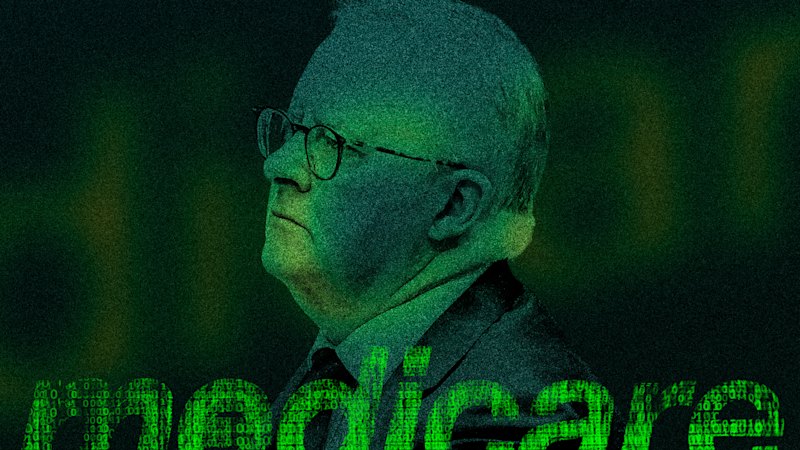
The prime minister’s hastily arranged press conference in New York revealed that an OpenAI agent had gained unauthorised access to the Medicare website in June, with public and private data accessed in the breach. He also revealed the company took three months to tell the Australian government what had happened.
Albanese said he’d spoken directly to OpenAI chief executive Sam Altman while at the United Nations to express his “extreme concern” and disappointment at the delay. He then took that very public.
Missing in all the detail offered was the fact he’d know about it for several days, but only chose to make it public now – a day after United States President Donald Trump pushed back against several middle powers demanding safeguards for the emerging technology.
In fact, the real story emerging from Albanese’s week-long New York trip is not that his relationship with Trump has become strained. It is that his carefully managed strategy for dealing with the unpredictable US president has collided with an issue on which the prime minister is now prepared to be much more explicit.
For much of his tenure, Albanese’s calculation was simple: stay off Trump’s radar. Engage when necessary, speak when spoken to and avoid gratuitously poking the bear.
Given Trump’s capacity for sudden shifts and personal grievances, it’s been a pragmatic and safe way for an Australian prime minister to protect the broader alliance while pursuing Australia’s interests. Even Albanese’s most persistent critics would acknowledge that Australia has maintained a functioning relationship with Washington through a volatile period.
It all came the day after the Trump administration publicly intervened into an Australian domestic policy debate, attacking the proposed digital duty of care as potentially enabling censorship and seeking an exemption for US platforms.
Albanese responded by making clear he is not retreating.
“It’s not about government control, it’s about giving people back control over what they receive on their devices,” he said.
If the clash over social media regulation was already significant, the AI fight raises the stakes considerably.
On the eve of the UN General Assembly, Australia joined 21 other countries in calling for global safeguards to ensure AI remains under human control. Trump then rejected the idea of a “globalist scheme” to regulate the technology and instead announced that US government documents would refer to AI as “super intelligence”.
That puts Australia on one side of an argument about whether the risks posed by increasingly autonomous AI systems require international guardrails, while Washington warns excessive regulation could undermine American technological leadership.
The Medicare breach gives Albanese a particularly concrete example to put behind that argument.
At a UN event on Tuesday, he went off script to link the government’s reforms not simply to child protection or individual control, but to misinformation, disinformation and the growing polarisation of democratic politics. Digital services, he said, were “having an impact on our entire society and how it functions”.
“People are moving away from the centre and more and more to the extremes, be they of the left or the right,” he said, arguing this was why the government’s approach was a positive move.
Until this speech, the government had presented its digital intervention primarily as a consumer-protection exercise. It was a way to give people more control over algorithms, force platforms to address foreseeable harms and protect children.
But once Albanese explicitly connected the legislation to political polarisation, the argument moves on to what is much more combustible territory in Washington and Hanson-land. He maintains that’s not what it’s about.
The government’s critics can now reasonably ask who will get to decide on what constitutes misinformation, disinformation or social harm, and where the line is drawn between protecting citizens from genuinely harmful material and regulating political speech.
It is perhaps an insight into where Albanese’s mind is at. And the extraordinary feature of this dispute is now that Washington had chosen to make the argument public while Albanese was standing on American soil selling Australia as a model for digital regulation.
Albanese and Trump posed for a picture at an official function on Tuesday night and, from all reports, had a warm yet brief encounter. He says they have a great relationship despite us naysaysers.
He has spent much of the Trump era avoiding unnecessary confrontation. But on digital policy, he has now made clear that he is willing to fight.
Cut through the noise of federal politics with news, views and expert analysis. Subscribers can sign up to our weekly Inside Politics newsletter.
KioskNews shows a cleaned-up reading view extracted from the publisher’s page — the original always lives on their site, not ours.