Tariff terms with US solid, official says
USTR PROPOSALS: Taiwan and the United States share a consensus on maintaining existing deals, Vice Premier Cheng Li-chiun said after the Washington announcement
Taiwan is confident of preserving its tariff terms with the US of no more than 15 percent, Vice Premier Cheng Li-chiun (鄭麗君) said yesterday, after US Trade Representative Jamieson Greer on Wednesday proposed new duties on 14 major trading partners over alleged excess manufacturing capacity.
The US’ proposal would apply tariffs of up to 15 percent to Taiwanese goods, accounting for existing duties, while leaving open an alternative rate of up to 25 percent if Washington finds ongoing consultations and commitments unsatisfactory, the Office of the US Trade Representative (USTR) said.
The targeted economies announced on Wednesday included China, the EU, Japan, South Korea and Taiwan, following USTR findings that their industrial policies contributed to excess capacity and burdened or restricted US commerce.
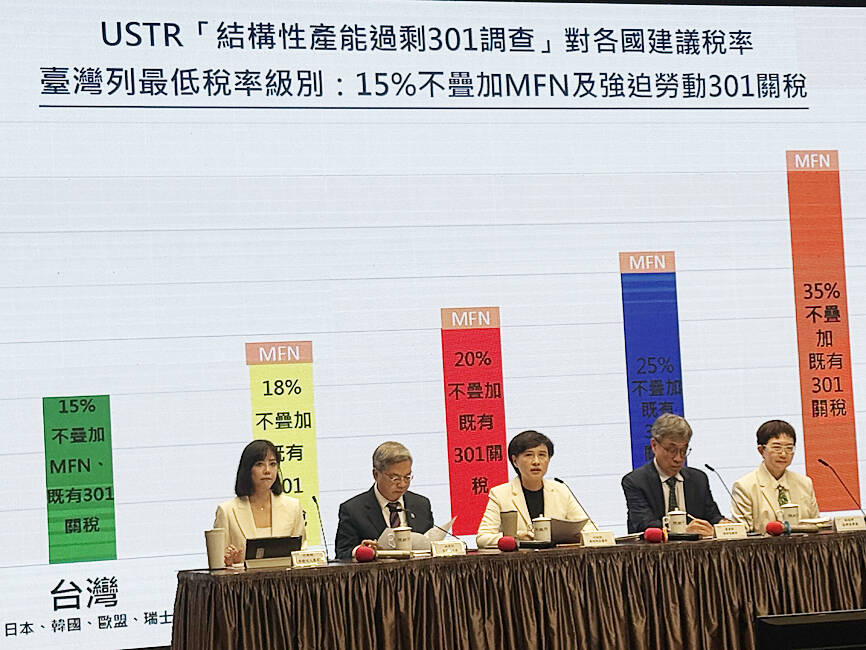
Vice Premier Cheng Li-chiun, center, attends a news conference at the Executive Yuan in Taipei yesterday.
Photo: Chung Li-hua, Taipei Times
The USTR said that government support, suppressed labor costs and other practices had undermined manufacturing in the US.
The proposed tariffs seek to address those practices while accounting for commitments made in trade agreements, the agency said.
Taiwan’s proposed treatment matched that of Japan, South Korea, the EU and Switzerland, placing them in the lowest tariff tier, Cheng said yesterday.
“Based on our communications, Taiwan and the United States share a consensus on maintaining the existing agreements,” she told a news conference in Taipei.
The 25 percent rate is “a proposed alternative, not a confirmed future tariff rate,” Cheng said.
“We believe that when the tariffs are finalized early next year, they will return to the 15 percent non-stacked rate stipulated in our agreements,” she said. “We are confident of that.”
The measures proposed by the US have not taken effect. Written comments are due on Jan. 5, with public hearings beginning on Jan. 25, the USTR said.
Some Taiwanese industrial and agricultural goods would remain subject to the 10 percent non-stacked arrangement introduced in July under a separate Section 301 action over forced-labor related import prohibitions, Cheng said.
The proposed 15 percent treatment would account for “most favored nation” duties and the July tariffs, rather than adding another 15 percent on top, she said.
Taipei and Washington negotiated the 15 percent arrangement earlier this year through an Agreement on Reciprocal Trade (ART), Cheng said.
After the US Supreme Court invalidated the legal basis for US President Donald Trump’s sweeping reciprocal tariffs in February, Washington launched the forced-labor and overcapacity investigations under Section 301 of the Trade Act of 1974 to rebuild its tariff framework, she said.
The new proposal listed 2,232 items for exemption from the additional Section 301 duties, including orchids, tea, coffee and pineapple cakes, she said.
New agreements would not be signed, as Washington was replacing its tariff authority rather than changing the substance of the agreements, she said.
Taiwan would submit the ART and an investment memorandum to the legislature after US procedures are completed and the negotiated treatment confirmed, she added.
KioskNews shows a cleaned-up reading view extracted from the publisher’s page — the original always lives on their site, not ours.