The bleph lady: Britain’s backstreet cosmetic surgeon

Robert Laycock, a facial plastic surgeon at Aintree University Hospital in Liverpool, first knew that something was up when a patient came to him in early 2024. She was a woman in her 40s who had undergone a blepharoplasty, a procedure that involves making an incision just below or above the eyelids and removing small amounts of skin and sometimes fat and muscle. The point of the surgery is to make the patient’s face look more youthful. This woman’s stitches, however, had started coming apart, leaving an open wound right above her eyes.
It is not unusual for botched private cosmetic surgeries to be fixed on the NHS. Laycock estimates that he sees three or four patients a year who need surgical intervention after too much tissue has been removed in a blepharoplasty. But something was different about this woman. “The surgery was done in a very odd way,” Laycock told me. The incision, he explained, had been made just beneath the eyebrow rather than on the crease of the eyelid. “[It’s] not the way that we would generally do a blepharoplasty in the UK.” He asked the woman where she’d had the work done but she was evasive and he dropped the subject.
A year later, Laycock was ordering a coffee in the hospital atrium when he noticed that the woman serving him had exactly the same scarring just beneath her eyebrows. He asked her about it. (He was familiar with the staff, who often came to him with questions about cosmetic procedures.) The woman said that someone called Luyen Vu had performed the surgery in a house just outside Liverpool. On her phone, she showed Laycock the Facebook page advertising the procedure.
Vu offered facelifts, necklifts, chin implants and labiaplasty. However, her most popular treatment – judging by the women who were very happy to share their results on social media – was blepharoplasty. It was easy to see the appeal. An upper blepharoplasty in the UK usually costs between £2,000 and £8,000, depending on the hospital and how experienced the surgeon is. Vu’s fee was £850.
After his encounter, Laycock contacted the General Medical Council (GMC), the independent body that regulates doctors, to ask what they could do to find out more about Vu and potentially stop her from working. The answer seemed to be very little: Vu was not registered with them and as such they had no remit to investigate her. The GMC told him to contact the police but the Merseyside police, he told me, said it was an issue for the GMC.
The confusion might have arisen from a loophole in the law: in the UK, it is technically legal for anyone to carry out surgery. What is against the law is pretending to be a registered surgeon when you are not. The law is also clear that any healthcare provider must be registered with the Care Quality Commission. Laycock spoke to the CQC but he reached a dead end there too: Vu was not identified as a healthcare professional so they had no remit to take further action.
It wasn’t just Laycock who discovered Vu’s work in 2025 – so did dozens of women across Liverpool. Initially, they had found her through word of mouth or her Facebook page. By April 2025, she had become sufficiently well known to attract the attention of Nip Tuck, a beauty and lifestyle podcast. In one episode, the two hosts sound the alarm about a woman in Liverpool whom they believed was charging too little for her work and was possibly operating in an unsound environment. (They also claimed that Vu was “sedating” her clients, which isn’t the case.) A clip of their outraged reaction was posted on TikTok; in response, women started uploading their own videos, partly in defence of Vu, whom they saw as unfairly maligned.
One woman, who looked to be in her 30s, shared a slideshow of images of her eye after having an upper blepharoplasty with Vu. If you compare the before and after photographs, her face looks younger and refreshed. It appeared as if Vu had done a pretty good job. The comment sections of these videos were filled with people asking for Vu’s details, affectionately referring to her as the “bleph lady”. “Girl the details we need the details,” posted one TikTok user.
Soon Vu was attracting the attention of the mainstream media. In July 2025, a reporter from Channel 5 News wore a hidden camera and posed as a client, meeting Vu and her assistant in a flat above a Thai restaurant in central Liverpool. The undercover reporter attempted to get Vu to admit whether she was or wasn’t a surgeon, but Vu dodged the question. In the same news package, another reporter followed Vu down the street, asking whether she was “putting some of [her] clients at risk”. Vu did not respond, and tried to hide her face from the camera. She subsequently moved her services out of the city; from October 2025 to August 2026, she popped up in Manchester, London, Dublin, and even Germany.
To her fans, Vu is a folk hero, a kind of Robin Hood for cosmetic procedures: not so much taking from the rich and giving to the poor, but offering to the poor what had until now only been accessible to the rich. To her detractors, Vu’s success is evidence that women are willing to risk serious injury to pursue ever more unrealistic beauty standards. To them, she represents everything that is wrong with a cosmetics market in the UK that has shifted in recent years from offering women superficial “beauty” treatments to pushing invasive, quasi-medical “aesthetic” procedures. It is a new grey area that is under-regulated, dangerous – and, in some cases, lethal.
In October 2025, a few months after the Channel 5 story, a woman based in Bury, Greater Manchester, began advertising Vu’s work on Facebook. “The transformation speaks for itself,” Cheryl Hogan wrote on the page of her salon, Fleek Aesthetics. “Brighter, smoother, and more youthful eyes with precision artistry that only she can deliver. Limited spaces available – don’t miss your chance to book with her while she’s back in Manchester!”
One person who visited Vu at Fleek Aesthetics was Laura (not her real name), a support worker for people with longterm disabilities. Laura is in her late 20s and wanted the loose skin above and below her eyes removed. “I lost weight and developed eye bags,” she told me on the phone. “No one else probably would have noticed my eye bags, but I did. So every time someone looked at me, I thought they were looking at [them].” A friend of hers who’s a paramedic had seen Vu for surgery herself and suggested Laura book in a lower blepharoplasty. Laura was persuaded by the personal recommendation and the £850 price tag. In late December 2025, she was sent the address of Fleek Aesthetics on WhatsApp. She was told to walk around the back of the building, where, she claims, Hogan let her in. Laura paid in cash and was asked to hand over her phone before heading upstairs.
There she met Vu, a neat-looking, middle-aged east Asian woman with a sharp bob haircut. She was wearing blue surgeon’s scrubs. Vu said hello in English, but then stepped back and let her assistant, a younger east Asian woman, translate. The room looked clean and orderly, which put Laura at ease. She sat down at a table and was injected in the arm with a test dose of the anaesthetic lidocaine; this was to check for any allergic reactions before a larger dose would be used during the surgery. Vu checked Laura’s blood pressure and began the consultation via her assistant.
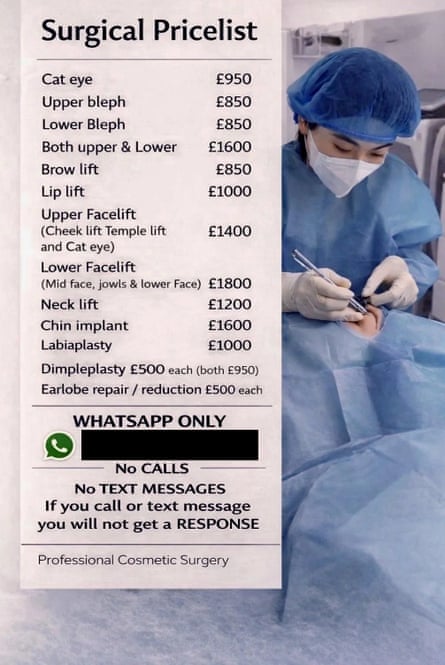
Laura wanted a lower blepharoplasty but wondered if she should also have an upper one. Vu told her that she would be best sticking with just the lower, a response that made Laura feel comfortable. If Vu were a scammer, she reasoned, she would be pushing for her to have more procedures. Vu’s assistant pulled Laura’s hair back into a bun, tied a surgical gown around her neck and sat her on a reclining beautician’s chair. Vu indicated that all her tools were sterile by showing them to Laura in their vacuum-sealed packages. Then the local anaesthetic was injected into her lower eyelids and Laura waited for the operation to begin.
To understand what a lower blepharoplasty involves, put a finger on your lower eyelid. Sometimes this area has “bags”, puffy looking skin that droops downwards. Beneath the surface layer of skin, there are three layers of muscle, one layer of membrane and then three pads of fat. When people are young this area is smooth and plump, but over time, the top layer of skin becomes looser, the muscles weaken, and the layer of membrane becomes thinner allowing the fat to bulge outwards and downwards.
Now imagine a surgeon holding a scalpel just beneath your lower eyelashes. She makes a cut through the top of the skin, another cut through the dark pink muscle and then she reaches the thin white layer of membrane. The membrane is cut in three places; this makes the little yellow cushions of fat visible, which are repositioned or removed. The goal is to create an even amount of volume across the lower lid. The surgeon sews back together all the cuts in the membrane and muscle. Any excess skin is removed and the original incision is sewn back together. Finally, the surgeon stitches the lower outer corner of the eye to support the lid’s muscles as they heal. It’s a complex procedure and can take anywhere between 30 minutes and two hours. The surgeons that I spoke with speculated that Vu carried out a simpler version of this procedure in which only excess skin was removed, with no muscle or membrane cut, and no fat pads removed or repositioned.
During her procedure, Laura could hear Vu cutting the skin beneath her eye with scissors (different cutting tools can be used for the procedure). “I was like, what am I doing?” she recalled. “You’re trusting that she’s a qualified surgeon in her country, but you don’t know that … You’re just trusting this random person with a scalpel just to rip open your eyes.” Many of Vu’s supporters online asserted that she had received medical training abroad, but this has not been verified by her or anyone acting on her behalf. In fact, Vu and Hogan had been very careful never to clarify the fact. (I reached out to Hogan through the Fleek Aesthetics business email to ask for an interview over the summer. I then contacted her for comment via a personal email and Instagram. I also tried to reach Vu through Hogan. I didn’t receive a response from either.)
When the operation was complete and Laura was handed a mirror, she felt absolutely petrified. The way Vu had cut and sewn the skin back together meant that her lower lids were pulled downwards, revealing the reddish inside of her lower eyelids. She asked Vu if this was normal, but the assistant told her not to worry. Her lower eyelids, she said, would revert to their normal position as she healed.
Laura was given some tablets and creams in Vietnamese packaging and was shown out of the salon. At home she looked up the medication using Google Translate. There were antibiotics for five days; suppositories for the pain for two days; antibiotic ointment to use after day seven and steroid tablets to take for seven days. (It is against the law to dispense prescription medication if you are not a registered healthcare professional.)
In the first few days some bruises developed but Laura continued to go about her routine. She told her friends and family about the surgery. By day five she was back working. On day nine she took her own stitches out, something surgeons usually prefer to do once they’re happy the wound is fully healed. After that, no one would have noticed that she’d had an operation at all. Looking at the photos she sent me, the bottom of her eyes looked less puffy and overall more well rested. Laura is young so, to my eyes, the difference was minimal; but it gave her a huge confidence boost.
Like Laura, many of the women having blepharoplasties in Britain are young. You might say that these are not people who “need” surgery to address signs of ageing. And yet the desire to go under the knife is intense. As one TikTok user posted: “Does anyone on here have the Liverpool bleph ladies contact details, because I’m 29 tomorrow and we need this fixing immediately, cut and snip me immediately.”
The modern story of cosmetic surgery is sometimes said to have begun during the first world war, when new techniques were honed to deal with soldiers’ facial injuries. Another landmark in the field was the invention of breast implants in 1961 by two surgeons in Houston, Texas. But to understand why women are willing to take such risks today with backstreet blepharoplasties, it would suffice to begin the story in 2010. This was the year when Apple introduced a front-facing camera on the iPhone 4, allowing people to take closeup selfies while seeing themselves on a screen. It was also the year that Instagram launched, allowing users to share those images with friends and strangers. By 2026, a majority of British people who use the app say that it has made them feel insecure about their appearance.
If Instagram created a problem for its users, it also gave a huge platform to someone who embodied the supposed solution: Kylie Jenner. Kim Kardashian’s little sister first appeared on British TV screens in 2007 in Keeping Up With the Kardashians. She was a normal-looking teenager; since then she has transformed into a woman whom Vogue described in 2024 as “strikingly beautiful in a way I’m not sure cameras – or comment sections – do justice”. From around 2016, a meme started to do the rounds summing up how drastically Jenner’s appearance changed over the years. It’s a before and after photo of her face with the caption, “You’re not ugly, you’re just poor.”
In 2015, amid much speculation about what procedures Jenner had undergone, she reluctantly admitted in an episode of Keeping Up With the Kardashians to dermal filler injections in her lips, saying they were something she had always been insecure about. Filler is hyaluronic acid, a gel-like substance, which is injected into the face to give it a plumper and more sculpted look. Immediately after the episode aired, one cosmetic clinic in the US reported a 70% increase in filler inquiries; in the UK, clinics also reported a rise in filler bookings.
A new type of “look” began to emerge in western online spaces and, in 2019, it got a name: Instagram Face. “It’s a young face, of course, with poreless skin and plump, high cheekbones,” wrote Jia Tolentino in the New Yorker. “It has catlike eyes and long, cartoonish lashes; it has a small, neat nose and full, lush lips.” Instagram Face was a product of what British sociologist Rebecca Nash described in an academic paper in the same year as a “dynamic, global beauty landscape”, a place in which a globalised beauty standard could be established and widely disseminated.
But as many British women started getting dermal fillers in pursuit of Instagram Face, they ended up with what was quickly derided as “Love Island Face”. In its most extreme form, the look was less finely sculpted Kardashian and more blow-up doll – a caricature of what a conventionally attractive face might look like. “Duck lips” – lips that had been overfilled – became so recognisable that Saturday Night Live did a sketch in which Phoebe Waller-Bridge pretends to be a Love Island contestant. “Just got me lips done,” she says. “I asked the doctor for an allergic reaction look.”
But Love Island Face wasn’t supposed to be natural. The obvious artificiality was part of its appeal – a way to demonstrate how much time, effort and money had been spent on one’s appearance. As Ruth Holliday, a professor of gender and culture at Loughborough University, told me: “It’s a perfectly logical thing to want to invest in your body in order to earn more money in the labour market when you work in a service job, or maybe even to get a better relationship.” In my conversations with women who had gone for surgical and non-surgical procedures, a wide range of motivations were discussed, but one recurring theme was self-worth. As one woman in her early 20s from Merseyside put it: “I don’t do it for anyone else, I don’t do it to impress a boy, I don’t do it to impress other girls, I do it purely for myself. I think as well you’ve got one life, invest in yourself.”
With demand came supply. In the UK, businesses providing dermal fillers were making “high profits in an era when all other commercial income is stalling,” according to a 2013 Department of Health report into the subject. To walk up and down any British high street is to see the evidence of this. Alongside vape shops and barbers, you’ll likely find a salon offering fillers – alongside Botox injections, micro-needling, CO2 laser skin resurfacing, and chemical peels. These painful-sounding cosmetic procedures are now referred to as “medical aesthetics”; beauticians have transformed into “aestheticians”.
In the US, Australia and Canada, dermal fillers have to be injected by doctors, nurses or dentists – but in the UK filler syringes can be administered by anyone. The British aesthetics industry is a “wild west”, said a recent Chartered Trading Standards Institute report. One woman told me that she preferred filler administered by unqualified high-street aestheticians. “I liked how they did the work, they did it more doll-like,” she said, referring to a style called the Russian Lip, which adds volume vertically and emphasises the cupid’s bow. The registered nurses, she said, made lips look too natural.
It wouldn’t be long before fillers fell out of fashion, not least because people noticed they started migrating across the face and absorbing water, leading to “pillow face”: a wide and less-defined face with a puffy appearance. A 2025 survey of UK clinics by the industry accreditation body Save Face reported 70% fewer patients asking for dermal filler compared with 2024. In 2021, the influencer Molly-Mae spoke on a podcast about her decision to undo her filler work; this involves injecting the substance hyaluronidase into the face, dissolving the acid. Afterwards, her inbox filled with girls telling her they had followed her cue.
In the early 2020s the emphasis shifted from adding volume to the face to “rejuvenating” it. Sought-after treatments started to include polynucleotides – most commonly an injection of salmon DNA that tells your cells to jump start the production of collagen and elastin in the skin. “Stacking” has also become popular: after some microneedling, in which small pricks are made to the face to stimulate the release of collagen and elastin (proteins that give strength and elasticity to the skin), “active” substances such as retinol (which also boost collagen) are applied for deeper penetration into the skin.
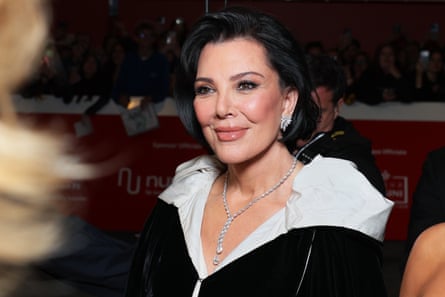
High-street treatments have their limits. They can make your skin seem fresh and smooth but they can’t radically change how you look. Only surgery can do this. Once again, it was a member of the Jenner family – in this case Kylie’s mother, Kris – who became a model for the best surgical intervention money could buy. In 2025, the 71-year-old Jenner appeared in Paris for Lauren Bezos’ hen do; she was sporting what New York Magazine would describe as the “Forever-35 Face”. She looked smoother, tighter and plumper – young, but in an uncanny way. A week later a representative for Jenner confirmed she had undergone a facelift. There was much speculation about what technique was used – the conventional method or the increasingly popular, more risky deep plane facelift, in which surgeons work on the deepest layer, right above the bone, to reposition the entire face.
after newsletter promotion
A deep plane facelift can fetch price tags of £30,000 or more depending on the skill, or fame, of the surgeon. This is where the blepharoplasty comes in. The procedure is, in many ways, a budget facelift: one retired plastic surgeon told me that surgery is seen as the “best value cosmetic procedure you can do” in terms of reducing the signs of ageing for the smallest price tag. Most cosmetic surgery is expensive because it involves a surgeon, anaesthetist and an overnight stay in a hospital. A licensed blepharoplasty starts off at about £2,000 because it can mostly be done under local anaesthetic and doesn’t require an overnight stay. Recovery times are quick and the healing can be discreet – all you need is a large pair of sunglasses.
In 2022, blepharoplasties overtook nose jobs as the most popular facial plastic surgery procedure in the US; in the UK, it’s occupied the top slot since 2019 when the British Association of Aesthetic Plastic Surgeons began its yearly audits. Until recently, customers were mostly in their 40s and above. However, Colin Vize, an oculoplastic surgeon based in Hull, confirmed to me that many patients are now younger. “In the younger age group,” he said, “it appears to be a social-media-driven thing.” In the US, people under 35 represent the fastest-growing group getting the procedure done.
Some British women opt to travel overseas. In the Netherlands, the clinic Faceland offers upper blepharoplasties for just £585. It’s able to offer these low prices due to the volume of patients it sees, but a BBC report from this year detailed some patients seeing their stitches come apart or becoming unable to close their eyes. (Faceland told the BBC it offers “safe and quality” treatments and that “less than 1%” of procedures have led to a complaint.) Speaking generally, Vize told me that the main issue with some overseas appointments is too much skin being taken away: “[Patients are] trying to close their eyes and they’re struggling.”
It was in this context that Vu emerged. If people wanted cheaper cosmetic surgery options and were willing to travel abroad, why couldn’t someone from abroad offer surgery in the UK? Vu’s online defenders see her as exactly the type of skilled migrant the British government claims to want. After all, she saw a gap in the market and filled it. “She is amazing and so is her work don’t get y people r putting her down,” said one woman in her 50s from Liverpool, replying to my request for an interview.
What I have gleaned about Hogan and her relationship to Vu comes from her prolific social media posts. Hogan is an attractive middle-aged woman with brown eyes, full lips and hair pulled into a ponytail. She seems to be an astute businesswoman who knows how to use social media to promote her services and doesn’t shy from using her platforms to talk about her faith in God or her political beliefs.
She’s a member of the British Traveller community and, in October 2025, posted that she’d seen a woman from the community receiving abuse online about her appearance, following botched lip fillers. Hogan wrote on a crowdfunder: “No woman should be made to feel unworthy because of her looks.” At the time, Hogan reached out to Vu to see if she would give the woman an upper and lower blepharoplasty surgery for free as part of a makeover – and she did. This appears to be where the women’s friendship and business partnership began.
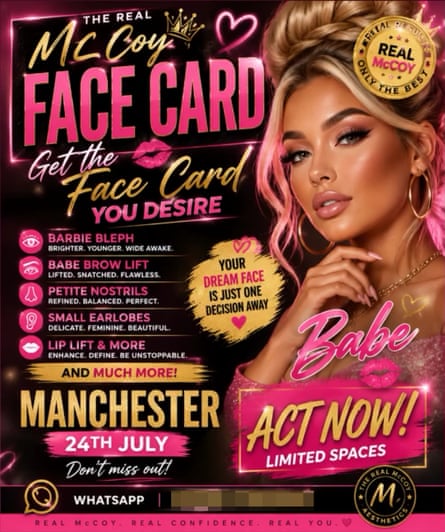
Later that month, Hogan began advertising Vu’s services on social media and hosting her at her salon, a premises that is not registered with the CQC. She also defended Vu from the negative stories that had appeared about her in the press. Posting on Facebook, she said: “Let’s get one thing straight – titles mean NOTHING if the skill, knowledge, and passion aren’t there. The Liverpool lady is a perfectionist whose results speak for themselves. Her clients trust her for a reason – and this right here proves that it’s not about the title, it’s about the talent.”
Not everyone is such a fan. This year, a woman set up a Reddit page called r/Support4LuyenVuVictim. She had visited Fleek Aesthetics for an upper blepharoplasty. When she was handed a mirror at the end of the surgery, she said she felt her soul leave her body. “I knew I had a lifetime of repair and misery,” she told me. “I’d actually been so deformed.” She felt that her eyebrows looked like they were in the wrong place, pulled too low. As she processed what had been done in the days after the surgery, she messaged asking for aftercare. She said: “You basically receive a ‘who dis?’ back … and that’s if you’re lucky. You will be ghosted too.” She is now on a waiting list to see an NHS consultant for corrective surgery.
One reason that people have differing opinions of the quality of Vu’s work is because she appears to use a technique more suited for east Asian than Caucasian eyes – this was the “odd” method that the doctor in Liverpool noticed. Instead of making the cut in the crease of the eye, she often appears to make it just below the brow. This approach is not suitable for all patients – especially older ones. Eyebrow muscles weaken and descend as we age. If tension is directly introduced to this area by removing excess skin, the brow muscles can descend even further. To avoid this, a UK registered surgeon would usually lift the brow muscles with a stitch and then cut excess skin away from the crease of the eyelid further away from the brow. It would appear that Vu was using a one-size-fits-all approach to an area of the face that varies from person to person.
To enter the world of extreme aestheticians is to encounter individuals for whom beauty has become an overwhelming obsession. Take Jordan James Parke, the self-titled “Lip King” who briefly hosted Vu’s work from his home. In 2016, Parke appeared on the daytime chatshow This Morning above the words: “My obsession with Kim Kardashian could kill me”. He had an androgynous look: his glossy lips, defined eyebrows and tiny nose looked feminine, but his shaved head was distinctly masculine. On the sofa, he listed all the work he’d had done: two nose jobs, a chin implant, neck liposuction, eyebrow tattoos, lip filler, cheek filler, smile line filler, jawline filler, a non-surgical thread facelift and botox.
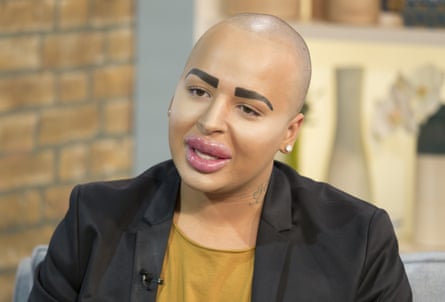
He also appeared on a US reality TV show called Botched, in which patients hoping to have previous surgery corrected visit two doctors in Los Angeles. Unlike the usual patients, Parke liked his exaggerated appearance. He explained: “Looking fake, you walk into a room and people want to know you, and you’re just up. I love attention.” However, he wasn’t happy that his huge lips had started leaking filler. The doctors advised him to have the filler dissolved in case his lips fell off.
Parke took it easy on the lip filler for a while, but then he started to administer filler injections himself. In September 2024, Alice Webb, a 33-year-old aesthetician, arranged to have a liquid BBL (Brazilian butt lift) from Parke – a procedure that involves injecting filler into the buttocks to add volume. Webb passed out and was taken to hospital, where she died the following day. An inquest found that Parke had used seven times the recommended amount of filler; traces of it were discovered in Webb’s heart, lungs, brain and kidneys. Parke was arrested on suspicion of manslaughter in October 2024 and, as part of his bail conditions, he was banned from carrying out any cosmetic treatments. But there wasn’t anything preventing him from setting up appointments for other people.
We don’t know how Parke first connected with Luyen Vu, but in December 2025 he was taking deposits for bookings for Vu and letting her use his living room in Manchester as an operating theatre. Another Channel 5 journalist went undercover and attended an appointment. In the footage, you can see a woman lying flat on what looks like a massage table as Vu works over her. Keeping Up With the Kardashians plays in the background.
The headline on This Morning would turn out to be prophetic: this year, Parke died while undergoing a cosmetic treatment in a London hotel room. The police have arrested two people in connection with his death but no one has been charged yet.
There were other aestheticians willing to host Vu, too. There was the Clinic Club, whose owner was banned from carrying out liquid BBLs until 2028 because of the risk of serious harm from the procedure, including sepsis. And there was Luxury Medical Aesthetics, a company that was reportedly hosting Vu in December 2025. Its owners had previously been exposed in 2024 for offering non-surgical “fat reduction” training courses, when in fact they were training people in surgical liposuction. Luxury Medical Aesthetics did not respond to ITV News at the time of the report. I also reached out to one of the owners via her new business but she did not respond.
The government is proposing to close the loopholes that have until now allowed people like Vu to operate in the UK. In the future, the Department of Health and Social Care told me, “only GMC-registered doctors working for CQC-registered providers would be able to offer and provide cosmetic surgery and the CQC will be given enforcement powers in cases where this legal restriction is breached”. The department also pointed out that, although it is technically legal to perform surgery if you are not a surgeon, other legislation and offences could apply to people who do, such as breaches of the Health and Safety at Work Act or even assault.
In the meantime, over the summer of 2026, Fleek Aesthetics was publicising blepharoplasty, facelifts and other procedures with someone called the Real McCoy, in Dublin and Manchester. There was no mention of Vu in the seemingly AI-generated Instagram posts. However, when one woman from Liverpool asked over WhatsApp if it was the Liverpool bleph lady doing the work, the answer was a simple “yes”.
In August, Luyen Vu made an appearance in full on the Instagram account of Fleek Aesthetics. Hogan had flown to Vietnam; she was planning to have Vu give her a second brow lift. It looked like a girls’ holiday. In one of her stories, she posted a video of Vu taking her to a nail salon and then at a restaurant. Hogan wrote under one story: “Love this woman.” Towards the end of her time in Vietnam, Hogan posted a message to her salon’s Instagram followers: “If anyone is interested in coming in November, comment ‘info’ and I will DM you.”
For a while, it seemed as if Vu’s story would end in Vietnam. But this month I came across a new video on TikTok. A woman with a Mancunian accent, who says she’s now homeless after her house was petrol bombed, discusses recovering from an lower blepharoplasty. On day eight of her recovery she posted a video with the caption: “Pretty impressive work Liverpool blepth [sic] lady”. In another post she encourages anyone who is interested to DM her, but to not share the number on social media. “Evil eyes are watching,” she says.

The Long Read magazine crime issue: out now
A special true-crime edition of the Long Read magazine brings together 10 of our most gripping tales from the past decade.
KioskNews shows a cleaned-up reading view extracted from the publisher’s page — the original always lives on their site, not ours.