A re-elected Xi could be perilous: MAC
CONSOLIDATION OF POWER: Concentrating the reins of power in his hands could knock out some of safety mechanisms against unilateral action China does have
By Fang Wei-li / Staff reporter


Chinese President Xi Jinping (習近平) might adopt more aggressive measures to assert de facto governance over Taiwan if he enters a fourth term, Mainland Affairs Council (MAC) Minister Chiu Chui-cheng (邱垂正) said yesterday.
Speaking at a seminar on US-China competition at the Taipei University of Marine Technology, Chiu said Taiwan upholds ideals of peace without harboring illusions, adding that peace cannot rely on trusting Xi or hoping for goodwill from China.
Approaching 15 years in power, Xi’s regime has undergone three extreme developments that keep up the pressure on Taiwan, Chiu said.
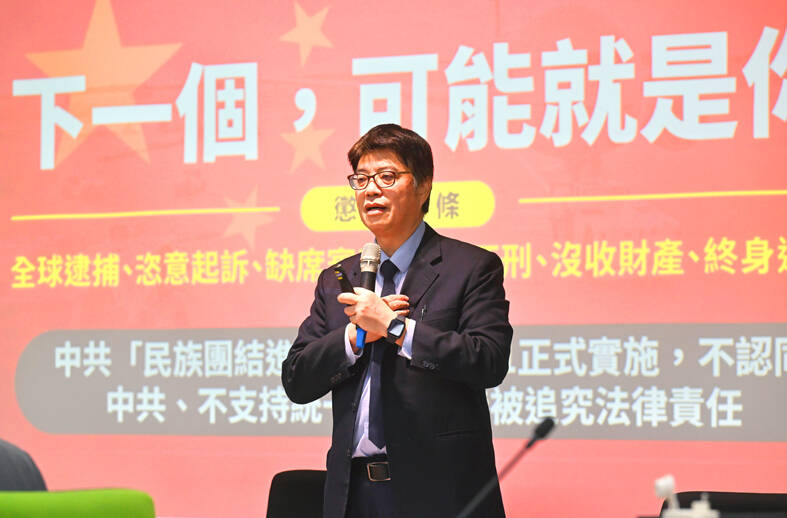
Mainland Affairs Council Minister Chiu Chui-cheng speaks at a seminar at the Taipei University of Marine Technology yesterday.
Photo: Lin Cheng-kun, Taipei Times
First, China’s power structure has shifted from collective leadership to absolute personal rule, eliminating internal corrective mechanisms and increasing the chances of risky decisionmaking, he said.
Second, Beijing has fueled fanatical nationalism, giving rise to military hegemony, “wolf warrior” diplomacy and nationwide mobilization, he said.
Third, Xi views achieving unification with Taiwan and displacing the US as key goalposts to legitimize extending his rule, making improved cross-strait relations difficult as long as he remains in office, Chiu added.
Looking toward next year, Chiu said that while Xi’s third term has relied on compound pressure to indirectly alter the “status quo,” a fourth term could bring direct attempts to change it.
These could involve a more aggressive “governance before unification” approach toward Taiwan, pressuring other countries to relocate or shut down Taiwanese representative offices, subjecting Taiwanese abroad to Chinese consular jurisdiction and expanding transnational repression alongside incentives to promote integration, he said.
Cross-strait disputes over jurisdiction are to become increasingly serious, Chiu said, citing a series of moves by Beijing that have gradually eroded the “status quo,” including rejecting the Taiwan Strait median line in 2020, normalizing military crossings of the line beginning in 2022, challenging Taiwan’s restricted waters around its outlying islands and claiming jurisdiction over waters east of Taiwan this year.
Addressing students in attendance, Chiu said that Beijing’s “22 guidelines” on punishing “Taiwan independence” allow for lifelong prosecution and could be applied to anyone who does not support unification.
He cautioned against cybersecurity risks associated with Chinese apps such as Xiaohongshu (小紅書), Douyin (抖音), WeChat and Sina Weibo.
In response to Chinese threats, the government is implementing President William Lai’s (賴清德) “Four Pillars of Peace” action plan to bolster self-defense and whole-of-society resilience, Chiu said.
“Facing Chinese Communist Party threats and coercion, we will neither yield nor compromise, nor will we provoke or act rashly,” he said.
Accusing the Chinese Nationalist Party (KMT) of equating peace with placating Beijing, Chiu cited Sun Yat-sen (孫逸仙) to argue that peace without struggle or strength is “false peace,” while underscoring Taiwan’s irreplaceable strategic value in the First Island Chain, high-tech supply chains and democratic way of life.
KioskNews shows a cleaned-up reading view extracted from the publisher’s page — the original always lives on their site, not ours.