Jalen Hurts blood clot: What is a superficial blood clot and how long could Eagles' QB be out
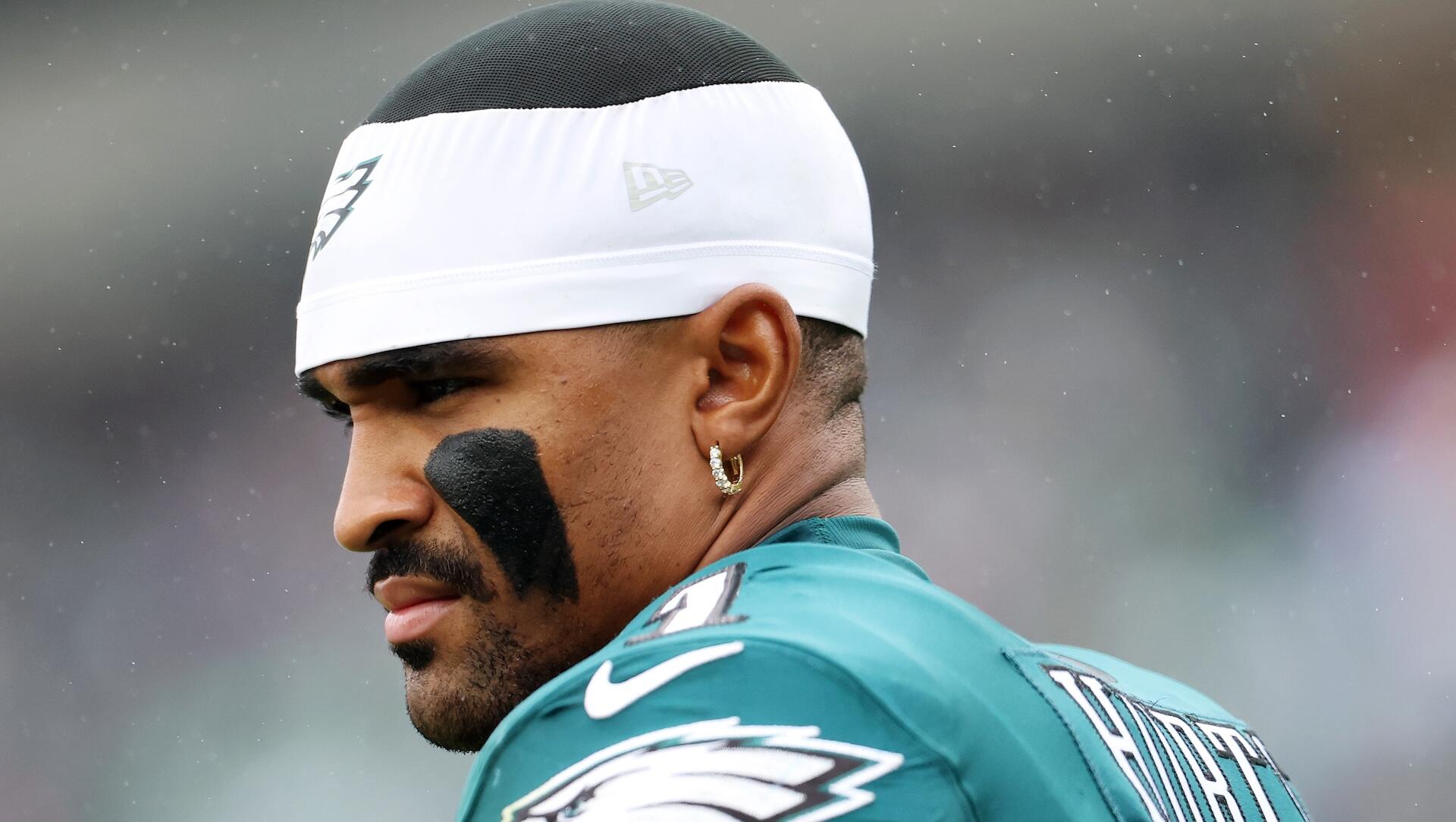
Movement in a blood clot detected in a follow-up ultrasound has sidelined Philadelphia's star indefinitely after he initially played through the clot against the Jaguars

• 4 min read
The Philadelphia Eagles were dealt quite a blow this week, as they revealed star quarterback Jalen Hurts was managing a superficial blood clot and would not play vs. the Carolina Panthers on Sunday. Given the situation, it wouldn't be surprising if Hurts missed more than one game.
In their statement released on Thursday, the Eagles said that four days after the Week 4 loss to the Los Angeles Rams, Hurts requested treatment on his calf. He believed he was kicked or cleated in the game, and his leg was bothering him. The Eagles performed an ultrasound on their quarterback's leg after they landed in London last week, and that's when the superficial blood clot was discovered.
However, the Eagles' medical staff determined Hurts could suit up against the Jacksonville Jaguars. On Wednesday, back in Philadelphia, the Eagles conducted a follow-up ultrasound, during which they saw that the clot had moved. That's notable. While the Eagles have not disclosed exact details of the situation, the movement of a blood clot could potentially lead to a pulmonary embolism, which could be very serious.
Hurts told reporters on Wednesday that his "calf injury" was "a very unique experience, to say the least," and that he got "nicked up" in the Rams game. Now, he's dealing with a situation that will hold him out indefinitely.
Let's take a look at what's going on with Hurts.
What is a 'superficial blood clot?'
The Eagles did not go into detail about the clot, but the fact that it's "superficial" is likely a good sign. This could be classified as "superficial thrombophlebitis," per Harvard Health Publishing.
An article found on The Journal of the American Medical Association (JAMA) describes a condition called "superficial vein thrombosis" (SuVT), where clots develop in superficial veins, typically in the legs or arms. Superficial veins are those closer to the surface of the skin. Risk factors include varicose veins, recent trauma, immobility and surgery.
This is different than "deep vein thrombosis," which is a much more serious condition that requires anti-clotting drugs, and could have completely ended Hurts' 2026 season. We've seen several cases of deep vein thrombosis in the NBA recently, including with Spurs superstar Victor Wembanyama, who missed the final 30 games of the 2024-25 season after doctors discovered deep vein thrombosis in his right shoulder.
As for superficial thrombophlebitis, Harvard Health Publishing says it can improve over the course of one week to several weeks. However, each case is different.
Has this happened before in the NFL?
Yes, there are numerous cases of NFL players missing time due to blood clots, and you don't have to look any further than the opponent Philadelphia faces this Sunday. Panthers star right tackle Taylor Moton hasn't played at all this season because doctors found blood clots in his lungs this summer. This was a much more serious situation that required Moton to immediately be placed on blood thinners.
Just recently, Moton revealed that he had been off blood thinners for a couple of weeks and could return to the field in the near future. He was listed as a full participant in practice on Wednesday.
Former first-round pick center Billy Price announced his retirement in 2024 after undergoing emergency surgery for a pulmonary embolism to remove a saddle clot that was entering both of his lungs. He pointed to the risk of internal bleeding while on blood thinners as a reason why he had to hang up the cleats.
Kansas City Chiefs Pro Bowl right guard Trey Smith fell to the sixth round of the 2021 NFL Draft despite being a two-time First Team All-SEC player because of concern over blood clots. He was held to just seven games played during his sophomore season at Tennessee after it was discovered that blood clots had returned in his lungs. Smith lost weight, underwent a six-month round of anticoagulants after consulting with specialists, and was eventually cleared to play football again. Smith's history with blood clots was a clear "con" on his scouting report, but he's had zero issues since being selected at No. 226 overall. He is a two-time Super Bowl champion.
New Orleans Saints wide receiver Chris Olave and New England Patriots defensive tackle Christian Barmore are two other players who have dealt with blood clots.
Each situation is different, and most of these situations are different from the one Hurts is currently facing. From what we know at the moment, his clot has thankfully not traveled to his lung.
What happens now?
Ian Rapoport reported that Hurts cannot play football until this situation is solved. As mentioned above, treatment for blood clots can include blood thinners, and you shouldn't play football on blood thinners.
We do not know for a fact that Hurts is going on blood thinners. Other treatments for superficial thrombophlebitis include bed rest, elevating the legs or applying warm compresses, according to Harvard Health Publishing. Every case is different, and it's something that has to be monitored.
How long could Hurts miss?
This is a tough question to answer, given that we don't have details on Hurts' clot — other than that it's superficial. We know Hurts will miss Sunday's game vs. Carolina, but Rapoport said the best way to describe his status is "out indefinitely."
Eagles' upcoming schedule
| Week | Opponent |
|---|---|
6 | vs. Carolina Panthers |
7 | vs. Dallas Cowboys |
8 | |
9 | vs. New York Giants |
10 | BYE |
KioskNews shows a cleaned-up reading view extracted from the publisher’s page — the original always lives on their site, not ours.