Could Europe’s cost-of-living protests sharpen EU-China trade tensions?
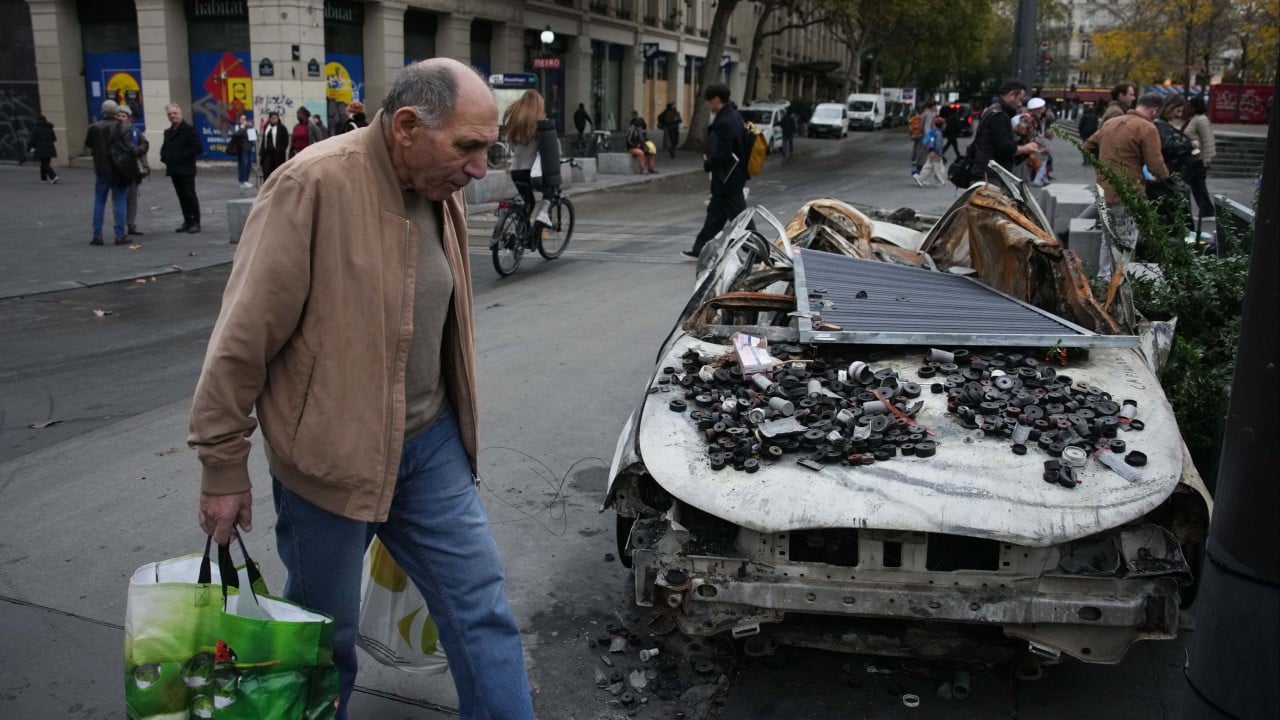
As violent protests fuelled partly by the cost-of-living crisis shake parts of Europe, most notably France, analysts say the unrest could add to pressure on European policymakers to take a tougher trade stance towards China.
“One could argue that the EU looks weaker, but then one could also argue that there is more of a need to show external strength at a time of such events,” said David Henig, director of the UK Trade Policy Project at the European Centre for International Political Economy.
The unrest comes as France faces growing financial pressures. Yields on French 10-year bonds topped 5 per cent for a third consecutive day on Friday as political and social turmoil continued.
On Thursday, French President Emmanuel Macron said requests to hold protests submitted by people “with no legitimacy” would be banned in the coming days. Requests filed by unions would be examined under the law, while local authorities would propose alternative routes to keep demonstrations away from city centres, he said.
Cui Hongjian, director of the Centre for EU and Regional Development Studies at Beijing Foreign Studies University, said the unrest could reinforce the narrative that Europe’s challenges were mainly the result of external factors, with China’s trade surplus singled out as a major cause.
“Politically, they will take a harder line – especially against China economically – to appease their domestic populations, signalling that they are actively working to shield European society from external economic pressure, unfair competition and similar challenges,” Cui said.
Public frustration over economic conditions was a major driver of the unrest, Cui said. Addressing those concerns would require substantial government spending, which could prompt European governments to impose higher tariffs on Chinese goods to bolster fiscal revenue, among other measures, Cui added.
Governments could also raise investment barriers for Chinese enterprises while demanding that they do more to create local jobs and generate tax revenue, he said.
Marc Julienne, director of the Centre for Asian Studies at the French Institute of International Relations, said Chinese exports were highly competitive and could help ease the cost-of-living crisis. But that same competition, he added, threatened European industry and employment and had pushed Brussels to press Beijing more forcefully to rebalance trade.
Meanwhile, Peter Chase, senior fellow at the German Marshall Fund, agreed that the protests could strengthen the view among European politicians that trade imbalances with China were contributing to political problems across the continent.
Still, the unrest would not necessarily influence the manner in which trade negotiations were held, according to some analysts. Henig of the UK Trade Policy Project said protests within member states were unlikely to directly affect talks with China, which are handled by the European Commission.
“Such is the noise around negotiations, but [it] does not usually affect what is happening in the rooms where talks happen,” Henig said.
SCMP Plus is a new premium news platform that gives you an
all-inclusive edge to stay ahead on China news.
To access our exclusive content you’ll need to subscribe.
Already a subscriber?
LOG IN
Ignacio Garcia Bercero, a senior fellow at Bruegel and former director at the European Commission’s trade department, said Beijing also had enough understanding of Europe’s political dynamics to “avoid a misjudgment”.
KioskNews shows a cleaned-up reading view extracted from the publisher’s page — the original always lives on their site, not ours.