Donovan’s Deep Dives: TSMC’s record-breaking investments are transforming Arizona
TSMC’s vast investment is bringing more than chip factories to Phoenix, as Taiwanese families and businesses help reshape the region’s cultural landscape
By Courtney Donovan Smith / Staff Columnist


Minister of Foreign Affairs Lin Chia-lung (林佳龍) was in Arizona on Oct. 5, to launch the Taipei Economic and Cultural Office (TECO) in Phoenix, the 14th such de facto Taiwanese consulate in the US.
In response, Liu Chang (劉暢), a spokesperson for China’s embassy in the US, said in a statement the same day: “China firmly opposes official interactions of any form between China’s Taiwan region and the US, including its federal and state governments.”
After the office plans were announced in July, Arizona Governor Katie Hobbs received two letters from China’s consulate general in Los Angeles asking her to object to the proposal. The AP reported the following: “In a July 3 letter, the Chinese authority called on the governor to ‘refute such an attempt by the Taiwan authorities and stop any political gimmicks to harm the friendship and cooperation between China and the state of Arizona.’” Whether AP had intentionally been echoing Chinese state media’s use of “Taiwan authorities” by using “Chinese authority” or not, it was still amusing.
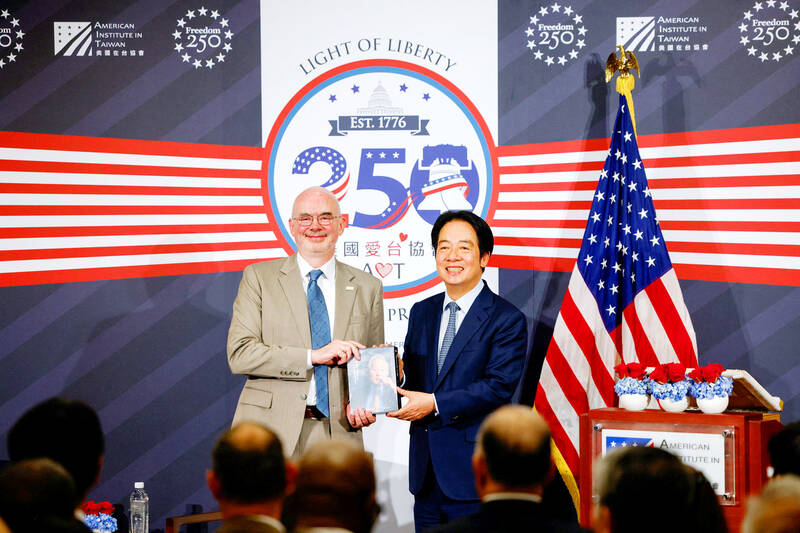
President William Lai and Director of the American Institute in Taiwan Raymond Greene pose for a photo while holding a two-volume autobiography of Morris Chang, the founder of the chip firm Taiwan Semiconductor Manufacturing Co.
Photo: Reuters
Not so long ago, such missives would have given many state governors pause. In Arizona today, the chances are zero.
“Every Arizona elected official should show the courage necessary to support the partnership between Arizona and Taiwan,” Hobbs said while attending the TECO office launch with Lin. “As our economic partnership grows, we are mobilizing every available resource to support Taiwanese companies expanding here in Arizona.”
Advanced chipmaker Taiwan Semiconductor Manufacturing Co (TSMC) recently pledged an additional US$100 billion to expand its operation in northern Phoenix, bringing its total investment in the Phoenix area to US$265 billion (NT$8.6 trillion).
LARGEST IN HISTORY
That quarter of a trillion US dollars is the largest foreign direct investment in American history.
It does not stop there; the region is attracting companies in TSMC’s supply chain from Taiwan and around the world. These investments bring high-paying jobs to locals, career opportunities for students in Arizona universities and a higher tax base.
A whole ecosystem of local businesses are necessary to support and maintain this investment, from construction firms to shoe shops.
Governor Hobbs was a guest of President William Lai (賴清德) in March last year on a visit to Taiwan. He made some interesting remarks.
“Due to our close industrial engagement, we now have more than 30,000 Taiwanese living in Arizona. I would like to thank Governor Hobbs for taking care of Taiwanese businesses and people. I believe that through our joint efforts, Arizona will become a shining example for Taiwan-US high-tech collaboration and the creation of non-red supply chains,” Lai said.
That 30,000 number likely includes spouses and dependents, which local employment numbers would not catch, but Taiwan’s de facto Washington embassy Taipei Economic and Cultural Representative Office in the United States (TECRO) would be more attuned to.
With the announced increased investments from TSMC and as more supply chain partners set up camp, that number is likely to grow fast — even accounting for some positions currently filled by Taiwanese eventually being replaced by fully trained replacements.
Arizona is also working to bring in a more diversified portfolio of Taiwanese investment. At a July conference in Taipei, Steve Hsu (徐竹先), head of the Arizona Commerce Authority’s Taiwan office, told the audience: “The investment opportunity in Arizona is not just available for tech companies — it’s an opportunity for everyone, including investors in hospitality, family offices and other industries.” His office has signed several MOUs with Taiwanese institutions to further expand connections.
Describing talking to attendees at that conference, a reporter from Rest of the World noted: “Several venture capital and family office representatives seemed excited and told me they plan to join investment delegation trips to Arizona soon.”
How effective Arizona is in further attracting Taiwanese remains to be seen, but the ground is fertile as investment continues to flow in from major players, spreading capital like fertilizer.
A further draw for Taiwanese is the phenomenon where expatriate communities lay the groundwork, build the connections and develop the infrastructure that makes it easier for compatriots to follow.
In other words, the Taiwanese community is likely to grow fast beyond what the massive influx of TSMC and supplier investment alone requires.
UNPRECEDENTED EXPERIMENT
Assuming the president’s 30,000 figure is correct, according a 2025 Pew Research report that would make the Phoenix metropolitan area the second-largest Taiwanese community, ahead of the New York City metro area population of around 25,000.
With the investment boom ongoing and showing no signs of tapering off, it is not inconceivable that the Phoenix area Taiwanese community could rival that of the Los Angeles metro area’s estimated 60,000.
This is unprecedented as the Phoenix community arose almost entirely in just the last few years. Communities in New York, Los Angeles and other areas arose organically over generations.
What is unfolding is an unprecedented social experiment fueled by the largest foreign direct investment in American history, making it groundbreaking both financially and in terms of immigration.
Even in a city of 1.7 million, adding a large town-sized population of highly educated, high-income people from the other side of the planet is going to have major impacts that will ripple throughout the region. The reverse is also true, as the community establishes itself and is influenced by American Southwestern culture, ripples of this cultural mixing will reach Taiwan’s shores. Rapid expansion of American-style Mexican food in Taiwan in the 2030s would not be surprising.
Also attending the TECO office launch was Phoenix Mayor Kate Gallego, who said the city is seeing a sort of “baby boom” in its Taiwanese communities, with several labor and delivery rooms even launching Mandarin-language programs. As a Sept. 1 Phoenix magazine report titled “Taipei of the Desert” notes: “Earlier this year, Phoenix Mayor Kate Gallego announced that more than 300 ‘TSMC babies’ had been born in Arizona since the company established its Phoenix campus.”
That same report describes hundreds of students enrolling in local schools and stated: “Now, hearing Mandarin at school pickup and seeing Taiwanese products at Costco have become commonplace — echoes of a larger cultural transformation taking shape across the Valley.”
Unsurprisingly, there are “TSMC villages,” new Taiwanese civic associations and of course plenty of new Taiwanese restaurants and food options.
For those following American politics, no doubt the recent tightening of regulations and raising the costs of H-1B visas comes to mind. This is indeed creating headaches for American high tech firms.
However, many of TSMC and other investors are not impacted by that, as their employees are receiving L-1A and L-1B visas, which allow multinational companies to transfer executives, managers and employees with specialized knowledge to a US office. The Trump administration has been loudly touting their success in attracting TSMC’s investment, so these visas will likely continue to be available.
Those visas also allow Taiwanese to apply for a green card and eventually become naturalized citizens.
How this unprecedented, fast-moving social experiment will play out remains to be seen. No doubt there will be many positives for the people involved as well as the wider Phoenix community — but also incidents of conflict. An interesting cultural marker will be if Taiwanese elements such as food and some cultural practices work their way into the identity of the city.
This experiment is now set to be replicated elsewhere, if on a smaller scale. On Monday, Oct. 12 Minister of Economic Affairs Kung Ming-hsin (龔明鑫) told Bloomberg that Taiwan plans to establish industrial parks in the US to help smaller domestic suppliers set up local operations and strengthen semiconductor and AI supply chains, starting with a park in Texas expected to cost up to US$4 billion.
Donovan’s Deep Dives is a regular column by Courtney Donovan Smith (石東文) who writes in-depth analysis on everything about Taiwan’s political scene and geopolitics. Donovan is also the central Taiwan correspondent at ICRT FM100 Radio News, co-publisher of Compass Magazine, co-founder Taiwan Report (report.tw) and former chair of the Taichung American Chamber of Commerce. Follow him on X: @donovan_smith.
KioskNews shows a cleaned-up reading view extracted from the publisher’s page — the original always lives on their site, not ours.