How businesses can prepare for cross-border disputes before they happen
Up to 10 million – that is the number of components that a single aircraft is made of.
It is also the number of points across a global supply chain where things could potentially go wrong.
“We have multiple tiers of suppliers all over the world,” said Anand Stanley, president of Airbus Asia-Pacific, citing supply chain risk as a key challenge that cross-border businesses now face.
He was speaking at a fireside chat at the Singapore International Arbitration Centre (SIAC) Symposium 2026, alongside Law Minister Edwin Tong and Peta Latimer, president of business consulting firm Mercer Asia.
Held at Shangri-La Singapore on Aug 24, the SIAC Symposium kicks off the week-long Singapore Convention Week 2026. (See box below)
Explaining that some of Airbus’ deals can run into the billions of dollars, Stanley said the sheer scale of it means not every risk can be accounted for through paperwork alone. “The contracts and the documents don’t necessarily get bigger (or more comprehensive) to manage the risk.”
Beyond paperwork, what holds a deal like that together is something less tangible – trust, said Stanley.
“Some of these deals just get done looking eye to eye on a handshake and a word,” he explained.
Echoing the thought, Tong noted that business contracts are getting larger and involving multiple parties across different jurisdictions. Suppliers and partners are linked by relationships “cultivated over long periods of time, (even) decades”, he added.
“Disputes, when they occur, ought not (to) derail the entire relationship,” said Tong, pointing to mediation as an option that businesses can take to resolve disputes while preserving the relationship between parties.
Singapore Convention Week 2026
Organised by the Ministry of Law, Singapore Convention Week (SC Week) 2026 was held from Aug 24 to 28 under the theme “Timeless principles, timely solutions: Nurturing trust in a changing world”.
The event debuted in 2019, when the Singapore Convention on Mediation (SCM) opened for signature in Singapore. SCM is an international treaty that provides a uniform framework that makes it easier for mediated settlement agreements to be enforced across borders.
As of September 2026, SCM has 60 signatories and 24 contracting parties.
SC Week has since grown; this year, the event gathered legal, business, and policy experts from nearly 100 jurisdictions to discuss evolving trends and solutions in dispute resolution amid an uncertain global environment.
Ajay Dua, vice-president and assistant general counsel at global tech firm IBM, was one of them.
SC Week “provides a fantastic platform to connect with professionals from other countries”, said Dua, who is responsible for IBM’s legal matters across Asia-Pacific. “(The sessions also) helped build a deeper understanding of perspectives of other stakeholders.”
At the United Nations Commission on International Trade Law (UNCITRAL) Academy Conference on Aug 25, Law Minister Edwin Tong announced two initiatives that Singapore is making in international dispute resolution:
A bid to host the proposed Multilateral Investment Tribunal (MIT) which would hear disputes between foreign investors and states; and
A new Centre for Arbitration and International Dispute Resolution (CAIDR) by the Ministry of Law and National University of Singapore to drive thought leadership and innovation in international dispute resolution.
The UNCITRAL Academy Conference is SC Week’s headline event.
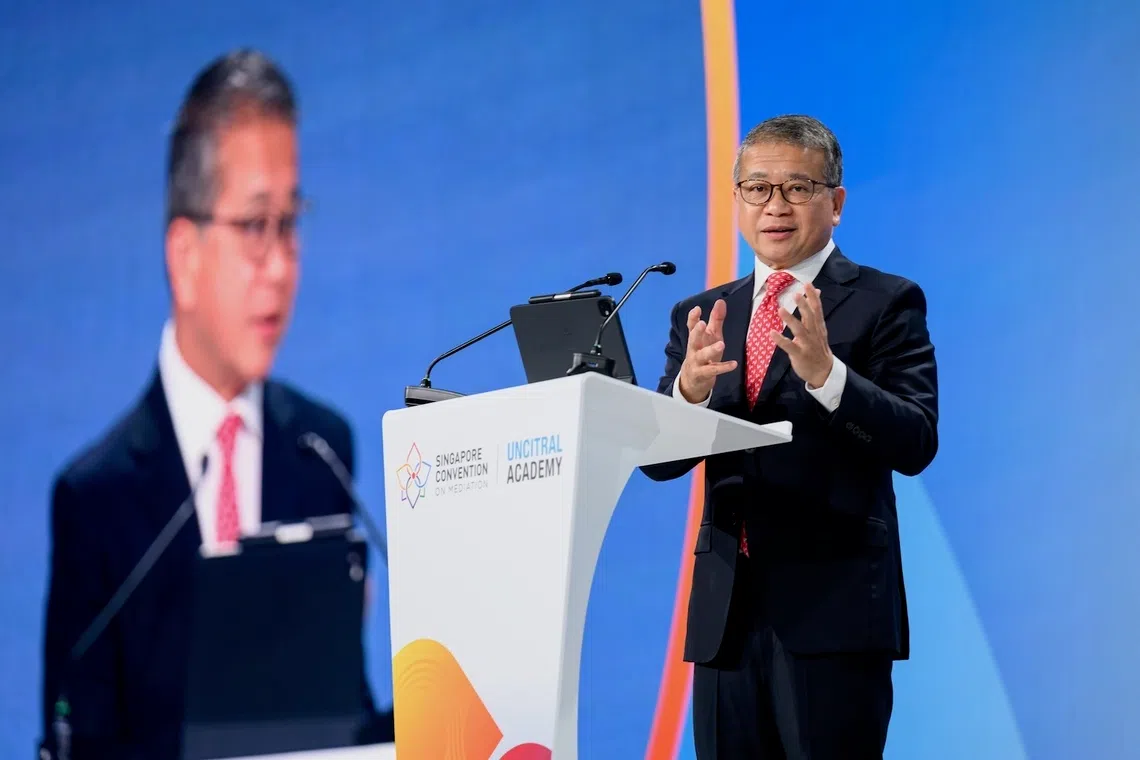
Mediation is an option that businesses can take to resolve disputes while preserving the relationship between parties, says Law Minister Edwin Tong.
Thinking beyond the contract
As businesses expand across borders, the challenge is not just adapting to change, said Peta Latimer, president of Mercer Asia.
“Businesses can handle differences in terms of how we operate across borders, (and) leaders typically enjoy change because it allows (them) to look for new avenues of growth,” she explained.
At Mercer Asia, Latimer is responsible for the performance of the firm across 11 markets in Asia, including China and Singapore.
Speaking at the fireside chat at the SIAC Symposium, she said the hardest aspect for businesses to manage is actually “unpredictability”.
At a separate SC Week event organised by Singapore International Mediation Centre (SIMC) on Aug 26, Tong advised businesses to stay prepared for unpredictable circumstances, including disputes that may arise.
One way is to discuss – before contracts are signed – “how and when mediation can be used”, he said. “Do not wait until the dispute occurs to decide how the dispute could be managed.”
To do so, Tong added, it is important to broaden the conversation beyond disputes practitioners. SC Week, for example, has made “a concerted effort to bring along more corporate and commercial lawyers, business leaders, people involved who are outside of the law, who negotiate transactions”.
Corporate lawyer Tan Teng Sen, who attended SC Week 2026, concurred. “When advising on cross-border transactions, it is important to think not only about getting the deal done, but also about how the transaction will perform if a dispute arises.”
Tan is a director of Corporate Mergers and Acquisitions practice at Drew and Napier. He added: “An understanding of developments in dispute resolution helps me think more strategically about the overall architecture of a transaction.”
Cross-border commerce is not slowing down, said Tong, and neither are the disputes that come with it. “This makes trusted ways of managing those disputes even more important.”
After all, he stressed, “dispute resolution (is only) a means to an end because businesses are here to do business – not to get involved in resolving disputes – and investors want (to) see the outcome of their investments.”
KioskNews shows a cleaned-up reading view extracted from the publisher’s page — the original always lives on their site, not ours.