Taiwanese highly support sustainable waste management
By Esme Yeh / Staff reporter


Taiwanese highly supported convenience stores’ efforts to reduce single-use items, but only 26.1 percent knew the significance of “refuse” in the “5R” sustainable living principle, a Taiwan Re-Think Environmental Education Association survey showed.
Results showed that people’s environmental knowledge and attitude have continued to improve over the years, association chief brand officer Sandra Wang (王滋鮮) said.
However, more than 70 percent did not know that refusing single-use items or unnecessary plastics is the first step of the 5R principle: “refuse, reduce, reuse, repair and recycle,” Wang said.
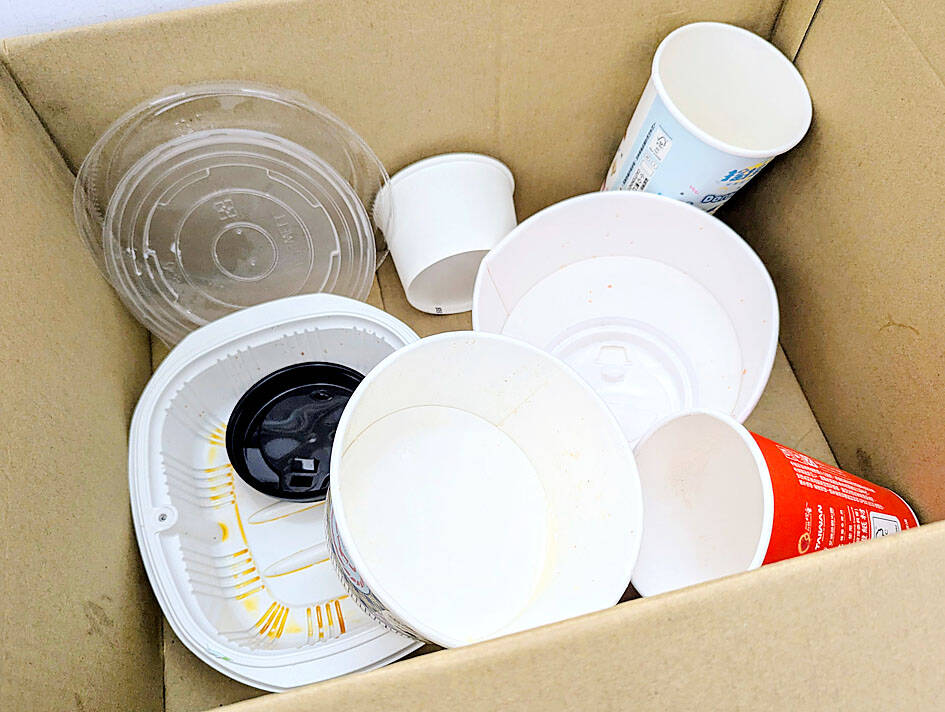
A recycling box in Taipei is pictured on Feb. 24 last year.
Photo: Lin Cheng-hung, Taipei Times
Only 26.1 percent knew the significance of “refuse” in the 5R principle, of whom more than 80 percent still ask for single-use items, she said.
This year, about 93.9 percent of respondents knew that paper coffee cups are recyclable, up from 84.6 percent last year, while people with knowledge of recycling plastics increased from 68.4 percent last year to 70.6 percent this year.
However, the percentage of people answering correctly to questions about kitchen waste recycling declined from 88.1 percent last year to 77.44 percent this year, likely because the rules were revised this year, the results showed.
The Ministry of the Environment also collaborated with the association and Taiwan FamilyMart Co on an environmental exhibition at Huashan 1914 Creative Park in Taipei.
The exhibition runs from today to Oct. 26, featuring a glass wall with more than 17,000 discarded cigarette butts, as well as thought-provoking environmental issues in daily life.
At a news conference yesterday, Minister of Environment Peng Chi-ming (彭啟明) thanked the association for helping promote environmental education with innovative ideas.
He also thanked FamilyMart for collaborating with the ministry on resource circulation, including a coffee grounds recycling program, which won a grand award in the Presidential Hackathon last year, he said.
As kitchen waste disposal fees surged due to the ban on feeding swill to pigs, proper management of kitchen waste has become a key issue, Peng said.
While kitchen waste disposal involves downstream management, reducing upstream waste is also important, he said.
The ministry has initiated communications with 20 major chain restaurants on the issue, Peng said, adding that the ministry has discussed food waste reduction with department stores and hotels, which produce kitchen waste mainly through food courts and buffets.
The ministry would establish an alliance to promote the “clean plate” campaign by the end of this year and launch a “cherish food Wednesday” campaign, Peng said.
KioskNews shows a cleaned-up reading view extracted from the publisher’s page — the original always lives on their site, not ours.