A $180 loan, a $1,040 demand: The debt traps ensnaring domestic workers
It was National Day evening. Retired kindergarten operator Mary (not her real name) and her husband were watching the parade on TV when her phone started ringing incessantly.
She ignored the first few calls from the unfamiliar Malaysian number, but they kept coming. Assuming it was urgent, she finally answered.
The woman on the line recited Mary’s full name and identity card number and claimed to represent a moneylending company. She demanded payment for an outstanding debt.
“I didn’t owe anyone any money at all, so I just hung up,” Mary recalls. Immediately, calls from other numbers came in rapid succession. As soon as she declined one, another rang. Then came the WhatsApp messages.
One message from a Philippine number read: “Your helper say she clear today her loan. Now your helper still no reply lei... I ****ing ask my people go up ar your house.”
Mary’s domestic worker Lucy (not her real name), had flown back to the Philippines to visit her sick father. She had worked for Mary’s family for four years. Mary had always thought of Lucy, 51, as a competent worker and great cook.
Mary had dropped her off at the airport just days before, and was not expecting Lucy back for another two weeks.
The loan sharks claimed over the messages that Lucy had borrowed $180, and, along with interest, the debt had ballooned to $1,040.
They sent over images of Lucy’s work permit that also included Mary’s full name, IC number and her home address.
“The scary part is they knew there was porpor (an elderly woman) living in the house,” she says, referring to her 90-year-old mother.
Mary called Lucy to confront her about the debt. The helper denied taking any money, claiming she had only inquired about a loan.
“Then how did the loan shark get a picture of your work permit?” Mary pressed.
Shortly after, Lucy stopped replying and blocked her number. Meanwhile, the loan shark’s threats escalated, all the way into the early morning.
“I woke up at 3am, literally crying, afraid that I’d find paint splashed on my gate the next morning,” Mary recalls.
For foreign domestic workers (FDWs) who need cash urgently, borrowing can take several forms: a purchase on instalment that can be pawned for money, an informal loan, or a loan from an unlicensed lender. The costs can mount quickly. Employers may discover the problem only when creditors contact or threaten them, as Mary did.
How many FDWs face such debts is unknown. Singapore had 323,800 migrant domestic workers by June 2026, according to the Ministry of Manpower (MOM), but no public agency publishes a count of those in debt.
The last worker-specific figures show about 460 reports involving unlicensed moneylending from 2013 to September 2018. The 3,172 cases of unlicensed moneylending harassment recorded nationwide in 2025 cover all victims, not just domestic workers.
A route to ready cash
Many workers support relatives back home on modest wages. Starting base salaries here typically range from $550 to $650 a month, according to FDW matching portal HelperChoice.
“A lot of them experience intense guilt because they are away from their families,” says Billy Lee, a pastor and executive director of Blessed Grace Social Services (BGSS), an agency assisting indebted foreign workers. “They find it hard to say no to any financial request from home.”

Pastor Billy Lee assists foreign domestic workers in negotiating with creditors.
ST PHOTO: GAVIN FOO
In July 2019, Singapore tightened loan regulations for foreign workers earning less than $10,000 a year, cutting the total amount they could borrow from licensed moneylenders from $1,500 to $500. The Law Ministry said the move was to “address social issues arising from these moneylending activities”.
Lee says workers in need of larger sums have also turned to shops offering goods on instalment. A worker can buy jewellery or a mobile phone with little to no cash upfront, pawn or sell it, then send the proceeds home. The debt to the shop, with its interest rates, remains.
At Lucky Plaza, a popular gathering place for Filipino domestic workers on their days off, The Straits Times counted six licensed moneylenders, five pawnshops, seven remittance centres, and more than 20 jewellery and mobile phone shops advertising hulugan, the Tagalog term for instalment plans.
The density of services under one roof means a worker can buy an item on credit with no cash upfront, pawn it for cash and remit the money home in a single visit.
“The retail shops have taken the place of the licensed moneylenders,” says Lee.
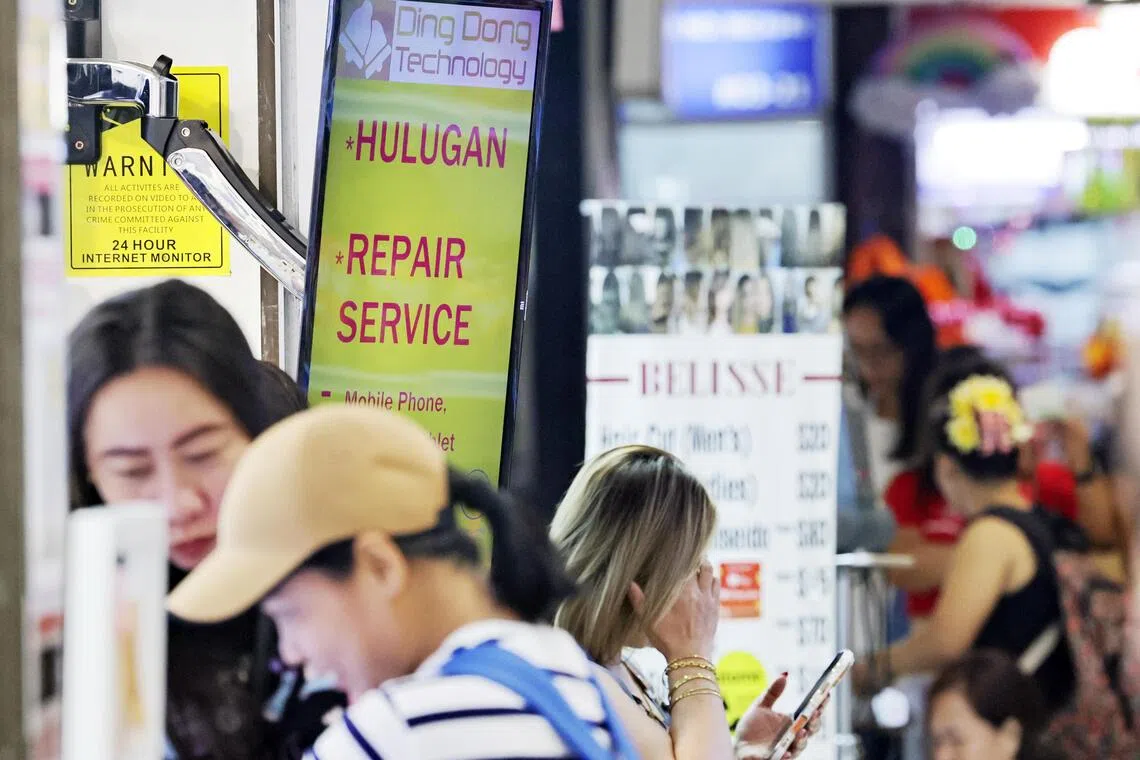
At Lucky Plaza, there are many shops advertising hulugan, the Tagalog term for instalment plans.
ST PHOTO: KELVIN CHNG
The shift began in 2019 after the licensed lending cap took effect. Immediately after the restrictions kicked in, BGSS saw an influx of 200 to 300 workers seeking urgent help. The caseload kept rising, with roughly 100 new individuals seeking help each week.
Soon, a new model took root across retail and jewellery stores. Operating legally, these businesses function as high-interest credit lenders through instalment sales models.
“Retail shops target them because FDWs are good customers: they repay because they are afraid of being sent back,” says Lee. “It’s a good business.”
Standard contracts reviewed by ST revealed steep mark-ups. In one case, a 22K gold necklace weighing 2.96g cost $1,320, payable over five months. Each late instalment incurred a further $90 charge. When the worker pawned the necklace at the pawnshop, it fetched $430.
Many workers also do not realise the true cost of falling behind on instalments until it is too late.
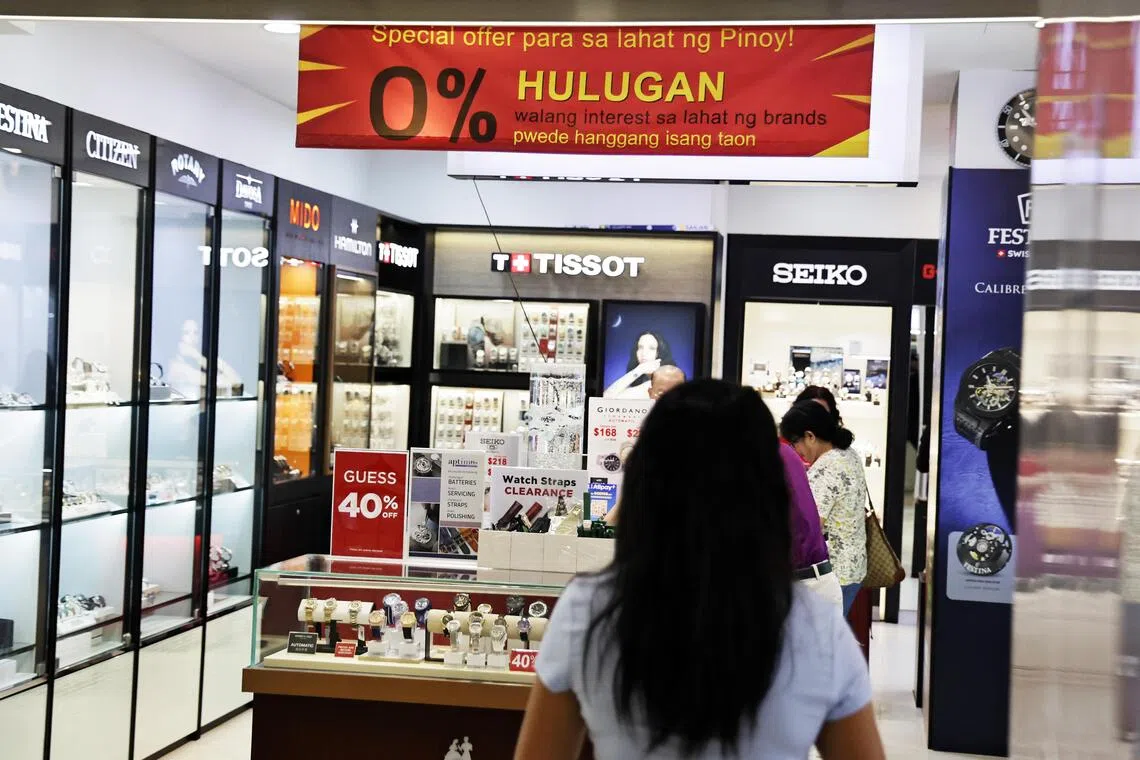
A retail shop in Lucky Plaza that offers “hulugan”, where a customer buys a big-ticket item by paying in instalments.
ST PHOTO: KELVIN CHNG
Wendy, 34, a Filipino domestic worker who came to Singapore in 2024, found this out the hard way. She needed $300 for her son’s school fees and bought a piece of gold on instalment from a jewellery shop in Lucky Plaza.
She made the first two monthly payments before her savings ran out. Desperate to cover the shortfall, she borrowed $280 from an online lender who turned out to be an unlicensed loan shark.
After she missed a payment, she says, the loan shark charged an $80 deferment fee every five days. The fees did not reduce what she owed. When she stopped paying that too, they messaged her incessantly and even sent cash-on-delivery food orders to her employer’s house, an apparent tactic to pressure her by bringing her debt to her employer’s attention.
Loan sharks and their tactics
Dorothy’s experience – which has left her unable to eat or focus on her job caring for an elderly couple in Singapore – shows how a worker can accumulate different kinds of debt while trying to meet one family emergency.
The 37-year-old Filipina came to Singapore in 2017 to support her three teenage children and her mother. Estranged from her husband, who gives little financial help, she is the family’s main breadwinner.
When her father was unexpectedly hospitalised in June, she bought jewellery on instalment from two Lucky Plaza shops and pawned it to send money home. She still needed more. An acquaintance introduced her to another Filipino domestic worker, who offered her a loan.

A family emergency led Dorothy (not her real name), a foreign domestic worker, to fall into a spiral of debt.
ST PHOTO: GAVIN FOO
Dorothy borrowed $450 from the woman and handed over her passport as collateral. “It was a big mistake,” she says.
She repaid the $450, plus $200 in interest, within a month. She then borrowed another $1,350 from the same woman. According to Dorothy, interest pushed the amount demanded to more than $2,000, to be paid within three months.
“If I borrow, I settle. I can pay every month, but I can’t pay the interest,” she says.
When she asked for the interest to be waived, the lender grew hostile and told her to meet her at Toa Payoh Police Station. Dorothy showed up, but the lender never appeared and ignored her calls subsequently.
After talking to friends at church, she suspected the woman was collecting debts for a loan shark. The domestic workers who borrowed money never met the lenders. Dorothy also learnt that the woman was holding several workers’ passports, including hers.
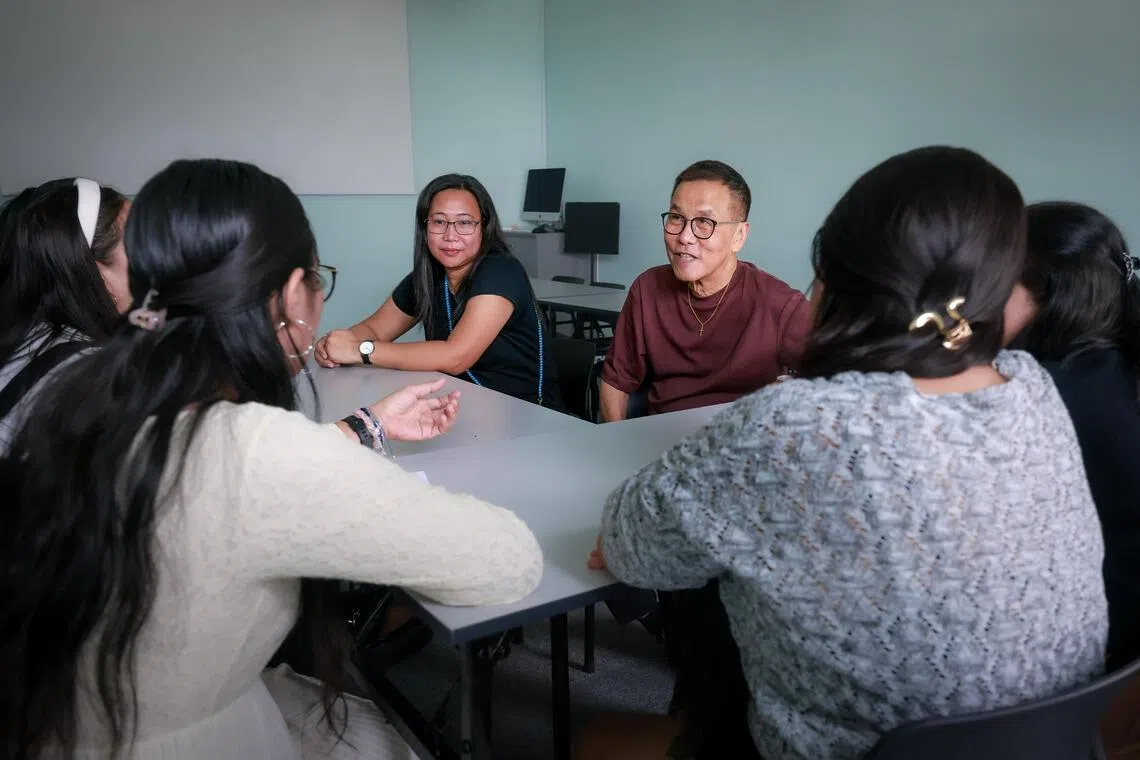
Pastor Billy Lee (right) and cell group leader Monette speaking with foreign domestic workers struggling with debt during a support session on Oct 11.
ST PHOTO: GAVIN FOO
Lee says he encounters about 10 Filipino domestic workers each month who have borrowed from loan sharks. He describes approaches made in person at workers’ weekend gathering places such as Lucky Plaza or Peninsula Plaza, and through social media. Some lenders, he says, first befriend workers and then recruit them to introduce other borrowers.
Others obtain work permit images, employer details or access to workers’ social media accounts, which can be used to contact or shame people who fall behind in their repayments.
In recent years, traditional physical harassment has increasingly shifted towards digital harassment, such as bulk SMS spamming, messaging employers and social media intimidation.
In one example of workers being drawn into such operations, police charged a 43-year-old domestic worker in February 2024 with using her TikTok account to promote illegal loans.
Dorothy eventually sought out Lee, who helped her file a police report. He says the lender has not responded to his attempts to contact her. Dorothy’s employer and family do not know about the loan.
“I cannot hide this for long,” she says, her eyes welling up.
If her passport is not returned, she says, she plans to tell them and approach MOM. She fears she could be sent back home.
The debt reaches home
That fear can give a lender another means of pressure: contacting the employer.
“They’re also hoping that when employers get harassed, they’ll pay off the debt,” Lee explains.
Mary faced that decision as calls and messages threatened her family. After consulting friends who had dealt with similar threats, she transferred the $1,040 demanded by the callers to a local bank account they supplied. She says she has not heard from them since.
“$1,040 is a small price to pay for peace of mind,” she says.
Mary initially resisted filing a police report, fearing retaliation, as the syndicate had her IC number and home address. But after talking to her family, she changed her mind and filed one.
As Mary cleared out Lucy’s room, she also found instalment slips from when Lucy had bought gold necklaces from jewellery shops in City Plaza and Lucky Plaza.
In September, two men turned up on her doorstep looking for Lucy, who remains uncontactable. The following week, she received a letter from MOM informing her that her helper’s permit had been revoked, and she is not allowed to work here.
According to Lee, the FDW debt crisis is widespread and under-reported. BGSS’ experience, he says, suggests that workers seeking help often have more than one creditor.
His group currently has 10 to 15 open cases, with each domestic worker owing on average two to four jewellery shops, “and that’s not including the loan sharks”.
“The problem persists because people are filling the gap since 2019 to exploit them,” adds Lee, who often redirects non-Filipino domestic workers to other churches or social service agencies.
He reckons that lenders and shops can count on employers paying to stop harassment, then recovering the sum through wage deductions. The problem will not be fully understood without better data and agency intervention, he adds.
“Go to all these shops and open up the books, and you can see the list of their clients who are FDWs. I’m sure it’s a long list,” he says.
Lee urges the Law Ministry, MOM and the Competition and Consumer Commission of Singapore (CCCS) to audit retail businesses that offer hulugan.
BGSS had written to CCCS about what it regards as unfair practices, particularly high instalment prices.
The commission replied that businesses are generally free to set prices according to their circumstances and that it has no power to regulate those prices.
MOM says it takes a serious view of migrant domestic workers borrowing from unlicensed moneylenders. A spokesperson says those who do so will have their work passes revoked and be barred from employment in Singapore. The ministry says it covers financial management and the consequences of illegal borrowing in its settling-in programme, WhatsApp channel and guidebooks, alongside financial literacy courses run by non-governmental organisations.
“Employers are also encouraged to highlight the risks and consequences of borrowing from unlicensed moneylenders and to encourage their migrant domestic workers to adopt prudent money management practices,” adds the spokesperson.
Meanwhile, financial education charities like Aidha are working to build financial resilience among domestic workers before they fall into debt traps.
The organisation offers courses ranging from financial goal setting, basic budgeting, needs-versus-wants distinctions and emergency funds, to more advanced financial decision-making and entrepreneurship. One free course helps domestic workers understand debt.
“A big part of that course is actually helping them understand the dangers of loan sharks, how to spot loan sharks. So we do see this as a critical area, and we do try and support better understanding in those areas,” says Aidha chief executive Jacqueline Loh.
She cites the case of a domestic worker who answered a Facebook loan ad and shared her phone number and other personal identification details. She had not wanted to take a loan, but loan sharks immediately transferred money to her, then demanded interest.
“It’s just an example of how easy it is to be deceived,” she says.
Education alone, Lee says, cannot overcome a worker’s fear of losing her job or upsetting her employer. He wants workers to feel they are able to raise a financial problem early and employers to know where to seek help.
Some employers, he says, will offer an advance or help a worker find support when they understand the situation.
“Being more empathetic will definitely benefit both employers and workers,” he says.
What he hopes most is for employers to see organisations like his as a first call, not a last resort.
“My wish is that agencies like us, who help domestic workers resolve their debt issues, become more widely known, so that employers can call us,” he says.
“There’s actually no avenue for employers right now. They don’t know what to do.”
KioskNews shows a cleaned-up reading view extracted from the publisher’s page — the original always lives on their site, not ours.