‘I confront my demons’: crime, corruption and poverty in Latin America – in pictures
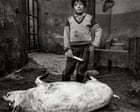
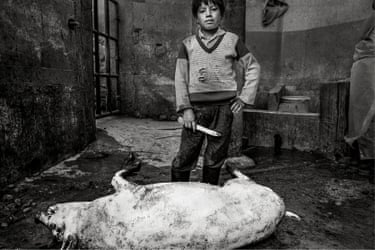
Slaughterhouse, Ecuador
For El Sur, Julio Mitchel, who was born in Cuba, combined his photographic work in Nicaragua, Guatemala, Mexico, Brazil, Venezuela, Ecuador and Peru. Incorporating black and white pictures alongside colour portraits, Mitchel views El Sur as essentially two books combined into one. El Sur by Julio Mitchel is published by GOST. All photographs: Julio Mitchel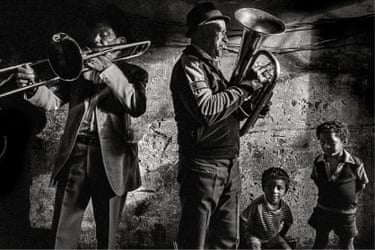
On the street, Ecuador
Mitchel: ‘For me, photography is like jazz – every single moment is different, and you have to capture it in that exact moment. One second before or after, it’s already dead. In a fraction of a second, it never goes back to the beginning’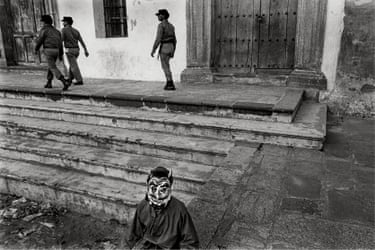
Boy with mask, Guatemala
‘I had to work very fast because there was a possibility that I was going to be mugged’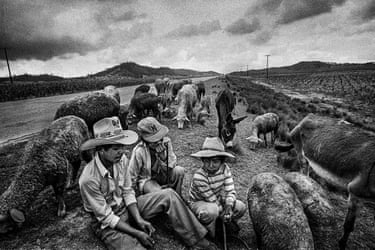
Boy shepherds, Mexico
‘The photographs span multiple treks I made from the 1980s to 2000. Everything has changed for the worse in the 500 years since the moment the Spanish and the Portuguese landed, only to be later followed by the United States army and marines – bill collectors for American corporations’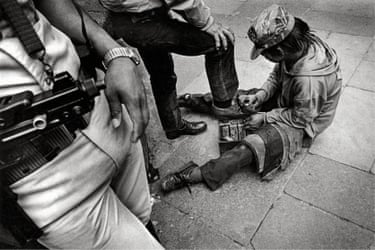
Shoe shine boy and guard, Peru
‘Although violence is present in some images, my main focus is its underlying causes: poverty, corruption, race and class inequality, a brutal and corrupt military, and an often corrupt clergy. As such, I have chosen to bypass individual captions in order to emphasise my overarching thesis: one nation, one set of problems’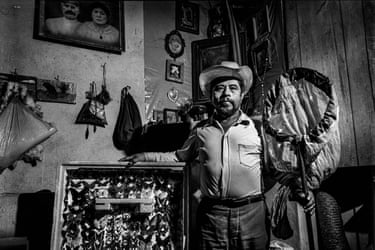
The village butterfly, Mexico
‘As I travelled, I noticed that the problem was common. It wasn’t going to take place exclusively in one country, or just in Central America, the Caribbean or South America’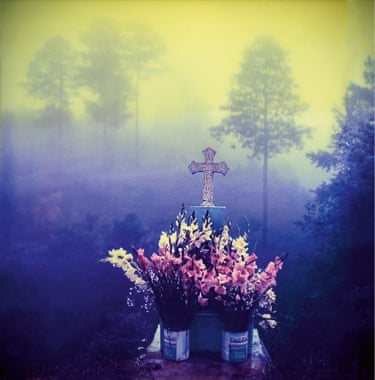
Countryside grave, Mexico
El Sur can be seen as two books: Journey, in black and white, and Portraits, in colour. Both are active conversations with the living and the dead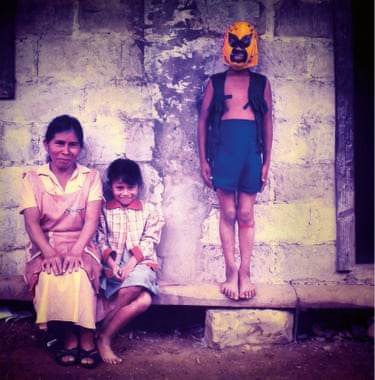
Family, Mexico
Mitchel, born in Havana in 1942, moved to New York City when he was 17. He studied photography under renowned photographer Lisette Model at the New School, which helped shape his unique documentary style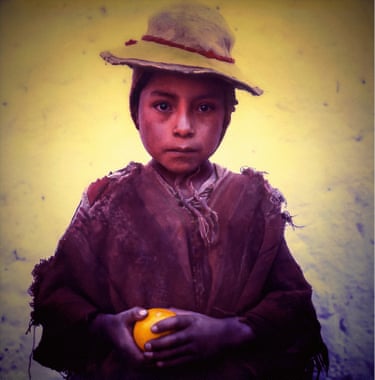
Boy, Peru
‘As a teenager, I was only interested in cameras as mechanical things; all mechanics fascinated me. Then I started looking at Popular Photography magazine. They had a Spanish edition that I used to read in Havana. Every now and then, among hundreds of advertisements they published, by mistake, they would print a good photo. Through that, indirectly, little by little, subtly, I started getting interested in real photography – not just as a mechanical object’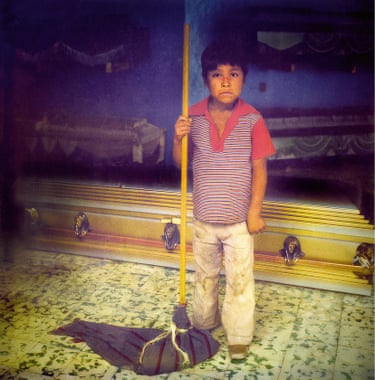
Boy cleaner sweeping at a funeral parlor, Mexico
‘I saw the work of several photographers and, at the same time, I was making plans to leave Cuba. I said, “Damn, when I get to the US, I’m going to make a little money and buy a camera.” I devoured all the books and magazines here. Then I started taking photography classes informally, but honestly, it lasted for only two minutes. I got bored; I wanted to work’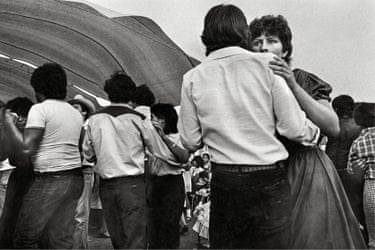
Couples dancing at a country fair, Mexico
‘We are entering the part that is hardest for me to express, which is the philosophy – what I believe. I don’t want to sound pretentious or pedantic, but it happens very often that people ask me: “Well, what is your photography about? What is your subject? What do your photographs say?” I say: “Damn, since it’s a visual thing, the images are the ones that have to speak, right?” I think it was Hopper who said: “If you could say it with words, there would be no reason to paint”’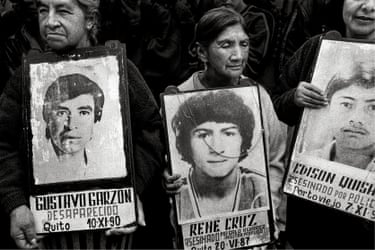
Mothers of the disappeared, Ecuador
‘The darkroom has taught me something; it gave me discipline. Speaking of philosophy, the philosophy the darkroom gives me is that you confront your demons there. That is where you have to make your choices. Do I make it lighter? Do I make it darker? More contrast? Less contrast? Did I make this mistake? Should it be this way instead of another way? Facing all those decisions is part of what I consider to be very existential. It is a solitary act. That’s the word I was missing: the act of creation is very solitary’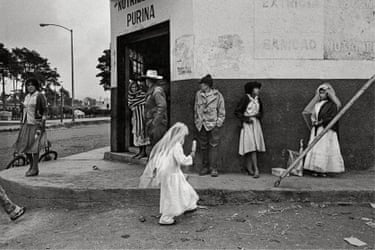
Girl in communion dress, Mexico
‘It is my reality. I show these images because it is a necessity I have. I see certain things, regardless of whether there is an audience or no audience’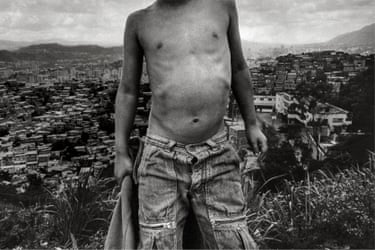
Slum child, Venezuela
‘Photographers, especially in this type of work, are their own worst editors. That is very typical. The most important piece of equipment for the photographer – especially for this kind of work – is a trash can’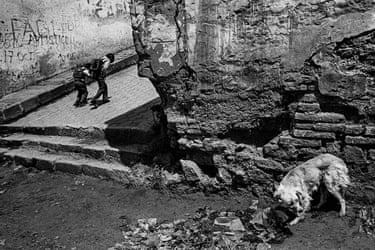
School boys , street dog, Ecuador
‘That trash can is where you throw away what isn’t necessary. That is editing, and that is the hardest discipline of being a photographer: what you throw into that trash can. The more trash cans you fill, the better photographer you will be’KioskNews shows a cleaned-up reading view extracted from the publisher’s page — the original always lives on their site, not ours.