From Mat Kilau to flying Malays: How communal anxieties fuel alternative history publishers
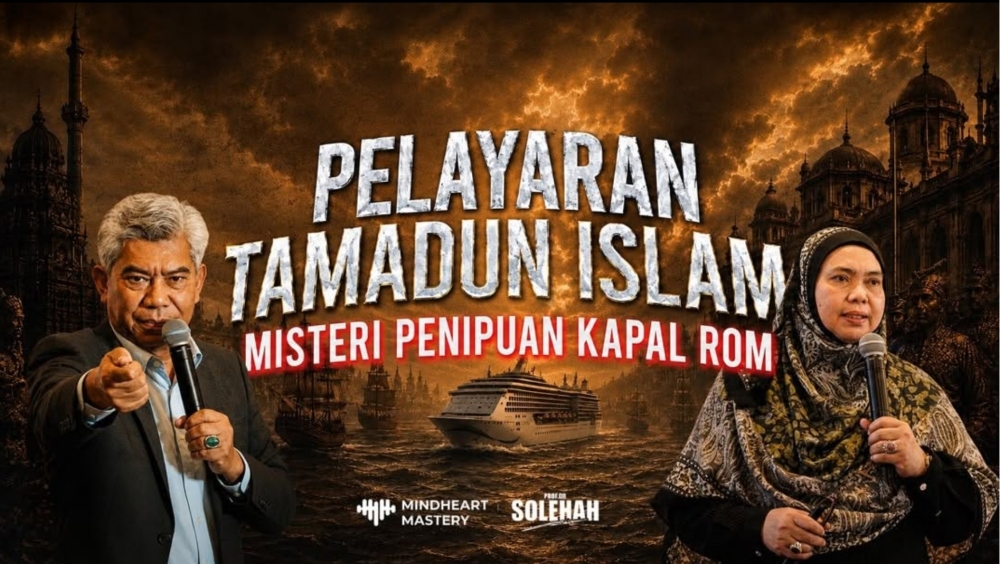

A poster promotes one of former professor Solehah Yaacob’s talks
By Malay Mail
First Published: Monday, 28 Sep 2026 9:11 AM MYT
KUALA LUMPUR, Sept 28 — From claiming that ancient Malays could fly to asserting that they taught the Romans naval shipbuilding, former linguistics professor Solehah Yaacob has drawn international ridicule while stirring passionate debate at home.
Although she was dismissed by the International Islamic University Malaysia in April, her revisionist claims retain a fervent following.
Boasting over 500,000 followers across Facebook and TikTok, Solehah continues to draw thousands of viewers, while her in-person Lost Malay History and Civilisation seminars remain in high demand, The Straits Times reported.
Sociologists trace the phenomenon to contemporary communal insecurities.
Aziff Azuddin of Iman Research said: “My reading is that the multicultural landscape of Malaysia, as well as Malay socio-political and economic anxieties, is why nativists, right-wingers – and people like Solehah – have such a purchase among some sections of the Malay community.”
Despite comprising over 60 per cent of Malaysia's 34 million citizens and holding constitutionally protected status, persistent economic anxieties continue to feed fears of marginalisation among some in the community, creating fertile ground for historical revisionism.
The revisionist push extends beyond social media personalities. Academics such as Universiti Sains Malaysia historian Azmi Arifin have questioned standard history syllabuses for over-relying on British colonial perspectives, arguing that terms like “feudal” fail to capture traditional Malay governance. He noted that anti-colonial figures like Pahang warrior Mat Kilau were unfairly branded as “rebels”.
Denying the pre-Islamic past
To assert historical supremacy, fringe revisionists often attempt to erase Malaysia's pre-Islamic heritage.
In a lecture in September, Solehah dismissed the country’s archaeological Hindu-Buddhist past as “mere propaganda” concocted by Western colonisers. Her videos blend local folklore with religious scripture, claiming that the prophet Abraham was Malay and that Moses visited Kedah's Gunung Jerai.
Cultural historian Eddin Khoo argued that defining Malay identity exclusively through a puritanical religious lens has made the region's pre-Islamic heritage uncomfortable for nativists.
“Solehah is a fantasist, but people want to believe that about themselves,” Khoo said. “To them, everything must trace back to their puritanical idea of Islam; otherwise, it is illegitimate.”
Khoo noted the irony in seeking monocultural purity when historical Malay societies were deeply cosmopolitan, pointing to Portuguese chronicler Tomé Pires’s account of 84 languages spoken in 16th-century Melaka.
Commercial appetite for alternative history
The demand for revisionist narratives is also commercial. Novelist and sociologist Faizal Musa pointed to the popularity of alternative history publishers such as The Patriots, whose online bookstore commands over 52,000 followers.
“Simple explanations are often seen as more appealing and credible than complex ones, particularly when they appear capable of being tested or disproved,” Faizal said, adding that such revisionist trends are a global phenomenon.
Khoo cautioned that unchecked pseudohistory erodes public historical literacy: “Myth has an important role in not just Malay, but also Asian history; however, this is not even myth – it is fantasy.”
KioskNews shows a cleaned-up reading view extracted from the publisher’s page — the original always lives on their site, not ours.