Robo-frog swims with liquid crystal muscles powered by light
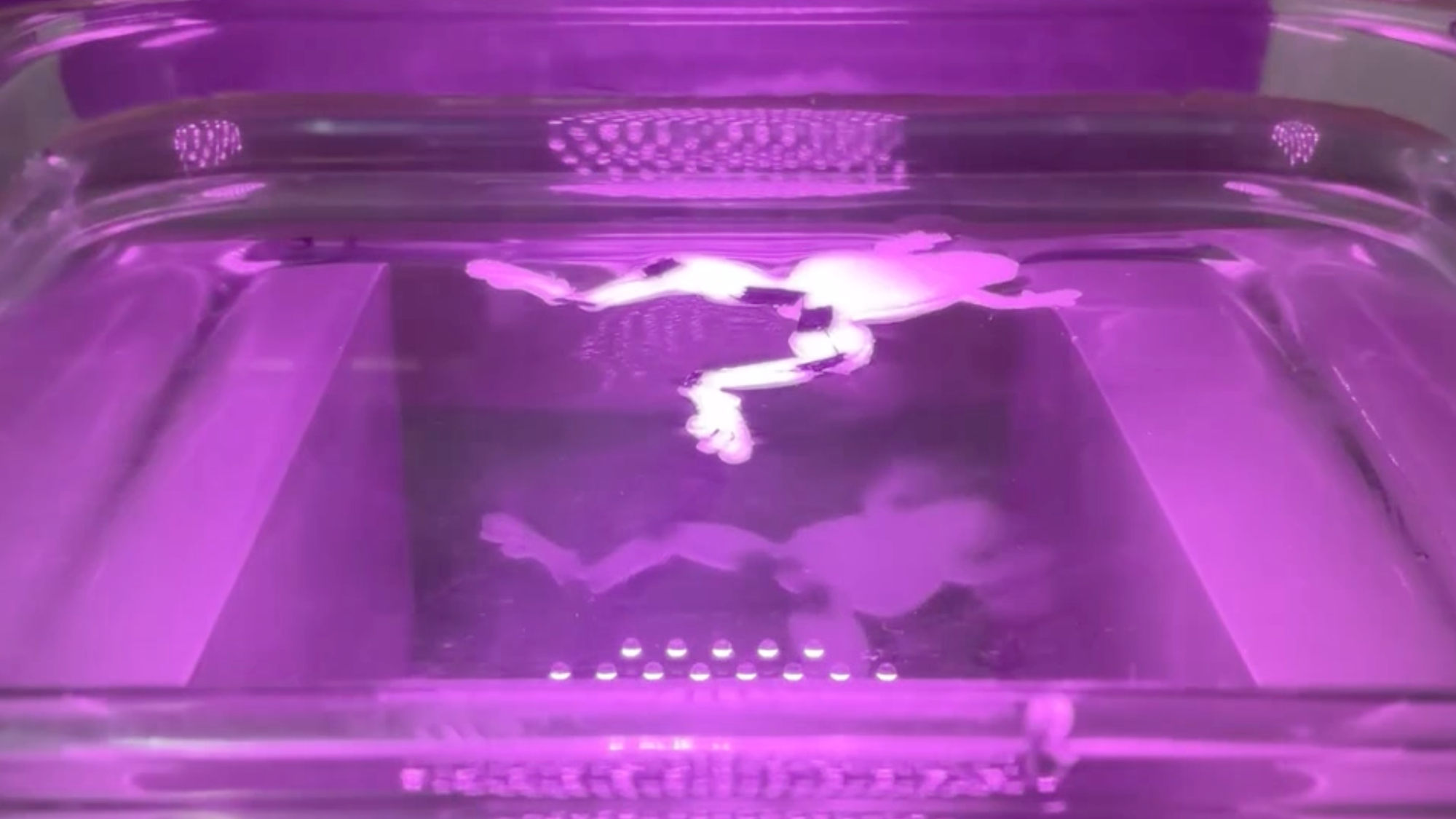
A silicone frog built by engineers at Denmark’s Aarhus University can’t swim nearly as fast as its amphibian inspiration, but it still manages to get the job done without any moving parts. The odd invention owes its slow-but-steady aquatic maneuvering to a set of six artificial muscles specially designed to contract when exposed to near-infrared light.
The team’s novel system is detailed in a study recently published in the journal Advanced Materials Technologies. Although similar setups may one day boost the capabilities of soft robots tasked with search and rescue or environmental monitoring, its creators are a bit more realistic about this frog-bot’s near-term uses.
“I could easily imagine these robots being used as toys before we see them on rescue missions,” Cecilie Ryberg, Aarhus University chemist and study co-author, said in a profile. “I think people would have fun playing with a frog like this using a suitable light source.”

Robot frog swims using light-sensitive artificial muscles
Each of the robot’s muscles is built using crystal elastomers. These materials are specifically manufactured to contract while they are heating, and then revert back to their original shape once cooled. In this case, Ryberg and her collaborators also added a molecule that converts near-infrared light into heat. This allows the muscles to tighten after directly exposing them to a lamp. That said, the process isn’t as simple as sticking the elastomers onto their model frog and dropping it into water.
“Getting the six muscles to work together was a major challenge,” explained Brigitte Städler, a study co-author and Aarhus University chemist. “If they don’t contract in a coordinated way, the frog won’t swim forwards. It may simply spin around.”
A lot of trial-and-error also went into concocting the elastomers themselves. In addition to contracting properly, the material needed the proper consistency to use in a 3D printer. To do this, Ryberg experimented with various molecular ingredients and molecule chain lengths to perfect the robot muscle recipe.
“In a conventional 3D printer, you typically melt a solid plastic filament. Our material is more like very thick syrup or icing that you squeeze through a piping bag when decorating a cake,” said Ryberg.
The final result is a light-powered soft robot that’s quite unique, but also not in any hurry. At its best pace, the frog swam a little over three inches in about two minutes. That may not get it to its destination quickly, but the proof-of-concept successfully offers a new way to think about robotic design, and the ways engineers can power their creations. Until then, there is always the potential for robo-frog toys.
KioskNews shows a cleaned-up reading view extracted from the publisher’s page — the original always lives on their site, not ours.