DFA admonishes China envoy over ‘thinly veiled threat on use of force’

Already have Rappler+?
to listen to groundbreaking journalism.
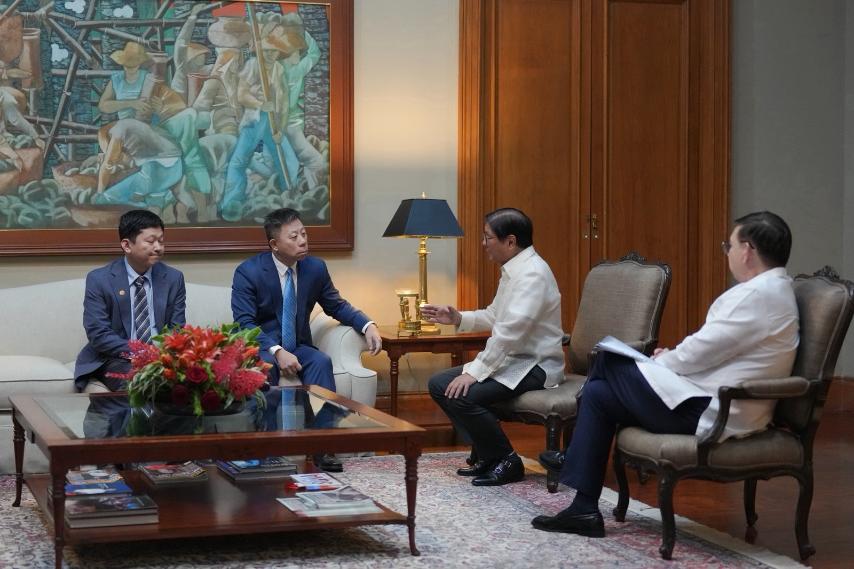
PH-CHINA TIES. President Ferdinand Marcos Jr. summons Chinese ambassador Jing Quan over maritime incident at the Ayungin Shoal in July 2026.
Malacañang
Chinese Ambassador Jing Quan asserts that Beijing is no troublemaker while saying Manila should 'feel fortunate' that China does not use force, even though it could 'easily win' if it does
AT A GLANCE
- The Philippine Department of Foreign Affairs criticized Chinese diplomat Jing Quan for making remarks that implied a threat of force, emphasizing the need for diplomatic tact.
- Jing's comments come amid ongoing tensions between the Philippines and China, particularly regarding the South China Sea, with the Philippines rejecting claims that military communication issues are to blame for the tensions.
- The relationship between the two countries has been complicated by China's aggressive maritime actions and its refusal to acknowledge the Philippines' rights in the West Philippine Sea, despite hopes for a diplomatic reset under President Ferdinand Marcos Jr.
This is AI-generated. Read the article for full context. Report any errors.
MANILA, Philippines – The Department of Foreign Affairs (DFA), in a rare public admonishment late Thursday, October 15, said it was “regrettable” that Beijing’s top diplomat to Manila, Jing Quan, “had a poor choice of words that would seem to convey a thinly veiled threat of the use of force.”
In a chance interview with reporters earlier on Thursday, Jing denied that China was a troublemaker in the region and blamed the Philippines — or at least Philippine officials — for causing tensions between the two Asian countries.
Talking to Philippine reporters, he added: “We should feel fortunate enough that you have a neighbor like China in this region. If we want to use force, we may easily win. But no, we’ll not use force. We love peace.”
Jing is a veteran diplomat who spent years in the United States before being assigned to the Philippines in late 2025.

“The business of diplomacy requires tact and restraint in order to create space necessary for discourse, dialogue and engagement, regardless of the disparity in positions or perspectives,” said the DFA in a statement reacting to Jing’s remarks, which it said were “hardly helpful in the context of the complicated bilateral ties between the Philippines and China.”
“It is hoped that all diplomats accredited to the Philippines take greater care in the language used in public statements so as not to further erode mutual trust and confidence, nor derail the advancement of dialogue and constructive engagement,” added the DFA in a statement released through its West Philippine Sea spokesperson Rogelio Villanueva Jr..
The latest chapter in the long-running war of words between the Philippines and China has seen the Chinese embassy in Manila making posts to blame Philippine Defense Secretary Gilberto Teodoro Jr.’s policy of cutting off military-to-military communication for escalating tensions at sea.
The Philippine military has rejected the claim, telling reporters that the absence of direct communication channels with China’s military is not to blame for the tensions, which it has attributed to aggressive actions by Chinese maritime forces. That the Philippine military is not allowed to directly engage with the People’s Liberation Army is not exactly new information, either. Teodoro has made no secret of this decision for years.
Jing’s remarks would not be the first time a Chinese diplomat has made veiled threats — threadbare as they may be — against the Philippines. His immediate predecessor, Huang Xilian, was also criticized in April 2023 for warning against closer military and defense ties with the Philippine’s treaty-ally the United States, or siding with Taiwan independence, lest the safety of overseas Filipino workers in the independently-governed island be compromised.
The Chinese embassy’s messaging and public communications strategies have changed dramatically since Jing took over in late 2025. Beijing’s embassy in Manila has been combative toward Filipino officials — mostly spokespersons from defense and security agencies and, occasionally, even nationally elected officials — in its public statements.
Jing’s latest remarks comes 10 months into what President Ferdinand Marcos Jr. and the DFA have hoped to be a year of “reset” in bilateral ties between Manila and Beijing.
The two Asian neighbors have close trade ties but diverge dramatically when it comes to talk of the South China Sea — in particular, the area called the West Philippine Sea.
Beijing claims almost all of the vast waterway, including areas that are part of the Philippines’ exclusive economic zone. China refuses to acknowledge the landmark 2016 Arbitral Award, which affirmed the Philippines’ EEZ and found China’s supposed historical claim invalid.
Under Marcos, Manila has been both assertive and transparent in protecting both its sovereignty claims and rights in the West Philippine Sea. China’s claims have meant that, for Filipino frontliners — the Navy, Coast Guard and even fisherfolk — harassment at the hands of Chinese maritime agencies is a risk in flashpoints in those waters. – Rappler.com
KioskNews shows a cleaned-up reading view extracted from the publisher’s page — the original always lives on their site, not ours.