Opinion: Opinion | BJP Seals Punjab Deal With Akalis. But What Explains Its Demand For More Seats?
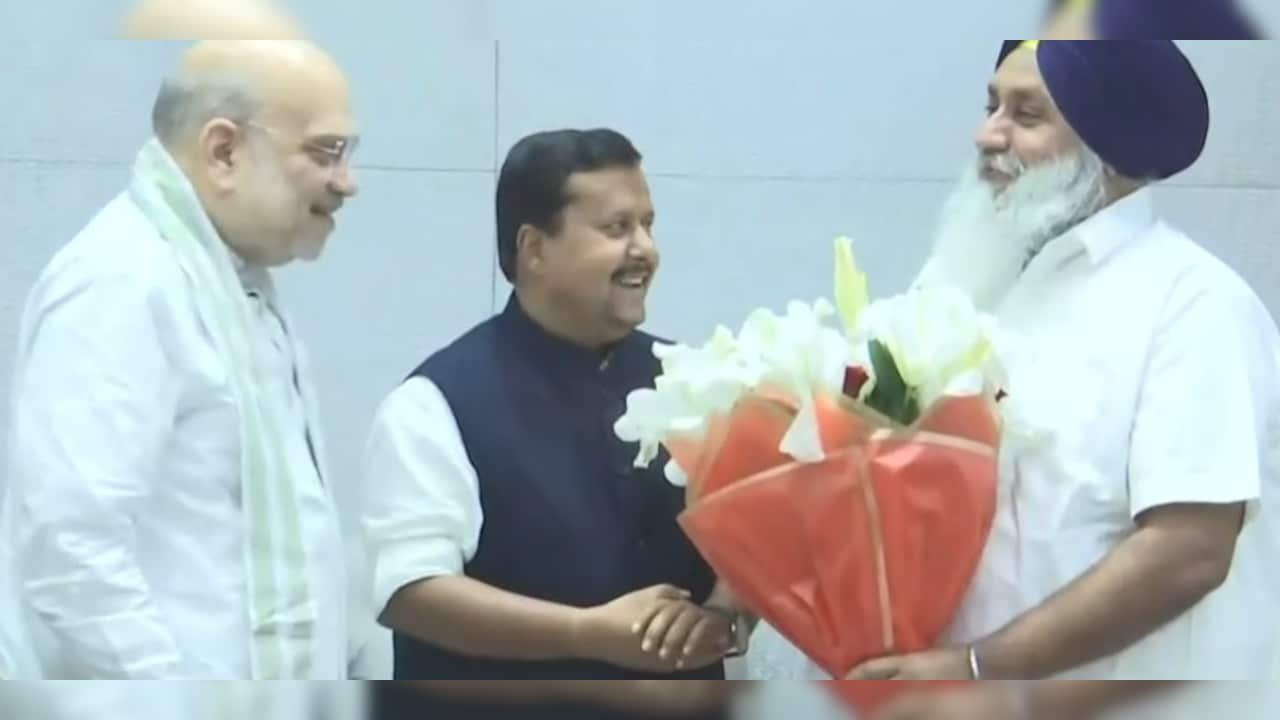
The Bharatiya Janata Party (BJP) and the Shiromani Akali Dal (SAD) have finally announced their alliance for the 2027 Punjab Assembly elections. Neither party has found it easy to win without the other, and together they won three state elections in 1997, 2007, and 2012. The real question is no longer whether to reunite but on what terms. The BJP, long the junior partner, wants a bigger share of seats than it has ever had.
A Formula From Another Era
Under the old understanding, SAD contested 94 of the 117 Assembly seats and the BJP, 23. For the Lok Sabha, SAD took 10 of the 13 seats and the BJP three: Gurdaspur, Hoshiarpur, and Amritsar. The logic was a natural division of the social base. The 2011 Census put Sikhs at 57.7% of Punjab's population and Hindus at 38.5%, so an alliance in which SAD gathered Sikh votes and the BJP gathered Hindu votes covered most of the electorate.
The partnership ended in September 2020 in the aftermath of the farm bills. Since then, both parties have fought alone, with poor results. In the 2022 Vidhan Sabha elections, SAD won just three and the BJP two seats. In the 2024 Lok Sabha election, the BJP won no seats in Punjab, and the SAD won one.
The Case The BJP Is Making
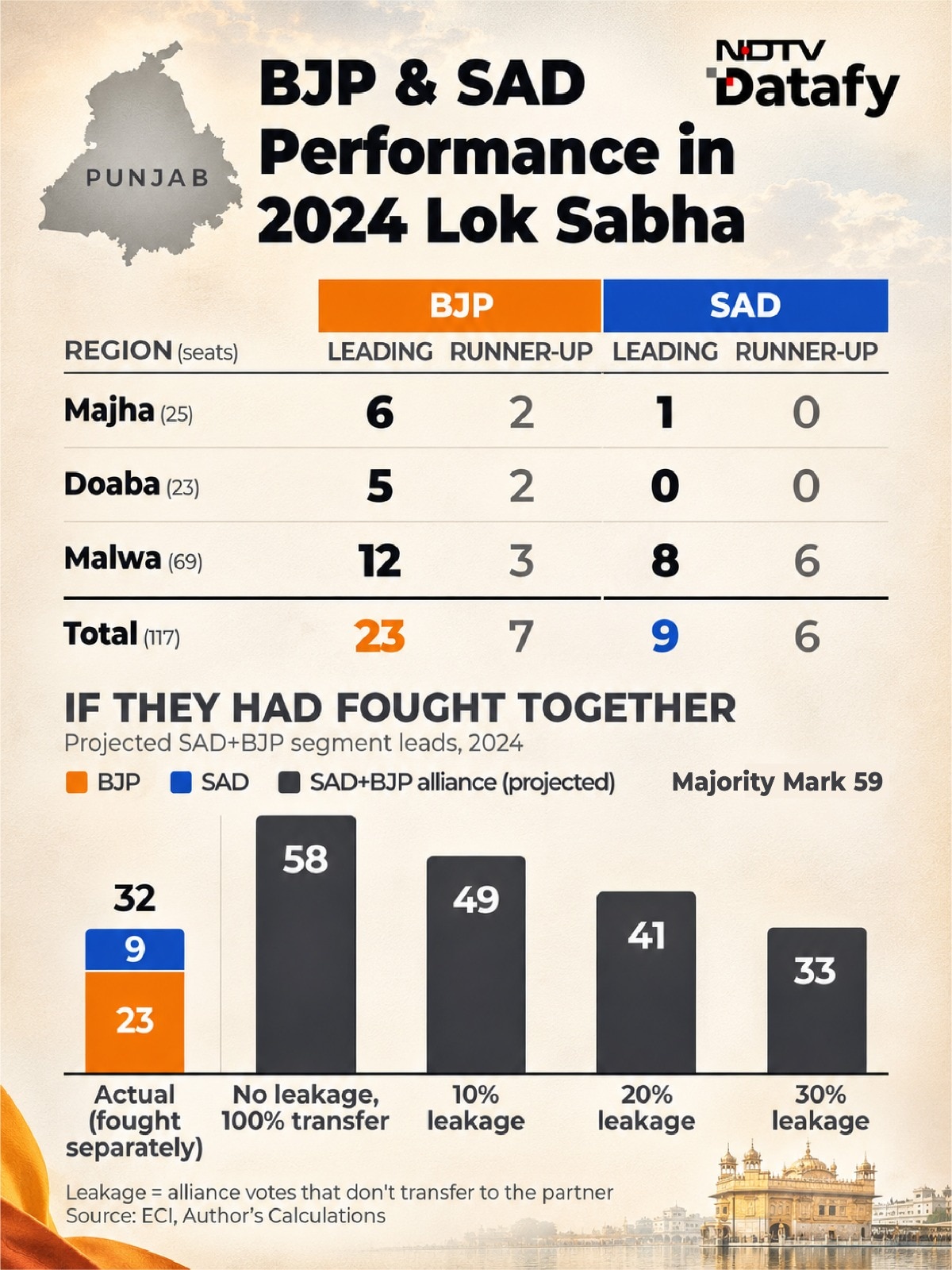
The BJP's argument rests on how the two parties fared in 2024. It polled about 18% of the votes in Punjab and led in 23 Assembly segments. SAD polled about 13% and led in nine. The BJP also finished second in seven segments against the SAD's six. The BJP's leads are spread across all three regions, while the SAD's are concentrated in Malwa, which accounts for eight of its nine. SAD has also been weakened by splits in the party and by the rise of Amritpal Singh's Waris Punjab De, which competes for the same Panthic vote. From the BJP's side, a party that outpolled its senior partner can no longer be expected to accept the old 23-seat quota.
Where Hindu and Urban Votes Are
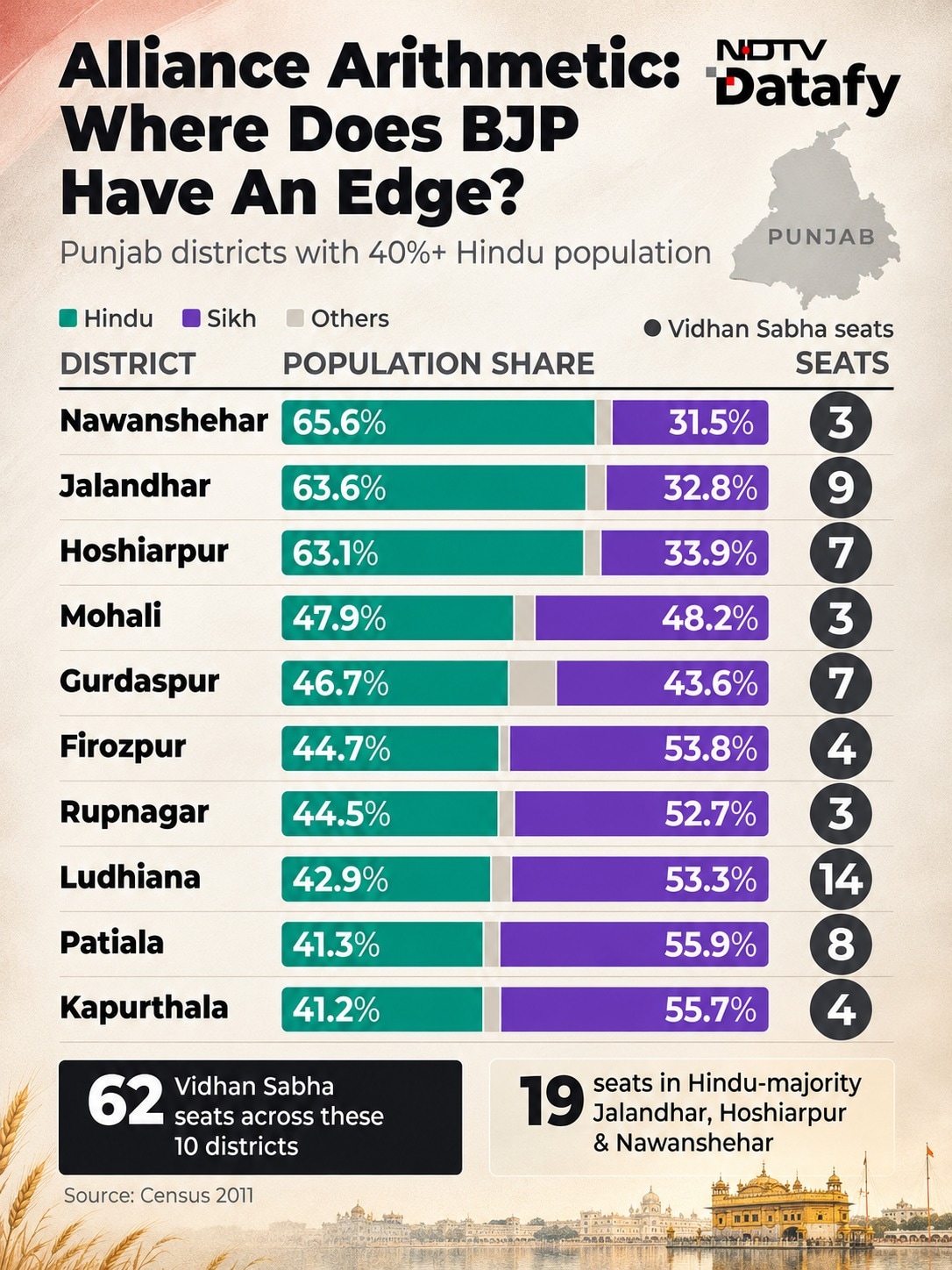
The BJP's second argument is demographic. Hindus are a majority in five districts: Pathankot, Jalandhar, Hoshiarpur, Fazilka, and Shahid Bhagat Singh Nagar (Nawanshahr). Together, they hold 26 Assembly seats. In seven more districts, the Hindu population is above 40%: Mohali, Gurdaspur, Firozpur, Rupnagar, Ludhiana, Patiala, and Kapurthala. Those seven districts hold another 43 seats.
Urbanisation points the same way. Punjab as a whole is 37.5% urban, but six districts are well above that: Ludhiana (59.2%), SAS Nagar (54.8%), Amritsar (53.6%), Jalandhar (52.9%), Pathankot (44.1%), and Patiala (40.3%). These districts hold 46 seats, and they are where much of the state's Hindu trading community lives. The BJP is at its strongest in such towns and cities.
These figures underpin the party's reported demand of 40 to 47 seats, and in some reports, an equal 50:50 split. The SAD, for its part, is said to have been willing to offer closer to 35. The chief ministership, traditionally reserved for the Akalis, is reportedly part of the bargaining as well.
What The Alliance Arithmetic Shows
A scenario model built on the 2024 results shows why both sides have reason to deal. Contesting separately, the two parties led in 32 segments (23 for the BJP and nine for SAD). If every vote transferred perfectly, a combined SAD-BJP would lead in 58, just one short of the majority. The model then discounts for leakage, meaning voters who refuse to follow their party's instruction to back the ally.
Two things stand out. First, each additional 10% of leakage costs the alliance about eight or nine seats. At 30% leakage, it is barely better than going alone (33 against 32). The alliance pays off only if roughly 70% or more of each party's voters follow their leadership's call. Second, even a perfect transfer produces 58 seats, one short of the 59 needed for a majority in the 117-member House. On the 2024 numbers alone, reunion does not guarantee victory. The alliance has to win over voters beyond the two parties' combined 2024 base.
The Limits Of The Numbers
Religion is not destiny. Malwa has only one Hindu-majority district, Fazilka, yet the BJP led in 12 Malwa segments, many of them urban seats in Sikh-majority districts. In Doaba, Jalandhar, Hoshiarpur, and Nawanshahr are all Hindu-majority and hold 19 seats, yet the BJP led in only five of the region's 23. A Hindu-majority district does not automatically vote for the BJP.
There are other caveats. Lok Sabha leads are a rough guide to assembly contests, where voters weigh local candidates and the question of who will lead the state differently. The 2024 contest was also a four-cornered fight, and a joint candidate may not collect the simple sum of two parties' votes. The religion figures date from the 2011 Census and are more than a decade old.
The Bargain Ahead
The BJP has a credible claim to more than 23 seats. It outpolled SAD in 2024, it is spread across all three regions, and it holds the urban and Hindu-heavy belts where the Akalis have little presence. SAD brings the organisational base in rural Malwa, and a Sikh vote the BJP has struggled to reach. The two are complementary, which is the original logic of the alliance.
A deal somewhere between SAD's reported 35 and the BJP's 40-plus would give each partner seats where it is strong. The harder questions lie beyond seat numbers: who leads the alliance, how much of each party's vote will follow, and whether voters see a reunion as renewal or as two weakened parties propping each other up. The 2027 result will turn on those answers more than on any seat formula.
KioskNews shows a cleaned-up reading view extracted from the publisher’s page — the original always lives on their site, not ours.