IPS overhauls inmate rehabilitation, officer responsibilities as prison security upgraded

The Israel Prison Service (IPS) is implementing sweeping changes to inmate rehabilitation, prison security and the responsibilities of correctional officers, including behavioral rehabilitation programs designed to prepare prisoners for reintegration into society, senior officials told Maariv during a visit to Dekel Prison.
Inmate R. is expected to be released from the prison where he is serving his sentence in approximately four months, provided everything goes according to plan and in accordance with a decision by the parole board. One of the main conditions for his release is meeting the requirements of the Behavioral Pattern Modification Department in Wing 5 of Dekel Prison.
The department, known by its Hebrew acronym SHADEH, focuses on changing behavior patterns.
Prisoners housed in the department who have agreed to participate in its educational rehabilitation program "receive things here that they have not received anywhere else," Dekel Prison commander Chief Superintendent Shahar Raymond explained to Maariv.
"There is an educational center here and an attention center for prisoners with attention deficit disorders. We do not treat them with Ritalin here. It is all about the personal work of each and every inmate," she added.
Discipline a part of rehabilitation
Slightly more than 20 inmates are sitting in the department's recreation room on the second floor, holding a farewell gathering for one of their fellow prisoners.
As in other places, the farewell gathering at the rehabilitation department includes light refreshments, such as wafers, cookies, and Bamba peanut snacks.
When Raymond enters, they all rise together.
"This is part of the discipline they adopt for themselves as part of their rehabilitation process," she explained.
The towering R. is eagerly awaiting his conditional release, and the prospect occupies much of his thoughts.
"We hardly talked about the elections here," he told Maariv. "Only on voting day. We are interested in other things, things related to life in prison," he said.
"Now I listen more, including to my children and my family. I learned that in the department."
R. is incarcerated for domestic violence offenses.
Such violence can manifest itself in abusive treatment of a woman, children, or other family members.
Prisoners in the rehabilitation department must meet several requirements that may appear relatively simple to an outside observer.
These include obeying the law and conducting themselves according to accepted social and cultural norms.
"They have difficulty adapting to this," Raymond said. "Not long ago, there was a case of a prisoner who was certain that the parole board would recommend shortening his sentence. That did not happen. He did not meet the minimum requirements of the behavioral modification program."
The road to release begins with changing habits
What exactly do these requirements involve?
They include obeying rules and consistently following them, maintaining appropriate behavior throughout every day, participating in a supplementary educational program that includes open group discussions, working and taking part in maintenance duties in their living quarters.
Essentially, these are basic standards that most people adopt in their everyday lives.
"They did not live according to these standards outside prison. Here, they are given an opportunity to meet them and live by them so that society will accept them as people with equal rights," Raymond added.
Another inmate, A., was called away from a group of prisoners working at a branch of a factory from southern Israel operating inside the prison.
For him, too, events taking place beyond the prison walls are of little interest.
"We talk about life here, in prison. The subject of the elections did not come up at all. We focus on what needs to be done during the period before release."
Dekel Prison houses 700 inmates.
These are not the most dangerous prisoners, but rather individuals sentenced to prison terms of up to seven years.
About 40% participate in educational activities, primarily religious studies, or work in factory branches established within the prison walls.
These facilities manufacture simple products, including soap, wipes, military clothing, and reflective safety vests. During the war, many of the working prisoners were involved in repairing and restoring sleeping bags.
The remaining prisoners prefer to get up for the morning roll call and then return to sleep or remain absorbed in their own thoughts.
"Some of the people who arrive here are serving sentences for traffic offenses that caused fatal accidents. Their trials lasted a long time, during which they had already undergone rehabilitation and returned to their normal lives. Suddenly, they find themselves behind bars, forced to deal with prison conditions," Raymond explained.
These inmates also include people convicted of negligence that caused fatal accidents or other deadly incidents, who begin serving their sentences years after the events occurred.
Wing 5 of Dekel Prison clearly reflects the changes that have taken place throughout Israel's prison and detention system.
Although inmates are required to maintain discipline, the conditions in their living quarters and surrounding environment make their isolation from society somewhat easier.
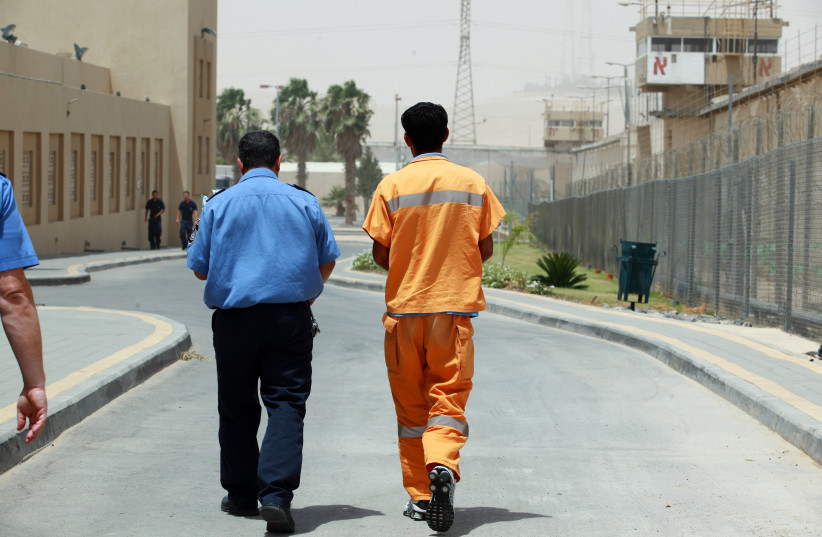
One example of this discipline is the requirement to walk between designated lines when moving in groups to work, educational, or social activities.
These gatherings take place in shared spaces, such as recreation rooms or dining halls.
No longer prison guards: The changing role of correctional officers
The prison dining hall is air-conditioned, orderly, and relatively pleasant. It also includes a kitchen and food storage facilities, such as refrigerators.
Some inmates are permitted to keep appliances, including televisions and radios, in their cells.
Those responsible for the prison departments and wings are now called correctional officers, rather than prison guards.
"There is a difference between what the Israel Prison Service looked like three years ago and what it looks like now," explained IPS Southern District commander Commissioner Yuval Erlich, 46, who has held the position for nine months.
Erlich is deeply committed to the organization's transformation.
"I joined the organization in 2007. I served as a team commander in the Nahshon Unit, was commander of Tzalmon Prison, head of the Training Division and a district operations officer before I came to command the district."
IPS personnel now wear their uniforms with undisguised pride, and their ranks include many female correctional officers.
Raymond reinforced his remarks.
"There has recently been a significant increase in the number of women joining this role," she said.
Erlich went on to describe changes to the equipment and protective gear used by correctional officers, as well as the risks of the work.
"The officers have received advanced operational and protective equipment, such as Taser stun guns, which every officer is equipped with. They are better trained to engage directly when necessary and to enforce authority and discipline.
"It is important to remember and understand that, unlike a combat soldier or police officer who disengages after participating in operations, a correctional officer lives alongside the prisoners and remains close to them.
"He looks the most brutal terrorists directly in the eyes. He is in constant contact with dangerous criminals, including those who would not hesitate to harm him and, if they knew who he was, even his family."
In recent years, under National Security Minister Itamar Ben-Gvir and IPS Commissioner Kobi Yaakobi, the Israel Prison Service has undergone major organizational changes.
Advanced operational divisions have been established to facilitate the management of prisoners while maintaining inmate security and providing support to outside agencies responsible for public safety.
Advanced technological systems have also been introduced, enabling continuous monitoring of activities inside prison wings and facilities, as well as their effects beyond prison walls.
These efforts include more effective and closely monitored measures to prevent prisoners from directing terrorist and criminal activities from behind bars.
"Simply putting a criminal behind bars is not enough. If he directs crime or terrorism while incarcerated, that must be stopped, and discipline must be enforced," Erlich said.
"If we do not ensure that leaders of criminal organizations or prisoners incarcerated for domestic violence receive treatment and are subject to disciplinary enforcement, and the prisoner continues threatening his partner or children, we have accomplished nothing.
"To a large extent, these activities reflect the broader responsibilities of the service as a partner in ensuring public safety."
Senior IPS officials described cases in which they monitored intelligence gathered inside prisons and passed it to the relevant authorities, saving numerous lives.
Concrete walls, a new women's prison and the fight against organized crime
The adjoining prison complex, which includes Eshel Prison, Dekel Prison and the Oz detention facilities, is expected to undergo two additional major changes.
Under instructions from the IPS commissioner, a reinforced concrete perimeter wall approximately four kilometers long and three meters high will be built around the complex.
Electronic identification and sensor systems will be installed along the wall to detect attempts to enter or leave the compound.
To prepare for the project, Bedouin residents living in tent encampments and makeshift tin structures immediately adjacent to the prison complex have been removed from the surrounding area.
In addition, under instructions from IPS Commissioner Kobi Yaakobi, a new women's prison, Neve Tirza, will be established within the complex.
To prevent criminal organizations from establishing themselves inside prison wings, IPS commanders continually transfer criminals between facilities within the district and elsewhere.
These transfers primarily involve the heads of criminal organizations, including figures associated with the Zaguri and Latif organizations, who have been imprisoned for several years.
The aim is to prevent them from creating areas of control within the prison system.
Erlich, who is married with three children and lives with his family in northern Israel, is also responsible for improving and expanding the district's prison facilities.
"Kfir Saharonim Prison will be rebuilt and brought back into service after Neve Tirza is constructed," he said.
He added: "This is intended to improve the living conditions of prisoners, who will have more spacious living quarters, and also those of service personnel, for whom prison buildings serve as a living environment for extended periods."
The IPS has also changed inmates' living conditions.
Prisoners classified as security inmates now live under significantly stricter and more restrictive conditions.
They remain in their cells for 23 hours a day and are permitted to leave for just one hour of exercise daily.
They receive food in accordance with legal requirements, while services and privileges such as family visits, the ability to organize under an established leadership structure, the appointment of a spokesperson, and the use of communal dining halls have been eliminated.
Meals are eaten inside their cells.
Criminal prisoners and inmates in other categories, meanwhile, may purchase products from the prison commissary, receive visitors, and participate in the educational system described earlier.
They are also offered opportunities to further their education or acquire professional skills.
Additional measures have focused on activities originating inside prisons that affect the outside world, as well as extensive improvements to the working conditions of correctional officers.
For example, mechanisms have been examined and introduced to prevent various forms of celebration upon release.
Procedures for bringing equipment into prisons have been reorganized, and the systems used to communicate with family members and others have been improved.
"Correctional officers have advanced, modern tactical equipment and accessories," Erlich explained.
"Additional weapons have been introduced, and officers have been authorized to cover their faces during various operations inside cells and to remove their name tags.
"All of this is intended to improve our ability to maintain control and enforce discipline in the cells and prison wings."
And what about inmates R. and A.?
They will continue waiting for their release, one for a relatively short period and the other for a
longer one.
In the meantime, they are learning to adapt to the new, effective, and beneficial behavioral modification requirements.
KioskNews shows a cleaned-up reading view extracted from the publisher’s page — the original always lives on their site, not ours.