Rare glob-eyed fish spotted in ocean’s twilight zone
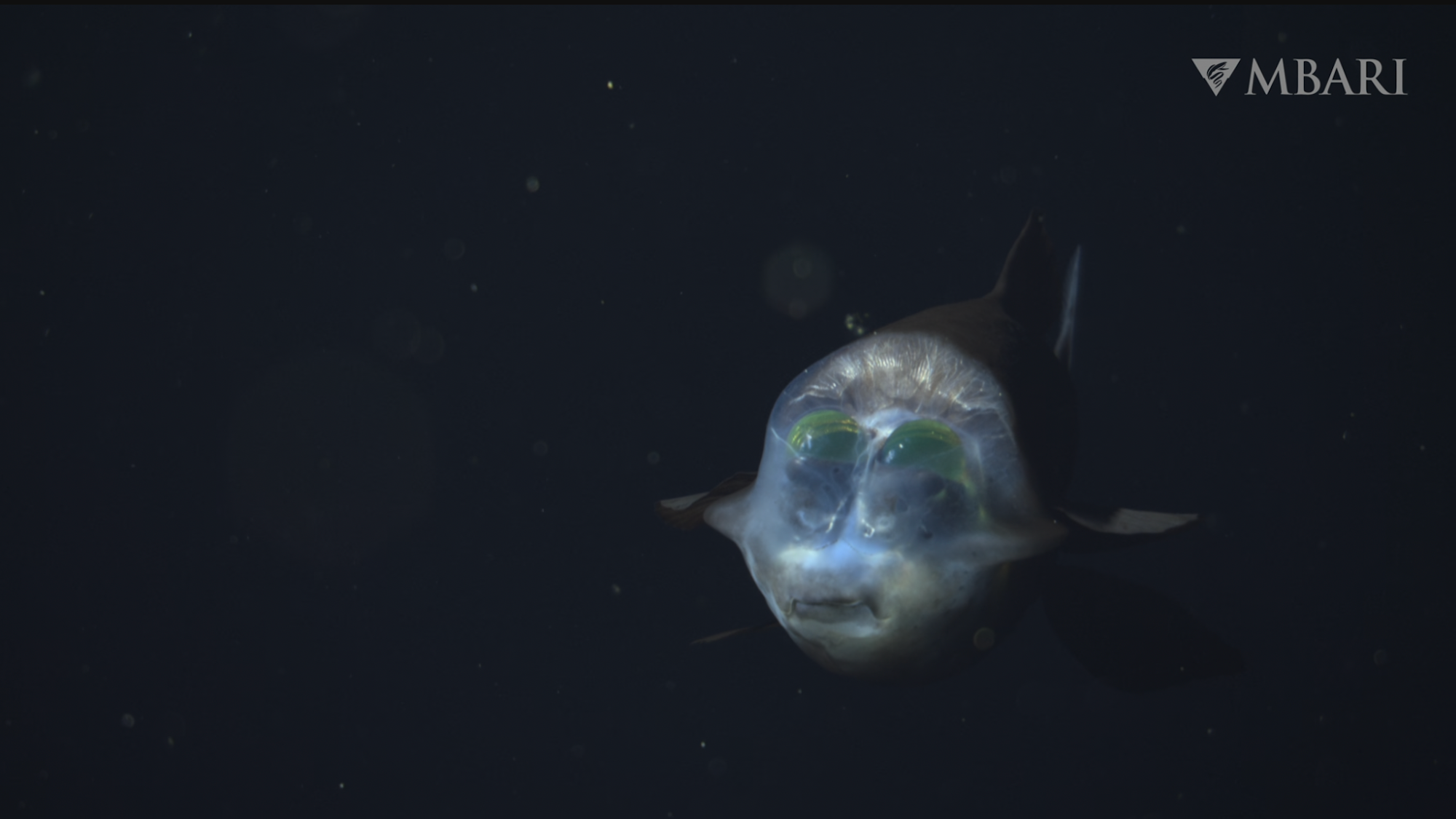
Few deep-sea species will cause an entire research vessel’s crew to rush into the control room to catch a glimpse—but the barreleye fish (Macropinna microstoma) is one of them. During the Monterey Bay Aquarium Research Institute’s (MBARI) recent eight-day Diving Deep for Delicate Drifters expedition, oceanographers aboard the David Packard were reunited with one of these rare, surreal creatures for the first time in nearly five years. This time, they successfully recorded the ethereal fish using a high-resolution 4K camera attached to Doc Ricketts, the ship’s remotely operated vehicle (ROV).
“Seeing a barreleye fish is a rare treat,” Steven Haddock, a MBARI senior scientist, said in the institute’s announcement. “Crew from across the ship joined the science team in the control room, mesmerized by this remarkable animal.”

MBARI researchers film rarely seen deep-sea barreleye fish in 4K
M. microstoma swims through the ocean’s twilight zone, a dim region around 2,000 feet deep in the water column. “Swims” may be a bit generous, however. The barreleye fish spends most of its time drifting in place, while using its large fins to maintain stability. Acute vision is pointless in the near-dark water, so M. microstoma evolved a truly unique set of eyes. The tubular organs roll back far enough to gaze upwards through transparent tissue in its head to hunt for prey. Subtle shadows alert the fish to a target, at which point its eyes rotate forward so it can pursue the potential meal.
Biologists are also fascinated by M. microstoma eyes’ green lenses, which resemble those of the strawberry squid (Histioteuthis heteropsis). Researchers theorize the pigment allows the fish to spot bioluminescence, giving it an additional tool to maneuver through the murky depths.
MBARI marine biologists have conducted around 7,000 ROV dives over almost 40 years of ocean surveys. In the process, they’ve amassed more than 41,000 hours of video footage.. Researchers have only spotted 11 barreleye fish in all that time, and their most recent encounter occurred in 2021.
“[The barreleye fish] reminds us of the surprising ways that animals have adapted to thrive in the ocean’s midwater,” added Haddock. “So many of them survive by looking for subtle optical cues…pitting bioluminescent camouflage against increasingly sophisticated visual capabilities.”
KioskNews shows a cleaned-up reading view extracted from the publisher’s page — the original always lives on their site, not ours.