Jack Dempsey v Gene Tunney at 100: when a great champion met his greatest inquisitor
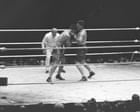
The two fights between Jack Dempsey and Gene Tunney rank with boxing’s most-storied championship bouts and are among the greatest sports spectacles ever seen in America. Wednesday marks the one hundredth anniversary of their first encounter.
Dempsey bridged boxing’s old and modern eras and was one of the most charismatic fighters in history. When Dempsey was young, biographer Randy Roberts recounts, “he lived in mining camps and hobo jungles, rode the rods, and more than once begged for food. What separated him was his willingness, even eagerness, to work. He accepted any type of employment from washing dishes, cutting lawns, and scrubbing floors to the harder work of coal-mining, digging ditches, and picking fruit.”
Dempsey had his own thoughts on his origin story: “I was a hobo,” Dempsey said. “But I was never a bum.”
Fighting under the name “Kid Blackie”, Dempsey had roughly 100 fights in Colorado, Utah, and Nevada from 1911, when he turned 16, through 1914.
“When you’re fighting, you’re fighting for one thing,” he later recalled. “To get money. When I was a young fellow, I was knocked down plenty. I wanted to stay down. I couldn’t. I had to collect that $2 for winning or go hungry. I had one fight when I was knocked down 11 times before I got up to win. I had to get up. I was a hungry fighter. When you haven’t eaten for two days, you’ll understand.”
In the ring, Dempsey attacked with unrelenting ferocity. Trainer Ray Arcel likened him to “a saloon fighter” and observed, “With Dempsey, every part of your body was a legal target.”
Sportswriter Paul Gallico echoed that theme, writing, “Dempsey seemed to have a constant bottomless well of cold fury somewhere close to his throat. He had tremendous courage, speed and determination, and good hitting powers. He was never a good boxer and had little or no defense. His protection was aggression. Dempsey never boxed anybody. When the bell rang, he ran out and began to attack his opponent, and he never stopped attacking him, trying to batter him to the floor until the bell ended the round. He had a smoldering truculence on his face and hatred in his eyes. He was utterly without mercy or pity, asked no quarter, gave none.”
Dempsey said: “To be a good fighter, you have to have three things. You’ve got to be able to give it. You’ve got to be able to take it. And you’ve got to have a fighting heart.”
Boxing was at low tide as America neared the “Roaring Twenties”. There hadn’t been a popular heavyweight champion since James Jeffries retired in 1904. Moral “reformers” were attacking the sport as sinful. And their efforts to abolish boxing gathered steam after Jack Johnson emerged as champion in 1908.
On 5 April 1915, Jess Willard defeated Johnson in Havana. The new champion was poised for stardom. But after winning the title, Willard went on tour with Buffalo Bill’s Wild West Show and other theatrical companies, and defended his title only once in four years.
Finally, in 1919, Tex Rickard, America’s premier boxing promoter, lured Willard back to the ring with a $100,000 guarantee to fight Dempsey in Toledo, Ohio on 4 July. It was the first major outdoor prizefight in the United States since Jeffries had come out of retirement and been battered into submission by Johnson on 4 July 1910. Willard weighed 245 lbs; Dempsey just 187. After three rounds, Willard’s jaw and nose were broken. Six teeth had been knocked out. There were cuts above and below his eyes. He could fight no more. Jack Dempsey was heavyweight champion of the world.
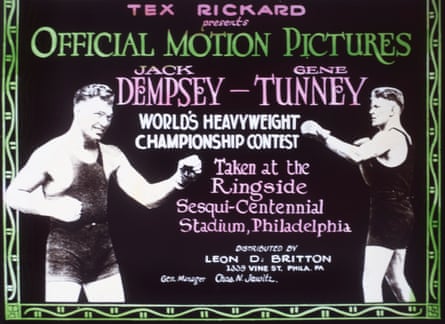
Rickard wanted to make boxing a respectable sport that appealed to all classes. Dempsey’s exciting fighting style and charisma made him an ideal instrument to achieve that goal. Meanwhile, more and more states were legalizing boxing, and religious reform movements had begun to weaken. Dempsey versus Georges Carpentier followed and brought the sweet science to new heights.
Dempsey-Carpentier was contested on 2 July 1921, in a temporary arena at Boyle’s Thirty Acres on the outskirts of Jersey City. More than 80,000 spectators (the largest crowd to witness a sporting event in America up until that time) attended. The live gate was $1,789,238 (more than double the previous record for a fight and equivalent to more than $32.5m today). The fight was also the first world championship bout to be broadcast live on radio, blow-by-blow.
Carpentier was hailed as a man of destiny, not just in his French homeland but throughout Europe. He was the reigning world light-heavyweight champion. But more important to his image, he’d served in the military as a pilot during the first world war and been decorated twice for heroism. He was handsome, graceful, intelligent, debonair, spoke reasonably good English, and was regarded by many as the most glamorous fighter ever to step into a boxing ring.
Dempsey was viewed as Carpentier’s opposite. He’d been indicted and tried (although acquitted) of fraudulently evading the draft during war. “He was dark complexioned,” Roberts notes. “His beard was course; his eyebrows were thick; and his face seemed cast in a permanent iron scowl. In the latter part of his career, Dempsey’s reserve in public would be recognized for what it was; basic shyness. But in 1921, his reserve and awkwardness around people were interpreted as the characteristics of a mean conceited man.”
In other words, Dempsey-Carpentier was hero versus villain with the foreigner in the preferred role. “The Frenchman was the hero,” Dempsey later said. “I was the flat-nosed bum.”
“The Fight of the Century” captured attention worldwide. On the morning of the bout, legendary sportswriter Grantland Rice wrote, “The greatest single day in the ancient history of an ancient sport has come at last; a day that has caught the imagination of more people from crowded centers to remote off-lying places than any single contest since the world’s dim dawn.”
Vanderbilts, Rockefellers, Whitneys, and Astors were seated at ringside. The United States Senate and House of Representatives had adjourned in anticipation of the event because 12 senators and 90 congressmen had tickets. The fight was also attended by a significant number of women. Ladies had been present at Willard-Dempsey but were confined to a special section. At Dempsey-Carpentier, they mingled freely with the men.
As was the custom of the day, the champion was introduced first.
Dempsey later recalled, “Joe Humphreys picked up his megaphone and bawled, ‘In this corner, weighing 188lbs, from Salt Lake City, Utah, the heavyweight champion of the world, Jack Dempsey.’ The only response from 80,000 Americans was a little applause and a low murmur. ‘And in this corner, weighing 172lbs, the challenger from Paris, France, Georges Carpentier.’ The people went wild. It was deafening. It hurt; believe me.”
The bell for round one rang at 3.16pm. At 3.30, it was over.
“Carpentier had more charm, more good manners, and more class in his dress than anybody I had ever met,” Dempsey said years later. “But it was probably the worst mismatch in the history of the heavyweight division.”
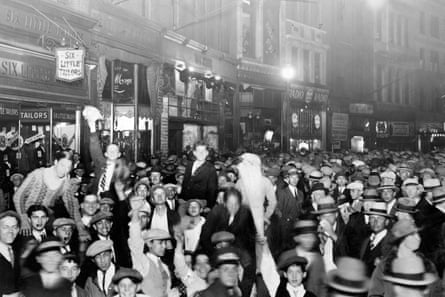
The New York Times devoted multiple pages to the fight and announced the result with a large-type, three-line headline that ran the full width of page one.
“I read the stories about the fight in the next day’s papers,” Dempsey said later. “Carpentier was the hero of the hour. Never before had anybody seen such courage. I was just a butcher who happened to win. I was a pretty bitter fellow. No matter what you’ve got, you want them to like you.”
Dempsey v Luis Firpo – Argentina’s “Wild Bull of The Pampas” – was the next building block for the Dempsey legend. On 14 September 1923, more than 88,000 fans filled the Polo Grounds in New York. An estimated 35,000 more were turned away. Once again, America’s blue-blood aristocracy was at ringside, joined this time by Babe Ruth.
Ten seconds into round one, a left uppercut from Firpo dropped Dempsey to his knees. The champion rose and floored Firpo seven times. Then Firpo launched a series of blows punctuated by a monstrous right hand that knocked Dempsey out of the ring. That moment, recreated on canvas by artist George Bellows, is one of the most famous sports images of all time. Dempsey landed in the press section; cut his lower back on a typewriter; and with the aid of one or more writers, was pushed back into the ring before the count of 10.
“It was pitch dark for a few seconds,” he said later. “Then I managed to focus on Firpo’s fuzzy form. I don’t remember climbing back in the ring, but I remember seeing 20 Firpos standing in front of me.”
In round two, Dempsey knocked Firpo down twice more. The Argentinian was counted out at 57 seconds of the round.
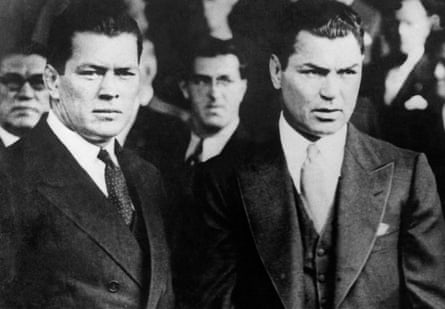
Then, like Willard before him, Dempsey put the title on ice, refusing to fight for three years. Finally, on 23 September 1926, he returned to the ring against Gene Tunney.
Tunney was a brilliant tactician. The only defeat in his 67-bout career was a loss by decision to the great Harry Greb, who he fought five times. As a young man, Tunney had knocked out Soldier Jones on the undercard of Dempsey v Carpentier. Then, instead of going to his dressing room, he’d stayed at ringside and, still in his robe, watched the main event. Over the years, he’d studied films of Dempsey countless times.
Tunney was complicated. He hadn’t graduated from high school but read prolifically as a road to self-improvement. That led to ridicule by some members of the press who treated his interest in books as a joke. During the build-up to Dempsey-Tunney, Paul Gallico wrote, “I think Tunney has hurt his own game with his cultural nonsense. It is a fine thing that he has educated himself to the point where he no longer says ‘dese’ and ‘dem’ and ‘dose’ and where he can tell one book from another and indicate some familiarity with their contents. But the man who steps into the ring with Dempsey with nothing but his hands as weapons needs to be a fighter and nothing but. He will have to have a natural viciousness and nastiness well up in him that will transcend rules and reason, that will make him want to commit murder with his two hands. I don’t think that Master Tunney, who likes first editions and works of art, has it in him.”
That earned a rejoinder from Tunney, who declared, “It never occurred to me that a habit of reading could be seen as a stunt or a joke. Wasn’t reading something we wanted to champion?”
A staggering total of 120,757 fans jammed Sesquicentennial Stadium in Philadelphia to witness Tunney challenge Dempsey for the heavyweight crown. That number and the $1,895,733 they paid in gate receipts (more than $36m in today’s dollars) were records for the time. An estimated 39 million more people listened to the fight on radio.
The bout was scheduled for 10 rounds; a distance approved by both the champion, who was giving away youth, and the challenger, who thought that 10 rounds with Dempsey would be enough. At 29, Tunney was only two years younger than the champion. But Dempsey had lived a hard life. His body had absorbed the blows of hundreds of fights. And he’d been out of the ring for three years. It was a classic confrontation between a puncher who was past his prime and a boxer who was in it.
“From the time the bout started,” Dempsey acknowledged later, “I was aware that my body and brain weren’t communicating properly. I was slower than I thought, or Gene was faster. He glided around the ring like he was on ice. Wherever I went looking for him, he stuck that left of his in my face, keeping me off balance, piling up points. Now and then, he’d stop me with a stiff right. There seemed to be nothing I could do, though I tried. Tunney was so scientific a boxer that all I seemed to be able to do was to take his punishment.”
Tunney won every round. He cut Dempsey over the right eye and jabbed his left eye shut. By the end of the bout, the champion’s jaw was swollen and he was bleeding from the mouth.
“I have no alibis to offer,” Dempsey said. “I lost to a good man.” Years later, he reflected back on that night and noted, “It’s sad to hear the fellow with the microphone yell: ‘The winner and new heavyweight champion of the world’ when you’re the old one.”
But there was another memory of that day that the fallen champion carried with him. Late in life, he reminisced, “I was booed when I fought Willard, though he seemed twice my size. I fought a Frenchman before an American audience and was booed. I fought an Argentinian before my countrymen, and I was booed. It always dug deep and hurt terribly. But when I started to leave the ring [after losing to Tunney], something happened that had never happened to me before. To my surprise, I was loudly cheered; more than I had ever been cheered before. The people were cheering for me, clapping for me, calling out my name. I never realized how much I had hungered for a sound like that.”
One year later, Dempsey and Tunney fought again. Tunney-Dempsey II unfolded before 104,843 fans at Soldiers Field in Chicago and generated boxing’s first $2m gate (the total was $2.7m). That encounter, which Tunney also won by decision, is best remembered for the “long count” controversy when referee Dave Barry refused to start counting until Dempsey went to a neutral corner after knocking Tunney down in round seven (the only time in Tunney’s career that he was on the canvas).
But that’s a story for next September.
-
Thomas Hauser’s email address is thomashauserwriter@gmail.com. His most recent book – a classic detective tale titled Sherlock Holmes and Mrs Rutledge – is available now. In 2019, Hauser was selected for boxing’s highest honor – induction into the International Boxing Hall of Fame.
KioskNews shows a cleaned-up reading view extracted from the publisher’s page — the original always lives on their site, not ours.