Ministry freezes electricity rates until December meet
MOUNTING PRESSURE: Taipower has accumulated losses of more than NT$400 billion, as it has been absorbing rising global oil prices for the past few years
By Meryl Kao / Staff reporter


The Ministry of Economic Affairs yesterday said it would delay setting new electricity rates until its meeting in December, in a bid to help curb increases in consumer prices.
Taiwan Power Co (Taipower, 台電) proposed raising electricity rates by about 12.83 percent to NT$4.2675 per kilowatt-hour, reflecting increases in energy costs, Deputy Minister of Economic Affairs Lai Chien-hsin (賴建信) told a news conference after wrapping up the electricity price review committee’s meeting.
The average electricity rate would remain unchanged at NT$3.78 per kilowatt-hour from next month until the next review, Lai said.
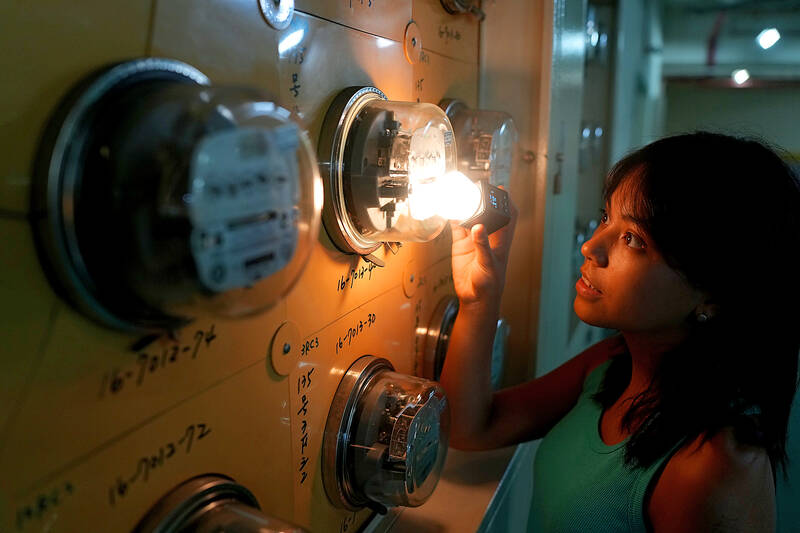
A woman checks electricity meters at an apartment in Taipei yesterday.
Photo: CNA
Seeking a Cabinet-backed subsidy of NT$71.1 billion (US$2.24 billion) to help Taipower absorb the fuel price surges from March through last month would be the ministry’s priority, Lai said.
Taipower is expected to lose NT$71.1 billion this year, he said, adding that the company could have been profitable this year, if the Middle East conflict did not occur.
Taipower posted a profit of NT$76.1 billion last year, giving it some leeway to absorb the electricity rate freeze, Taipower president Kuo Tien-ho (郭天合) said.
“As neighboring countries have relied on supplementary budgets and subsidies to mitigate the impact from the Middle East conflict, the committee decided to support to seek government funding first to ease Taipower’s financial burden,” Lai said.
The NT$71.1 billion subsidy, if approved by the legislature, would significantly improve Taipower’s financial situation and help ease the pressure for further electricity rate hikes, Lai added.
Taipower is facing mounting financial pressure, as it has accumulated losses of more than NT$400 billion due to absorbing high global crude oil prices instead of passing costs to consumers for the past few years, Kuo said.
Taipower lost NT$21.4 billion in the first seven months of this year, bringing its accumulated losses to NT$372.2 billion, he added.
General Chamber of Commerce of the Republic of China chairman Paul Hsu (許舒博), a member of the electricity price review committee, said he did not support a blanket freeze on electricity rates.
“We hope electricity rates can be frozen for households and small and medium-sized traditional industries, while high-tech industries should see moderate [price] adjustment,” Hsu said.
A mild increase would have a relatively limited effect on high-tech companies, Hsu added.
The committee discussed the possibility of hiking electricity rates for heavy power users such as artificial intelligence (AI) data centers and semiconductor companies, but no consensus was reached, Lai said.
Increases in electricity demand from AI and semiconductor companies should not push up rates for all users, he said.
However, electricity pricing cannot predetermine that specific industries should bear the additional costs, he added.
Industries’ electricity use patterns, growth prospects, international competitiveness and the impact on consumer prices would be reviewed by a working group and discussed further in December, he said.
KioskNews shows a cleaned-up reading view extracted from the publisher’s page — the original always lives on their site, not ours.