Flags not permitted on Gordie Howe Bridge’s shared-use path
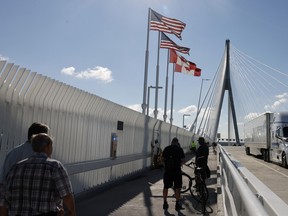
At about the midway point of the new Gordie Howe Bridge, four flags fly over the multi-use path — two Canadian and two U.S. — marking the international boundary. But under the bridge’s rules, pedestrians, cyclists and other users of the three-kilometre crossing aren’t permitted to display a flag.
Sign In or Create an Account
The prohibition against “displaying, distributing or attaching” flags enacted by the Windsor-Detroit Bridge Authority also extends to signs and banners.
It’s not immediately clear if it includes flags on or worn as clothing, or affixed to bicycles or other modes of conveyance permitted on the crossing over the Detroit River connecting Canada and the U.S.

Get a dash of perspective along with the trending news of the day in a very readable format.
By signing up you consent to receive the above newsletter from Postmedia Network Inc.
A welcome email is on its way. If you don't see it, please check your junk folder.
The next issue of NP Posted will soon be in your inbox.
We encountered an issue signing you up. Please try again
National Post has contacted the WDBA for comment and more information.
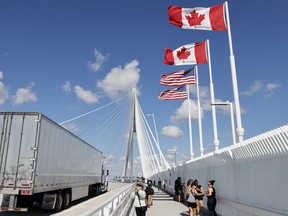
Other forbidden actions include trespassing, loitering or gathering — including unlawful assemblies, protests or actions that disturb the peace — and impeding or obstructing the flow of cycling, pedestrian or vehicular traffic. Users cannot deploy drones or other unmanned devices from the path, nor can they use speakers or other loud and disruptive devices.
It’s also against the rules to engage in “violent, threatening or illegal behaviour,” or tamper with or damage property, equipment or safety devices.
The path attracted 3,400 users on its first day, Aug. 5, the Windsor Star reported at the time. The bridge itself opened nine days earlier on July 27.
Both were delayed this summer when U.S. President Donald Trump and his administration blocked the opening and complained that the agreement with the Canadian government was unfair. Canada footed the $6.4 billion construction cost under a revenue-sharing agreement with Michigan that would see Canada repaid before splitting the toll.
Negotiations with the White House led to an agreement dictating that Canada will give the U.S. 50 per cent of net revenues for the first 15 years, after recovering operating costs. The U.S. share will go into a United States-Canada Economic Development Fund under its control.
In a new rule change, certain e-bikes are now permitted to use the path, provided “the electric motor provides power only when the rider is actively pedalling,” and the throttle caps out at 32 km/h, as reported by the Windsor Star last month.
The WBDA’s max recommended speed for the path, however, is 20 km/h.
“This is not a race,” WBDA notes online. “Enjoy your trip across the bridge at a low speed.”
Also not permitted on the 3.6-metre-wide paved path are electric scooters, electric and regular skateboards, segways, hoverboards, one-wheel devices, rollerskates, in-line skates and similar devices.
Starting Nov. 1, the bridge will revert to winter hours, 8 a.m. to 4 p.m., with no entry after 3 p.m. “to allow users to complete their journey within the hours of operation.” The WBDA estimates a one-way crossing at 45 minutes on foot and 20 minutes by bike, but notes that “border processing times are not included in these estimates and may add to the total length of time.”
Regular hours (8 a.m. to 8 p.m.) resume on April 1, 2027.
Travellers from Canada and the U.S. are advised to bring their cross-border travel documents — a passport or Nexus card — along with those of any minors in their company. Individuals can go halfway across, but they must still return through Canadian or American customs officials.
Our website is the place for the latest breaking news, exclusive scoops, longreads and provocative commentary. Please bookmark nationalpost.com and sign up for our newsletters here.
Join the Conversation
This website uses cookies to personalize your content (including ads), and allows us to analyze our traffic. Read more about cookies here. By continuing to use our site, you agree to our Terms of Use and Privacy Policy.
KioskNews shows a cleaned-up reading view extracted from the publisher’s page — the original always lives on their site, not ours.