AFTER THE BELL: How long will King Coal continue to glitter?
Despite growing up in a country that really depended on coal I had no idea of how important it was in my life.
We moved from Cape Town to Johannesburg just in time for the 1985 school year, which meant that the year after that was dominated by the celebrations of Joburg’s centenary.
And so I learnt all about the gold industry, how important it was, how it created so much for our economy and how nearly half of all the gold mined by humans had come from this place that my family had just moved to.
And, would you believe, at one point I even got to join the miners as part of a school outing to the then brand new Gold Reef City.
I don’t know if teachers would be allowed to take so many minor miners underground now, but I seem to remember that fiddling with the light on my hard hat was probably the best part.
And yet, I only realised how important coal was to my life when too much coal got too wet back in the wet summer of 2007 and 2008.
Those raindrops, that fell so coldly on my head in the mud of the ANC’s Polokwane Conference that year led to load shedding and all that followed.
Now, all we seem to talk about is how quickly we need to move away from using coal.
The numbers speak for themselves, you can’t really argue against the economic case for it; renewable power, once installed, relies on solar and wind which you don’t have to pay for. Coal has to be mined and transported, sometimes for thousands of kilometres.
And yet the scale of our coal mining industry is staggering.
This morning Exxaro Resources reported its revenue was up 7% to R22-billion. Its Ebitda was R5.6-billion, while it sold nearly twenty million tonnes of coal.
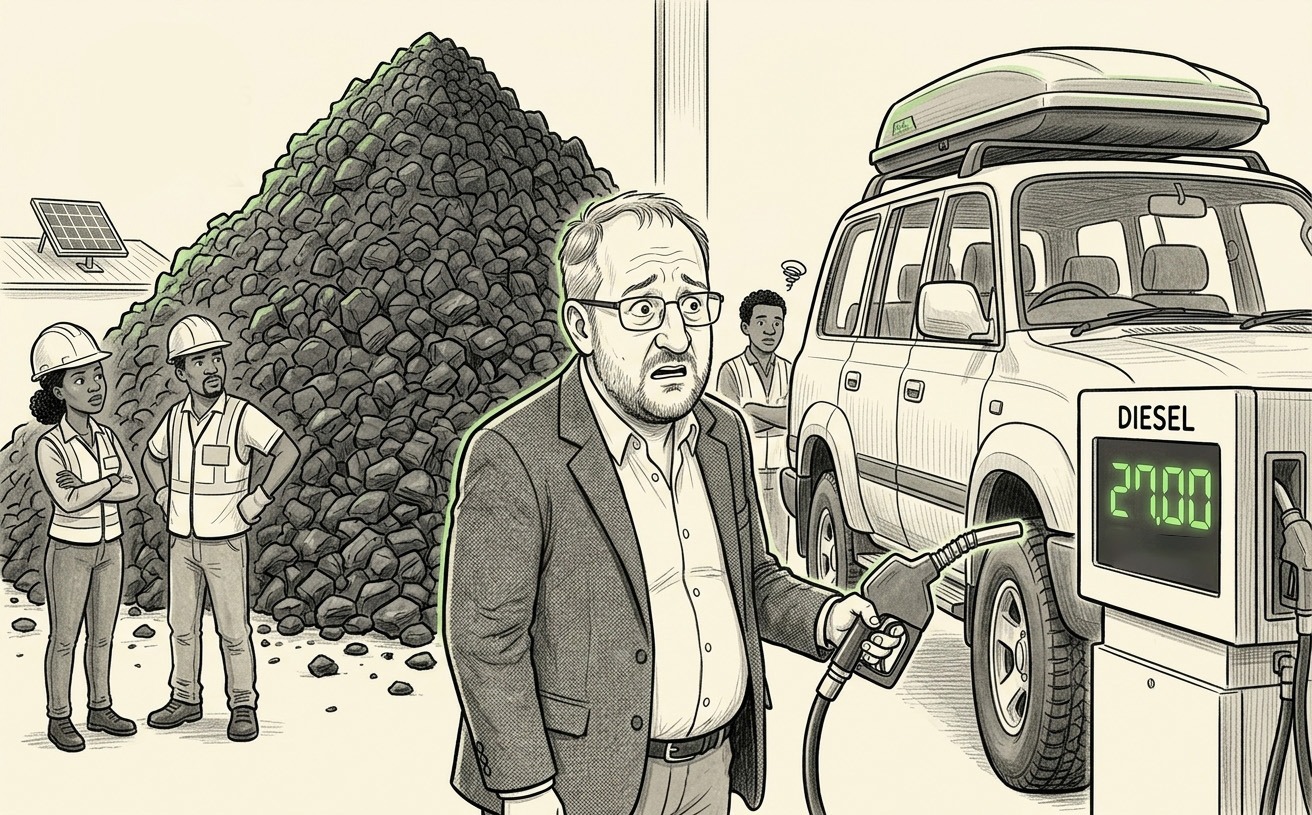
The numbers are hard to comprehend, they produce literally mountains of coal.
And there is so much of the stuff under our ground. Some estimates suggest we have about 6% of the world’s total coal deposits.
You might think: “So what, I have solar?”
But the sheer energy it contains, its “calorific value” to use a phrase I’ll have to look up later, makes it hard to really live without.
Sure, the transition is one way. But only over a long period of time. International coal prices have ebbed and flowed significantly over the past couple of years.
You may remember, back when Transnet looked entirely hopeless and trucks seemed to block every route to Richards Bay and Maputo, how difficult that time was.
It was all because coal prices had risen dramatically, driven by stronger international demand.
That was just three years ago, long after everyone had started their company reports with how they were becoming “carbon neutral”.
And this is the problem for the people who run companies like Thungela and Exxaro. They have huge amounts of capital invested in operations that are generating a return, they employ thousands of people and yet they know this will not go on forever.
One of the biggest factors in all of this is probably our government.
It has to draft an energy policy that will last for generations, not knowing exactly how the energy transition will play out.
I think this tension might be at the heart of the big Supreme Court of Appeal case this week, where the government appealed against an earlier ruling that essentially said Eskom would not be allowed to build any more coal-fired power stations.
I can understand the sentiments of the activists who have brought this case. They see the transition as just one way. And they also believe coal is incredibly harmful for them.
That I can see. If you spend any time at all on that stretch of the N4 that runs past so many of our power stations, you can see the impact that smoke must have on the people who live there.
And while I don’t have any brief for the government, I think it might be hard to accept that this one option of generating power would be closed to you forever.
I don’t think for a second there is a case for building a new coal-fired power station now. The private sector, Eskom and the government as a whole are all investing in too much renewable power for that to be feasible.
But, as Roxette once told us, never is a long time. If I were arguing for the government I would simply say I cannot predict the future and we need to keep our options open.
Especially when the weather is as variable and as extreme as it is becoming.
Exxaro is doing exactly that; its renewables energy business seems to be growing nicely and it’s obviously planning for the longer term.
Despite the huge amount of gold taken from the Witwatersrand basin, about as much remains underground.
I suspect, if gold prices stay at these levels, that there will be a great incentive to innovate enough to get more of it out of the Earth.
But that won’t happen for coal. Most of the huge resource that is left will probably stay where it is. DM
KioskNews shows a cleaned-up reading view extracted from the publisher’s page — the original always lives on their site, not ours.