Breaking down to build again: Andrey Rublev's bid to reinvent himself
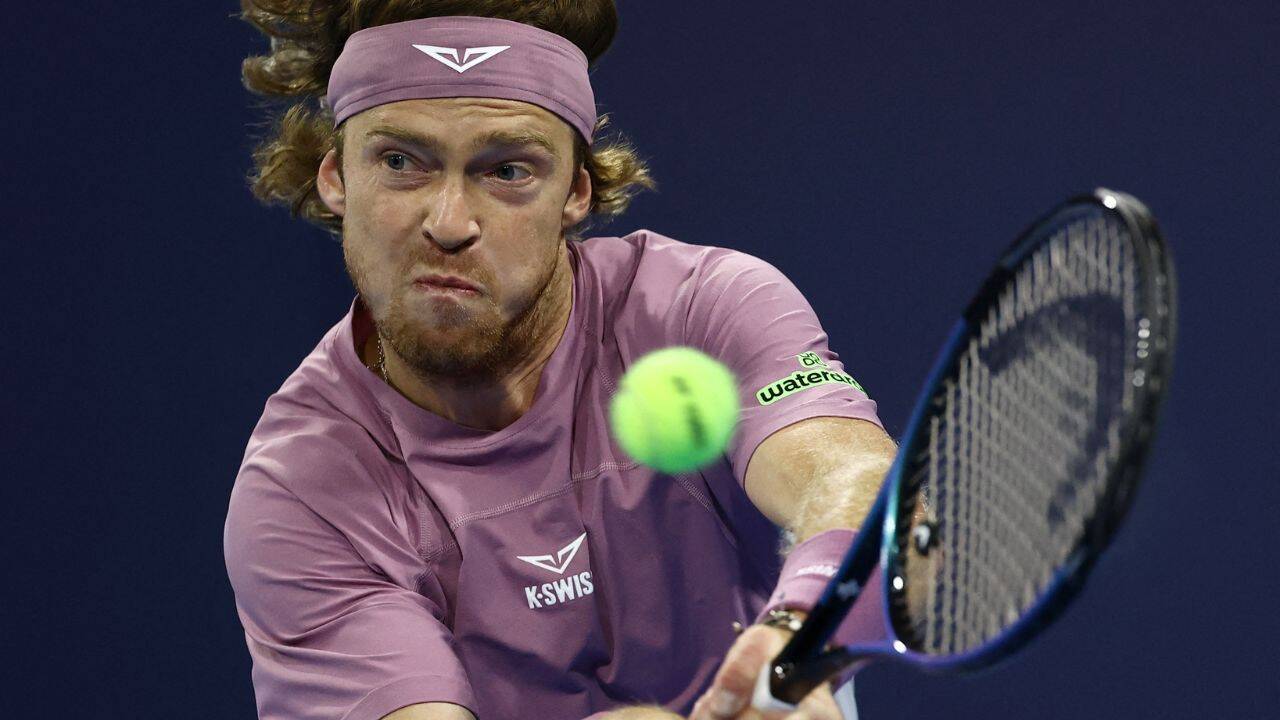

Andrey Rublev
Andrey Rublev has spent much of his career trying to get better at being Andrey Rublev. Now, the mercurial Russian, whose on-court meltdowns are almost as well chronicled as his title wins, is attempting to rewrite the script that took him to world No.
5. At 28, he is trying to become a different player.Rublev has slipped to No. 23, falling outside the top 20 for the first time since January 2020 six weeks ago. For a player who finished inside the top 10 between 2020 and 2024, for five consecutive seasons, and reached 10 Grand Slam quarter-finals, the decline is striking. Yet, after 36 main-draw appearances at the majors without advancing beyond the last eight, Rublev has come to a realisation, to build something new, he must first be willing to break down what got him here.“It's not easy to change something that you know for all your life,” said Rublev, the No.4 seed at the Almaty Open, an ATP 250 event. “It’s not easy to switch that, what brought you to No.5 in the world for something else that you don't really trust yet.”The forehand, Rublev’s biggest weapon, is a useful example. It’s a shot he could turn to under pressure almost without thinking. But the instincts that once served him so well can also become constraints when he is trying to expand his game.
“I’m trying to change, on and off the court, mentally, things that have become a habit, that have already taken me to the limit, with what I could do with that,” he says, eyes fixed on the table before him. “Now, it's the second part of (my) career where I try to do something different completely.”There is no guarantee the experiment will work. Rublev knows that as well as anyone.“Maybe it's going to make the second part of my career better than my first part, or maybe not,” he says, lifting his gaze and looking straight at the interviewer.
“But at least I know I did something, I gave myself a chance.”“With the game I used to have, it will go down little by little until I cannot play anymore,” he says. “To be just top 30 for the next five-six years, for me, it makes no difference.”For the past 18 months, Rublev has been working with former world No. 1 Marat Safin, a partnership that pushed the 28-year-old to address mental and emotional struggles that has seen him harm himself physically on the court.Asked what has changed most since working with Safin, Rublev does not begin with tactics or results.“I'm enjoying much more the life. I'm much more in peace with myself,” he says.It is a striking answer from a player whose intensity has long been one of the defining features of his tennis.
“From the past, before Marat, I was very depressed,” he says. “Taking ... antidepressant pills to don't feel depression.”He pauses, taking a deep breath, before describing how low he had felt.“Basically, it was a bit of drama that was happening to me, and I didn't know how to escape. I was at the bottom of my darkest days.”It was there, he says, that he reached a point at which he could no longer continue as he had been. He faced a choice -- to remain trapped in the same patterns or to try, finally, to do something about them.“I choose to try to fix it,” he said.Rublev is not short of reminders that reinvention is possible.“When you see players like Sasha (Zverev) or Daniil (Medvedev), when they're doing something good, it gives a clear signal that I can do it as well,” he says. “Because I know what I'm capable of. If he can do it, I can find a way as well.”
KioskNews shows a cleaned-up reading view extracted from the publisher’s page — the original always lives on their site, not ours.