China poised to restore military presence to top leadership at party congress
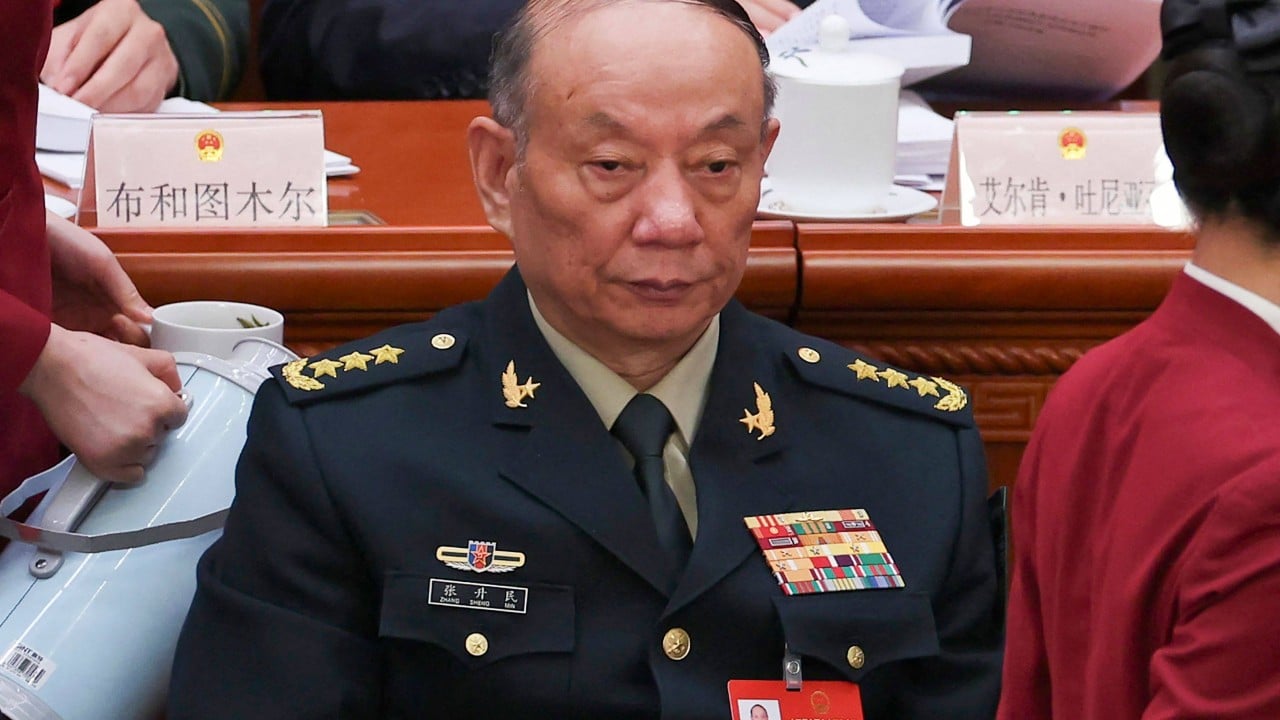
Beijing is expected to gradually restore military representation in its top leadership, analysts say, as the Communist Party seeks to strike a delicate balance in its relations with the People’s Liberation Army (PLA) amid an anti-corruption drive that has hit the top ranks.
They said the process was expected to be completed at next year’s 21st party congress, which will usher in a new leadership line-up for both the party and military.
The move ended an unusual gap in military representation on the Politburo following the expulsion earlier this year of Zhang Youxia, the former vice-chair of the Central Military Commission (CMC).
Since 1997, it has been a party norm to have two military representatives on the decision-making body – namely, the two vice-chairs of the CMC. However, the sweeping anti-corruption drive brought down both officials.
03:00
China’s fifth plenum focuses on discipline and loyalty to Xi
But viewed more broadly, the military leadership is still severely depleted. The anti-corruption drive has snared five of the CMC’s seven members, leaving the party’s supreme military organ with only two formal occupants: Xi Jinping and Zhang Shengmin.
The Central Committee also saw its military representation drastically diminished in the past few years.
This week’s plenum furthered that trend, endorsing disciplinary penalties against 16 more military figures.
With military representation on the Central Committee hollowed out and operational commanders disproportionately affected, Zhang’s interim appointment “solves the immediate procedural deficit of having zero military representatives on the Politburo”, said a Beijing-based party history researcher, who declined to be named.
However, he said a Politburo military delegation composed solely of a disciplinary commissar was “suboptimal” as it created “operational asymmetry”.
While the Politburo typically has two military members, uniformed officials do not usually sit on the Politburo Standing Committee. About 20 per cent of the Central Committee’s roughly 200 full members are from the military.
The Politburo’s two military officers typically include an operational commander and another focused on political work. The researcher said this ensured specialisation, with “internal checks and collective leadership”.
“Neither one can completely dominate the armed forces, ensuring control by the civilian CMC chairman,” he said.
Meanwhile, the Central Committee’s military seats are filled with PLA officers from major service branches, theatre commands and CMC functional departments.
The researcher said the current system struck a balance, limiting the military from gaining too much power in top political bodies, while granting the armed forces institutional access to high-level policy deliberation.
The arrangement has changed over the decades, illustrating the evolution of party-military relations – from the early days after the Communist Party’s revolutionary victory, when almost all party leaders were military officers, to the two fixed seats today.
The researcher said next year’s 21st party congress would bring a “return to institutional equilibrium”, restoring the PLA’s usual representation on the Politburo and Central Committee. He said this was important to realise the PLA’s centenary goal – a key deadline for Beijing’s military modernisation.
“The party regards military modernisation as an integrated and indispensable part of China’s overall modernisation. That has not changed, despite the corruption crackdown,” he added.
A Beijing-based military commentator, who once served in the PLA, said party leaders were widely expected to fill the CMC vacancies through a two-stage process: interim promotions to stabilise core operational departments in the next six months, followed by decisions on the structural reconfiguration at the national party congress.
“In the most likely case that General Zhang Shengmin stays for another term, the party will need to promote another vice-chairman in charge of combat operations, who may rank below him,” said the expert, who declined to be named due to the sensitivity of the matter.
KioskNews shows a cleaned-up reading view extracted from the publisher’s page — the original always lives on their site, not ours.