Recent lobbyist for Palantir had key role in helping Andy Burnham become PM

A recent lobbyist for the controversial $450bn US tech company Palantir played a senior role in helping Andy Burnham become prime minister, it has emerged.
Martha Dalton, whose company Lodestone worked for Palantir in 2024 and 2025, campaigned for Burnham in the Makerfield byelection that secured his return to parliament. She worked closely with his team on strategic communications and rebuttals, and was among supporters who clapped him into Downing Street in July.
Lodestone, which Dalton co-founded, worked for Palantir on projects including promoting its software at events in parliament where its engineers demonstrated AI-powered systems for use in British public services to MPs.
Dalton previously worked on the autumn 2025 deputy leadership campaign for the current education secretary, Lucy Powell, a few months after Lodestone stopped working for Palantir.
Her role emerged as Palantir fights to retain its £330m contract with NHS England to run the federated data platform, a national medical data system.
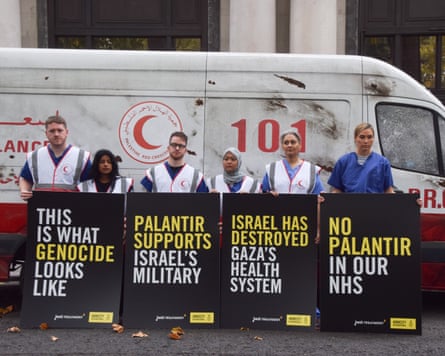
Burnham’s government is under pressure to scrap the deal. Campaigners are angry about Palantir’s work for the Israeli military in Gaza and Donald Trump’s ICE immigration crackdown. They have also raised concerns, acknowledged by NHS England’s chief executive, Jim Mackey, that the benefits to public health may not be as significant as has been claimed.
Lodestone’s work for Palantir and Dalton’s subsequent role with Burnham is the latest link between Labour and the tech firm, which also works for the US and UK militaries and was co-founded by the Trump-supporting tech billionaire Peter Thiel.
The Labour peer Tom Watson took a full-time job lobbying for Palantir earlier this month after a period as a member of Lodestone’s “strategic advisory council”. Palantir previously employed Peter Mandelson’s lobbying firm, Global Counsel, before it collapsed over the former Labour trade secretary’s links to Jeffrey Epstein.
Dalton wrote on her LinkedIn account that it had been “an absolute honour to work on Andy Burnham’s campaign to become Labour leader and prime minister”. She took six weeks’ unpaid leave from Lodestone to spend time in Makerfield “supporting on strategic comms and rebuttals”.
A spokesperson for Lodestone said: “She had no contact with clients during that time and did so because she believes Andy Burnham is the best person to lead the Labour party and the country. Lodestone had previously worked with Palantir on various projects – all focused on helping them to explain their technology to those who rightly hold them to account.”
Health workers who want ministers to scrap Palantir’s NHS deal protested at the Labour party conference in Liverpool on Tuesday. Labour members had earlier tabled a motion calling for the deal to be axed, claiming Palantir was “facing numerous allegations of involvement in serious breaches of human rights”, citing its development of technology for Israel’s military.
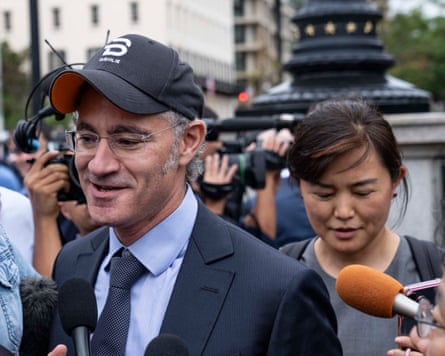
Palantir’s executive vice-president for the UK and Europe, Louis Mosley, has said its technology was used to locate hostages but not to identify military targets in Gaza. That appears to contradict an earlier statement by the firm’s chief executive, Alex Karp, who was challenged last year by a protester alleging “Palantir kills Palestinians” in Gaza. He replied: “Mostly terrorists, that’s true.”
after newsletter promotion
Palantir’s fortunes in the UK are intertwined with the Labour government. A break clause in the NHS England contract looms in February 2027. The Labour mayor of London, Sadiq Khan, is also in a legal battle with Palantir after he blocked the Metropolitan police from awarding it a £50m contract to supply AI tools to assist criminal investigations. The firm also has a £240m contract with the Ministry of Defence and has been selling its services to other police forces and councils.
Mosley recently said that people who don’t recognise the positive impact the firm’s technology has on cutting treatment waiting times and speeding up hospital discharges were suffering from “Palantir derangement syndrome”.
Tom Brake, the chief executive of Unlock Democracy, a not-for-profit campaign group, said candidates should observe Cabinet Office advice on secondments before adding volunteers or secondees to their campaign teams.
“This requires successful secondees to declare relevant outside interests, clarify that potential conflicts will be explored and ensure appropriate mitigations are put in place,” he said.
A Labour spokesperson said: “There are robust rules and procedures to manage any potential conflicts, whether that be in government or in campaigns, and those were followed.”
A Palantir spokesperson said: “Lodestone has worked with us on a range of projects to explain how our software is used to deliver public services – for example parliamentary events that enable MPs to see demonstrations of our software and ask our engineers questions around data privacy and security.”
KioskNews shows a cleaned-up reading view extracted from the publisher’s page — the original always lives on their site, not ours.