AI rise could fuel China invasion threat: Palantir
Palantir Technologies Inc’s head of defense Mike Gallagher on Wednesday warned that advances in artificial intelligence (AI) capabilities have made it more compelling for Chinese President Xi Jinping (習近平) to seize control of Taiwan.
Gallagher, a former Republican member of the US Congress who led a House of Representatives committee focused on US strategic competition with China, said that Taiwan’s importance to AI development has grown to the point that Xi might need to act on Beijing’s designs toward the nation — especially in light of the competition between the US and China to dominate the technology.
“The logic of Xi Jinping sacrificing enormously to take Taiwan is getting more compelling,” Gallagher said at a defense policy event in Indiana with US Senator Jim Banks.
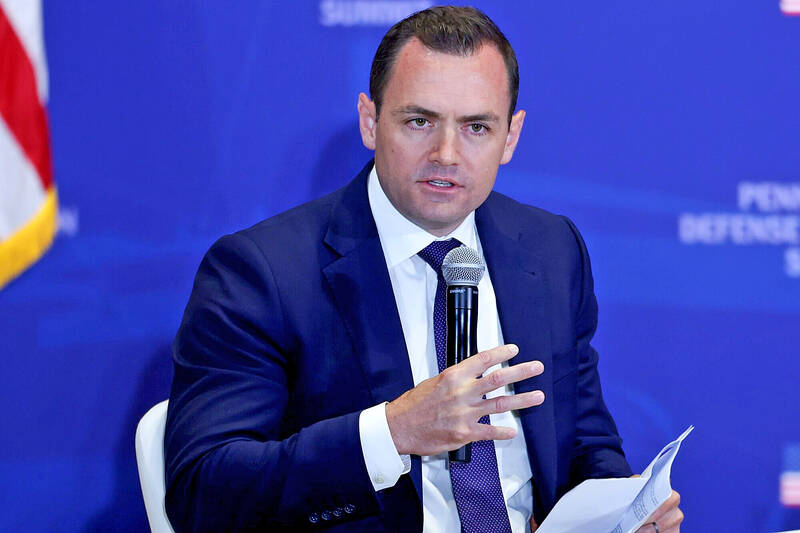
Palantir Technologies head of defense Mike Gallagher speaks during the Pennsylvania Defense and Innovation Summit in Pennsylvania on Wednesday.
Photo: Bloomberg
Chinese embassy in Washington spokesman Liu Chang (劉暢) said in a statement later on Wednesday that Beijing “brooks no external interference” and suggested the US “act prudently” on Taiwan.
“The Taiwan question is China’s internal affair,” he said. “Stronger cooperation between enterprises on both sides of the Taiwan Strait in semiconductors and other fields is the right path toward mutual benefit and win-win outcomes.”
As Taiwan is the home to Taiwan Semiconductor Manufacturing Co (TSMC), it makes it a chokepoint that China could exploit to halt US progress in AI technology if authorities in Beijing found the US was gaining too much of a lead, Gallagher said.
“If China takes Taiwan, they will control TSMC or disable TSMC — they will have the ability to hold the rest of the world economically hostage,” said Gallagher, who left Congress in early 2024 and joined Palantir later that year.
While some prominent US officials have previously warned that China was seeking the capability to invade Taiwan by next year, the US has backed away from that projection, including in March with an intelligence assessment that concluded an invasion “would be extremely challenging and carry a high risk of failure.”
Even so, China has stepped up patrols by its coast guard off Taiwan’s east coast, highlighting the risk that a blockade would pose to global supply chains in the event of a Chinese invasion.
The patrols add to the regular military drills conducted by Chinese forces in the region.
Palantir plays a critical role in the US military as a key provider of technology for the Pentagon, including its Maven Smart System, which uses AI for surveillance and targeting.
During his remarks, Gallagher said that companies in Silicon Valley have increasingly talked about the inflection point where AI models begin to improve themselves, calling it the kind of super intelligence that could get China’s attention, characterizing it as being on par with the development of nuclear weapons.
“If that is true, that we’re at an inflection point, and this technology is a game changer on par with the advent of nuclear weapons in the 1940s,” he said.
KioskNews shows a cleaned-up reading view extracted from the publisher’s page — the original always lives on their site, not ours.