Chief Economic Advisor V Anantha Nageswaran: ‘Job creation is happening but whether they are paying adequately seems to be the problem’
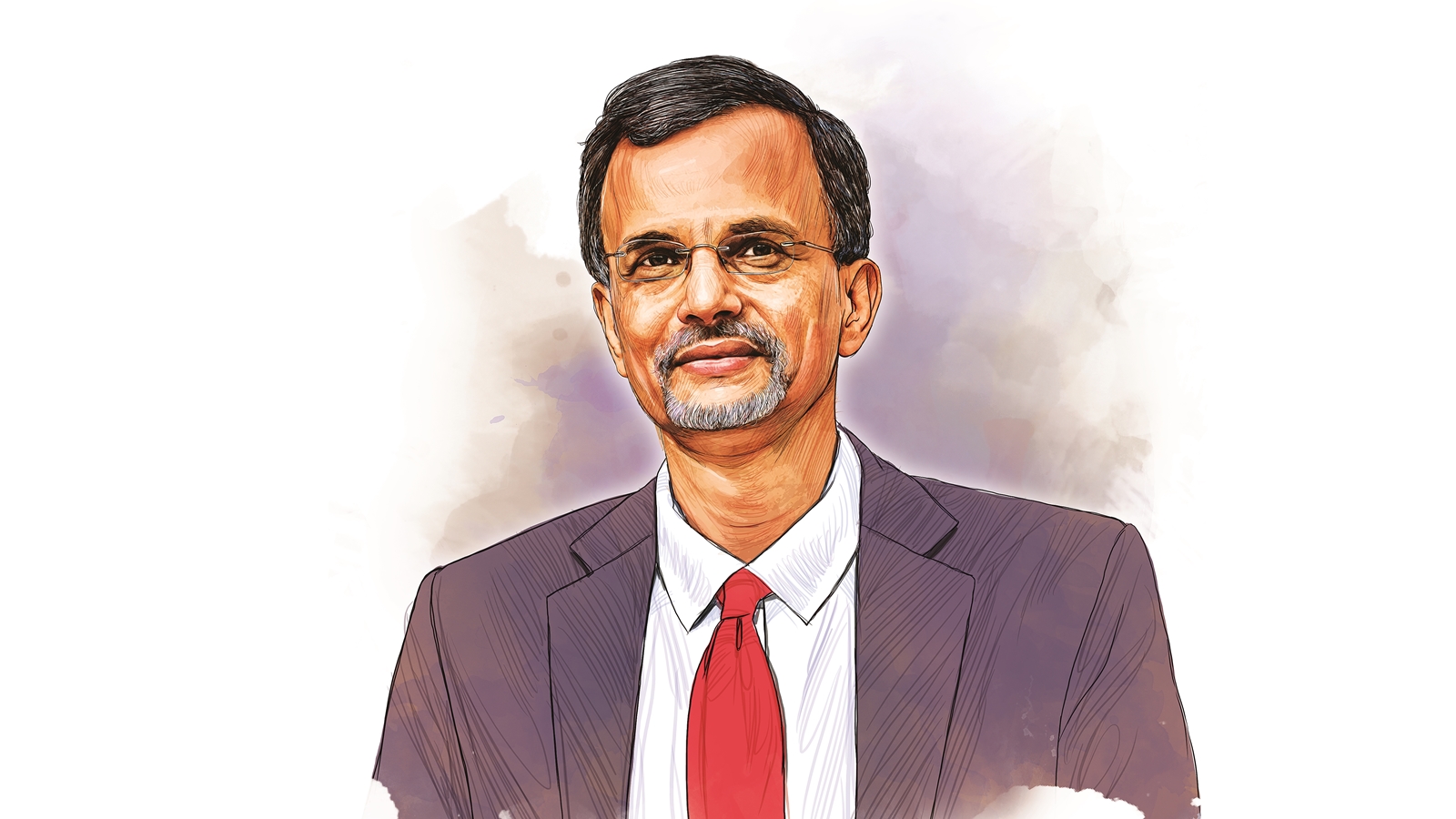
Chief Economic Advisor V Anantha Nageswaran on the effect of the AI stock evaluations on India, how we don’t have a jobs problem but an income problem, being AI-proof and finding ways to insulate the economy from external pressures. The session was moderated by Aanchal Magazine, Deputy Associate Editor, The Indian Express
Aanchal Magazine: You have been flagging the AI stock valuations as a bubble. How do you assess the recent correction?
I have always distinguished the financial market aspect of the AI bubble and the technological potential of it. The financial ecosystem, in the last two years, had been drawing in a lot of debt and there has been circular financing between companies involved in the AI ecosystem, giving us memories of what happened in 2008 – the unravelling of global markets.
Having been considered a non-AI ecosystem participant in the last two years, India would benefit if such a backlash were to occur in the AI financial ecosystem. That is what happened in July and August, and then in the week of October 12, when the International Monetary Fund and the World Bank had their annual meetings. There were doubts about AI and the following day the Indian markets rose quite sharply. So, while, in the developed world, it could be longer and beneficial — the financial ecosystem unravelling — from the Indian perspective, it is net positive.
Aanchal Magazine: True, Indian markets have picked up, but do you see that optimism holding up for some time?
Of course, this is not the only story that will determine the optimism or the continued increase in financial asset prices in the Indian stock market. In the last few days, oil prices came down quite significantly. Brent was trading at $115 per barrel, now it is down to $94. Of course, today it is $98 as we speak, and the Indian 10-year bond yield, approaching 7.5 per cent, has also rallied to 7.2 per cent. So all these factors played their part as well. But the most dominant influence was this: India’s status as a non-AI play is definitely weighing positively on the Indian market sentiment and also drawing in FIIS (Foreign Institutional Investors) in the near term.
Aanchal Magazine: You have also listed out the risk factors, from crude to escalation of input costs, in the Monthly Economic Review. What gives that optimism to retain 7 per cent plus growth despite the emerging uncertainties?
Story continues below this ad
The risk factors are mostly medium-term factors. In the near term, what matters to us is the landed cost of crude. That cost, from May to August, had come down significantly after a sharp increase in March-April and also parts of May. But now in the last two months, September and October, it went back up again. The reason for optimism comes from oil companies doing well from June to August, and the high energy prices that have not impacted consumers, their disposable income or purchasing power. Then, in 2025, we had a big direct tax cut in February, followed by GST rationalisation and rate reduction, in September 2025. And, in financial year 2025-26, inflation was very low. That also added to real income growth last year.
So these things have an effect. Two-wheeler, three-wheeler and four-wheeler sales have been doing well, we are seeing healthy bank credit growth and that’s also reflected in the monthly GST collections. Even though import prices are playing a part, domestic GST collections are running at 16 per cent. Competitive exchange rate is boosting exports and export sectors as well. These are the reasons why our high-frequency indicator-based nowcasting model is picking up continued growth momentum in the economy.
On upskilling: Invest in trade-related skilling and human-centric services. Those have job opportunities both inside and outside India and will be AI-insulated, because these skills require humans in the loop
Aanchal Magazine: So the maximum chatter right now is about attracting foreign investments. Can you talk about the suggestions to cut Long-Term Capital Gains (LTCG) tax or Securities Transaction Tax (STT) and the change in the LRS (Liberalised Remittance Scheme of the RBI) limits? Does India require such significant changes right now?
We have entered the active pre-budget consultation period and it will not be appropriate on my part to comment on these proposals. The only thing I can say is that the LTCG tax went up back in 2018 to 10 per cent and the STT was not lowered. The Indian market continued to move higher all the way up to 2024. In fact, it went up by 4x between 2020 and 2024. See, the problem with isolating some of these factors — multiple developments have come together. The AI boom picked up from 2024 onwards. In 2025, we had the United States impose tariffs on India in April and October, which also raised doubts among investors about the kind of restrictions Indian exports of services and goods both might face in the coming years. So all these factors might have played a part. And of course, valuations went ahead of themselves. It is not uncommon that when valuations go far too ahead of themselves, markets go through a period of consolidation and correction before prices and earnings come into alignment. The NASDAQ Composite Index peaked in March 2000 but did not regain that peak until about 2013 or so. These things happen. The Finance Minister is looking into the proposals and evaluating them.
Story continues below this ad
P Vaidyanathan Iyer: Irrespective of the fact that companies are growing well with good profits, there are concerns about jobs. We are not creating enough manufacturing jobs. How do you look at this problem? Will it continue for the next 5-10 years, given our demography? What would be two or three things that we can do?
I don’t think we have as much of a jobs problem as an income problem. What we are seeing from the Annual Survey of Industries and private sector data like Naukri.com, etc., is that jobs are being created, but perhaps more temporary employment or contract jobs, which do not necessarily offer much higher pay or regular increases in salaries compared to full-time jobs with perks. I think that seems to be the problem: job creation is happening but whether they are paying adequately seems to be the problem.
Policy has been at it, especially since 2024. The first budget in the third term was dedicated to job creation. It focused on incentives for first-time jobs, for hiring in the manufacturing sector, it created internships and corporate apprenticeship schemes.
On being self-reliant: The coming decades will be a contest not only for energy and commodities, but also for technology and capital. Such exogenous measures are needed to accelerate indigenisation
The second thing we are doing now is to conclude free trade agreements (FTAs) with different regions which open up markets for both labour-intensive goods and services.
Story continues below this ad
The third thing, which I would consider an employment or job creation policy, is to focus on deregulation at the ground level. The plumbing of regulations in the states started in a systematic manner last January and will continue next year as well, apart from whatever is happening at the Union government level, because deregulation policy basically lowers the cost of doing business for small and medium enterprises, and they are one of the big hirers.
The fourth thing that we should be focusing on is investing in agriculture, which we don’t do enough. That sector globally has a size close to $2.5 trillion, as big as textiles and apparel. If you do more of that and even if we get a global market share of 4 per cent, that is about $100 billion in market size, and that will create jobs, not only boost productivity. And lastly, invest in trade-related skilling and human-centric services. Those have job opportunities both inside the country and outside, and they will also be AI-insulated, because these kinds of skills and human-centric services require the important presence of humans in the loop, and it would not be possible to replace humans that easily with AI. We need to do all these things. Post-COVID economic recovery in different parts of the world has been predominantly capex- and profit-led rather than employment- and income-led. But in India, we must continue to pursue all these things. Private sector has an important role to play. Where I am more optimistic about is the multiplier effect that trade agreements that have been concluded and which are imminent — the ones with the EU, with Canada and possibly with the United States. There is much in store in those agreements and their potential to boost labour-intensive manufacturing sectors such as textile, shrimp farming, leather and footwear.
And then, completely refashioning and reimagining the skilling landscape, which is happening with the PM-SETU initiative. It is in six states on a pilot basis. And you must have also heard about the Blue Dot initiative, which is like Uber for job creation. This kind of GPS for the employment market is one of the ground-level micro-initiatives that will make a difference. The job challenge is something that will be ongoing; it has been there for quite some time and given our size, it will be there. Policy must keep at it and find ways to create more bottom-up growth. Luckily, we have 28 states plus eight union territories: some can do advanced manufacturing, several other states can do labour-intensive manufacturing, and some can focus on agro-processing. We need to pursue all of them.
Nikhil Ghanekar: We are in the middle of yet another pollution emergency in large parts of north India. The Economic Survey 2025 and 2026 had noted the impact of air pollution and climate, but don’t we need to broaden the assessment of its impact on productivity, public health, tourism and even investments?
Story continues below this ad
Yes, it definitely has an impact but it’s difficult to quantify, and we haven’t done an exercise in quantifying them because when it comes to econometric or quantitative or statistical assessment of these phenomena, it is very difficult to control other factors
Dheeraj Mishra: China recently put a restriction on the export of tunnel boring machines at a time when India has taken up difficult projects, especially in the Himalayan region. What impact can it have on India’s mega infrastructure projects vis-à-vis relations with China? Have we developed capabilities to make our own tunnel boring machines?
Yes, I think we are developing capabilities. Your newspaper itself may have covered it — one of the German manufacturers making TBMs (tunnel boring machines) in China has commenced production in India. Some of these measures will only spur indigenisation. Right now, they have not said they are completely stopping the export; they have imposed more conditions on them. This is why I said the coming years and decades will be a contest for real resources — and resources doesn’t mean only energy and commodities, it’s about technology and capital. Sometimes these exogenous measures coming from abroad are probably the catalyst that we need to accelerate indigenisation.
Siddharth Upasani: Over the last five to six months, private capex went from green shoots to possibly the next stage. Some of this is also linked to the AI boom. Do you think this is linked to the data centre build-out in India?
Story continues below this ad
It’s a speculative question. First of all, the revival in capital formation in the private sector in India — I don’t think I will attribute it to the data centre phenomenon, because some of them were prior commitments.
P Vaidyanathan Iyer: A few states have announced unemployment allowances. We are heading into another state election cycle. Do you think unemployment allowances make sense? This is on the back of cash allowance schemes for women in several states. Political parties and state governments give examples of women having been able to generate employment, but there is no long-term data on it.
The extent of the problem has to be gone into. We still don’t have a good handle on what is happening to gig or self-employment. We immediately categorise all of them as informal, but some of them could be a matter of choice. Second, you have to break it down into states where it is a problem and where there is voluntary unemployment. So to come up with an omnibus answer isn’t easy.
P Vaidyanathan Iyer: In general, it seems like a huge drain because it holds back states from making productive investments.
Story continues below this ad
The question is whether you provide an unemployment allowance, if so for how long, how much, and in return what do you want the recipients to do. These questions occupied policy makers in various countries, like those in Europe, where such allowances haven’t necessarily solved the unemployment problem. One of the reasons the US has shorter unemployment or recession cycles is attributed to not having generous unemployment benefits — the natural healing capacity of the economy isn’t impacted. That’s why it’s difficult to give a generalised and off-the-cuff answer.
Sukalp Sharma: Do you believe that there is something that needs to change or should we stay the course with regard to energy price fluctuations?
We have diversified our supplies on crude oil, natural gas and have incentivised other energy sources. We opened up the nuclear energy sector and framed rules for it. Of course, with renewable energy, we may have a large installed capacity but utilisation is now running into some challenges, in terms of having firm power backup and getting investments in grids to be able to accept renewable energy.
At the same time we also did a better job of giving equal emphasis to distributed solar energy for rooftops, which is actually good because that will reduce the pressure on the grid. We are also mandating battery energy storage systems. So, we are going about it in a systematic manner where over time we will be reducing the dependence on fossil fuel and reducing the dependence on imported fuel. We also have to focus on the demand side which is to improve a) the energy intensity of the economy, b) having invested in public transportation across major Indian Tier I, Tier II cities, we have to now focus on Transit Oriented Development (TOD) which will incentivise their use by the residents.
Story continues below this ad
Amitabh Sinha: We are heading into another climate conference (COP31). Considering climate has clearly been dropped in the international agenda, do you see pressures on India to ease a bit?
It’s a question that is probably better (asked) once the conference is over. Has the pressure eased? Yes, I suppose. But it also means that the funding for it also has become a challenge. Focusing on climate adaptation rather than emission mitigation is something that is not going to change from our perspective because we are facing the lagged effects of what has been out there for more than 200 years. Our policy plan for climate change is a reality. Therefore, we have to continue to make efforts to insulate the economy and the farming sector from its vagaries and therefore we are investing in irrigation infrastructure. We have to find the resources to be climate adaptive which is more important in the near term.
KioskNews shows a cleaned-up reading view extracted from the publisher’s page — the original always lives on their site, not ours.