Over 30,000 told they cannot return home to Nepal’s flood-hit danger zones
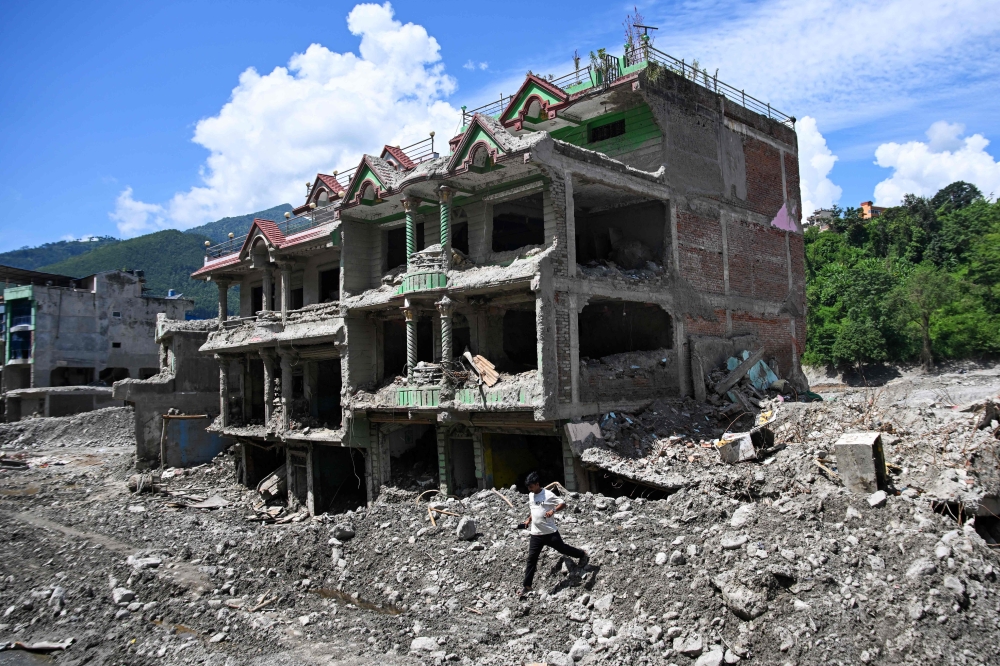

Flood victim Rohit Sahani walks past his damaged shop in the aftermath of flash floods in Trishuli, Nepal’s Nuwakot district, on September 22, 2026. — AFP pic
First Published: Thursday, 24 Sep 2026 3:21 PM MYT
KATHMANDU, Sept 24 — Nepal’s top disaster official said an estimated 33,000 people affected by last month’s devastating flood will be required to resettle rather than returning home, as the South Asian nation grapples with the aftermath of the disaster that damaged over 7,500 buildings and has left thousands of people still missing, Kyodo News reported.
Dharam Raj Uprety, chief of the National Disaster Risk Reduction and Management Authority, told Kyodo News in an exclusive interview that the areas where flood marks — in some places 13 metres higher than normal river levels — are visible are to be declared “danger zones.”
“We know there is a possibility of future disaster. So, we don’t want to take more risk,” Uprety said earlier this week, adding that the affected population, estimated to be around 33,000 people, would be resettled in safer areas.
The August 26 flood and debris flow triggered, according to Nepal’s government, by an ice-and-rock avalanche in the upper Lhende Khola watershed in Tibet, killed 1,451 people and left about 5,700 people, including over 600 foreign nationals, missing in Nepal. Of the missing, five are Japanese nationals.
Uprety acknowledged that sentimental attachment to places where people are born and spend their lifetime poses a challenge in convincing flood-affected people to move to a safer place.
But he said teams from his office, the Department of Survey, and relevant ministries have already scouted safer areas close to the danger zones, so that the flood-affected can move to “safe settlement” and live with “dignity.”
Search operations at the tunnels of some of the 12 hydropower projects pummelled by the avalanche debris are winding down. Authorities are planning to announce the conclusion of such operations and move to post-disaster recovery at the end of this week.
“There is very, very little chance or no chance of getting any survivor,” he said.
The government has decided to extend the immediate assistance of approximately US$2,600 (RM10,600), or 400,000 Nepalese rupees, to each family as a housing grant, on top of a monthly allowance of US$98, or 15,000 Nepalese rupees, to each family of up to four members as livelihood and rental support.
For each additional member of the four-member household, an extra 2,000 rupees is provided as livelihood and rental support.
Earlier this month, the government estimated US$4.77 billion would be needed for initial recovery from the flood, but Uprety said the amount is expected to increase.
“That (US$4.77 billion) is an initial estimate based on rapid assessment. It did not include the costs the government will have to bear to compensate flood-affected citizens for nationalising their privately-owned land, now designated as a danger zone,” he said.
“The final recovery need could very easily be double the initial estimate,” Uprety told Kyodo News.
Cash-strapped Nepal is hoping that part of the need will be met through Nepal’s development partners including Japan, China, India, Britain, the World Bank, and the Asian Development Bank, among others. — Bernama-Kyodo
KioskNews shows a cleaned-up reading view extracted from the publisher’s page — the original always lives on their site, not ours.