Interactive: The Delhi road dust story, through a PM2.5 particle’s eyes
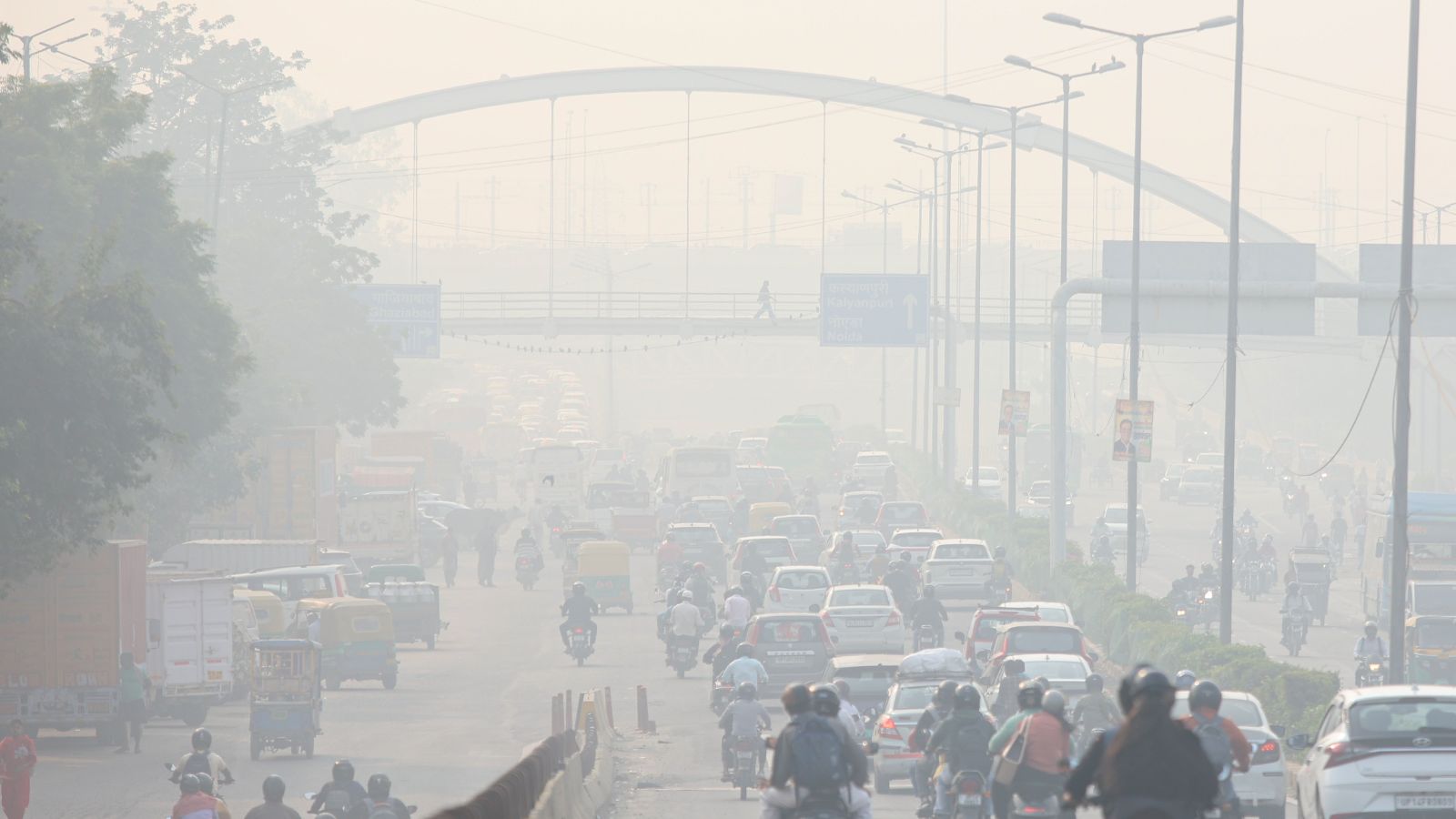
The NCR administration is taking pollution-mitigation measures such as daily mechanical road sweeping, intensified water sprinkling with dust suppressants, and stricter inspections of construction sites (Photo: Amit Mehra).
AI Narration
Listen
00:00
Delhi road dust is a stubborn villain. Once it settles, passing traffic whips it back into the air, and the city’s dry summers and loose soil make it a year-round threat.
One study found PM10 as high as 1,700 micrograms per cubic metre within 10 metres of some roads, against a 24-hour limit of 100. Experts say paving and roadside greening matter as much as sweeping, and that sprinklers and anti-smog guns mostly just move dust around.
Delhi road dust | The dust cycleWhy road dust keeps coming back
Once dust settles on a road, moving vehicles can lift it back into the air. The cycle can continue even when no fresh dust-generating activity is under way.
01
Dust collects
Particles accumulate along road edges, medians and other surfaces.
02
Traffic moves
Passing vehicles disturb the dust lying on the road.
03
Dust rises again
Particles are resuspended in the air, adding to pollution.
04
The cycle repeats
Dust settles again and can be lifted by more traffic.
A looping pixel-art illustration of cars and a truck passing a Delhi roadside. Dust rises, swirls around pedestrians and settles.
Illustration: traffic lifts settled road dust; the cloud rises, spreads and settles again. Animation is illustrative.
A close-up block-style figure surrounded by swirling roadside dust, with the question displayed in a caption bubble.What happens when you inhale road dustfilled with toxic particles?
What adds to the problem?Broken road edges, potholes, unpaved stretches and debris from construction and demolition transport, according to a CAQM expert panel.
Reports cited in the investigation also called for paving, greening and drought-resilient roadside planting alongside sweeping.
How is Delhi road dust sweeping going?
By the Centre’s reckoning, Delhi needs 505 machines. By September, the city’s agencies reported 98. When we investigated in May, the then 76 machines were covering about 23 per cent of roads.
Explained
Why road dust keeps coming back
Road dust is difficult to control because it is a primary and persistent source of air pollution; once deposited, it is repeatedly re-suspended by vehicular movement. In Delhi, dry summers, loose alluvial soil, and a weakened Aravalli range mean dust needs to be actively managed. A January 2026 report identified road dust as a major pollution source in Delhi and a committee set up in 2025 traced re-suspension to dust along medians and road edges, poor road design, weak maintenance and encroachments that obstruct cleaning.
The MCD promised 70 more by October. Our investigation finds only 11 will be on the road before December. The other 59 are due by December-end or January.
Delhi road dust | The fleet gap505 sweepers needed. Delhi had 76.
In January 2026, the Centre directed Delhi to prepare a plan to expand its mechanised road-sweeping fleet.
76
Machines available across Delhi at the time
505
Machines required, based on road length and width
The filled portion represents 76 of the 505 machines required.
429 shortThat was the gap when the requirement was set.
These are Delhi-wide figures from January 2026. The separate order for 70 machines is an MCD procurement.
Why delay in Delhi road dust sweepers?
Tenders worth Rs 924 crore were floated 106 days after an urgent December 2025 meeting, and work orders took another 145. The MCD says it was told only in late December that it, not the PWD, had to buy the machines, and blames the West Asia crisis.
Delhi road dust | The long wait70 machines: from urgent need to delayed delivery
The MCD flagged an urgent need for road sweepers in December 2025. The order for 70 has a contractual deadline of March 2027.
17 Dec 2025
MCD officials flag an urgent need for at least 88 machines.
2 Apr 2026
Tenders floated for 70 machines, 106 days after the meeting.
24–25 Aug 2026
Work orders issued to three firms, 144–145 days after the tenders.
Sept–Oct 2026
Four machines tested; field trials conducted.
Nov–Dec 2026 Proposed
11 machines proposed for deployment.
Dec 2026–Jan 2027 Proposed
The remaining 59 machines scheduled for deployment.
March 2027 Deadline
Contractual deadline for the full consignment, according to company representatives.
MCD says disruption from the West Asia crisis delayed shipment. Proposed deployment dates are subject to change.
The vendors agree shipping now takes 40 to 45 days, not 25, and that electric machines are hard to airlift. They say their contracts run to March 2027, but they’re trying to deliver by December-end, as the MCD asked.
Delhi road dust: Centre’s stand
The Centre raised the issue in at least seven meetings, set a September deadline, missed it, and on November 19 demanded action on a ‘war footing’. And so, for now, the MCD is hiring nine machines and stretching shifts from eight to 12 hours.
Key takeaways
-
Only 11 of 70 new road sweeping machines will be on Delhi's roads before December.
-
MCD had said in May that all 70 machines would join its fleet by October.
-
The other 59 are due by December-end or January, when pollution typically peaks.
-
MCD told a crisis meeting on December 17, 2025 that it needed at least 88 machines.
-
Tenders worth Rs 924 crore for 70 machines were floated 106 days later, on April 2.
-
Work orders were issued 144-145 days after the tenders, on August 24-25.
-
Only nine machines are in hand so far; MCD plans to hire nine from a Telangana firm.
-
Two of three contractors say their contracts require full delivery only by March 2027.
-
MCD blames the West Asia crisis; shipping now takes 40-45 days instead of 25.
-
Delhi had 76 machines in May against the 505 the Centre recommended.
-
Machines covered only about 23% of Delhi's motorable roads in a year, an earlier probe found.
-
Road dust is Delhi's top pollution source: 56% of PM10, per a 2016 IIT Kanpur study.
-
Delhi recorded its worst Diwali-day air quality since 2021 on November 8.
-
New imported machines are self-propelled and vacuum-based, needing no manual clearing ahead.
KioskNews shows a cleaned-up reading view extracted from the publisher’s page — the original always lives on their site, not ours.