‘I never saw my son, until they handed him over in a bag’: inside El Salvador’s brutal crime crackdown
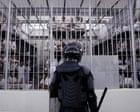
At midnight on a Monday in December 2021, dozens of soldiers and police officers stormed into the home of Sandra Carolina Velasco Mena. They were looking for her 22-year-old son, Jefferson Alexánder Hernández Velasco.
“They wanted to arrest young people,” Sandra says. “Two of the policemen said it was because they were short of three people in their quota.”
The arrest came amid an intensifying crackdown on criminal groups in El Salvador, launched by Nayib Bukele, who won the presidency in 2019. For decades, the country of 6 million had been racked by extreme levels of gang violence, with its exceptionally high homicide rate at one point exceeding 100 per 100,000 inhabitants – the highest rate in the world outside a war zone.
Hernández was taken away. “They treated him like an animal,” says Sandra.
Homicide rates in El Savador had been falling, but in March 2022 an alleged truce between the government and gangs appeared to collapse when gangs reportedly killed 87 people in three days. Bukele responded by declaring a nationwide state of emergency.
What followed was an unprecedented campaign of mass incarceration. An estimated 90,000 people were arrested. About 120,000 people remain incarcerated – roughly 2% of the population, one of the highest rates in the world.
The crackdown has swept up tens of thousands of people with no proven links to criminal gangs, human rights groups say. The so-called state of exception allows the government to detain suspects for prolonged periods while curtailing constitutional rights. Thousands have been prosecuted for the vaguely defined offence of “unlawful association” in closed proceedings where evidence is kept under judicial seal and not made public.
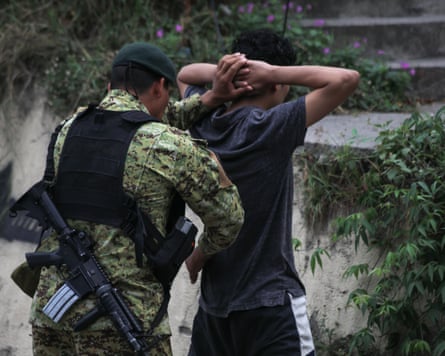
Sandra insists her son is innocent and has no gang affiliation. “My son was a family man, very calm, very passive,” she says. “He worked on a farm where they cared for chickens. He loved soccer, and took care of his little brothers. He was a jovial boy.”
A judge ordered Hernández’s release at a hearing more than three years ago, she says, but instead of being freed, he was transferred to Cecot, El Salvador’s notorious maximum-security prison, the centrepiece of Bukele’s war on gangs. Sandra has not seen her son since.
“I don’t know what’s going on. We don’t have any communication with him, nothing. I don’t know anything,” she says.
Beatriz Magaloni, a politics professor at Stanford University and senior fellow at its Freeman Spogli Institute, says El Salvador has become a “carceral state of terror”.
“The atrocities are more than I ever expected,” she says. “The regime can perpetually condemn these people. There is no rule of law, no protection, it is really tragic.”
Bukele’s crackdown has also been marked by allegations of abuses, torture, sexual violence and beatings. At least 513 people have died under state custody during the state of emergency, according to Cristosal, a human rights organisation, while Amnesty International has said most deaths were of people who had not been not convicted of a crime.
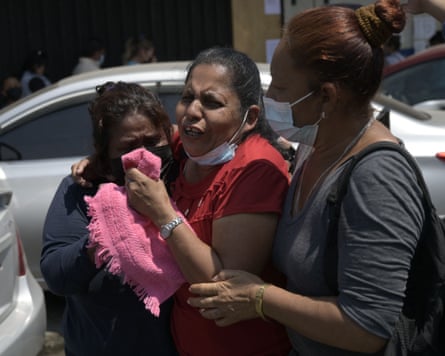
Among them was Julio César Santamaría Flores, 32, who worked as a mechanic. His mother, Idalia Flores, 52, says he was arbitrarily detained on suspicion of gang affiliation on 1 December 2022. Idalia says she was initially told her son would be detained for 15 days, before being told his detention would last six months.
“My son was detained under the state of exception, arbitrarily detained, unjustly accused, of gang affiliation,” says Idalia. “I never saw my son again after he was arrested. Until they handed him over to me in a bag.” When she saw her son’s body, she says he had been “practically tortured”.
Behind the prison walls, former detainees describe a system of malnutrition, physical abuse, degrading conditions and torture.
Víctor Barahona, a journalist, was arrested in June 2022 during the wave of detentions, accused of illicit association. Before his arrest, he says, his life had been “joyful”. He spent 11 months and 12 days in custody, much of it in Izalco prison, which he describes as hell.
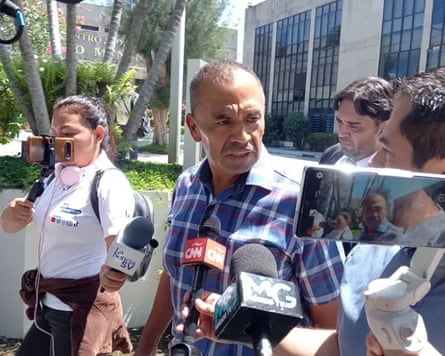
Barahona says he was also held in Mariona, or La Esperanza, prison where 230 men were crammed into a small cell, enduring degrading conditions. He describes most of his fellow prisoners as “innocent” and “hard-working people”.
“The guards tortured us psychologically and beat us constantly. They treat you like a rat, like garbage,” he says.
Detainees were denied medicine, deprived of sunlight, given just one glass of water a day and punished for worshipping, Barahona says. “When I was released, I had lost 80 pounds. I was malnourished. I had fungal infections. My health was very poor,” he says.
after newsletter promotion
The scale of the crackdown has also raised questions about the incentives driving the arrests. Interviews with El Salvador’s police conducted by Human Rights Watch (HRW) found that officers faced pressure to meet arrest quotas, with those who fell short risking disciplinary action or losing their jobs. HRW says this pressure encouraged officers to accuse people of gang affiliation on the basis of flimsy or fabricated evidence, disproportionately affecting people in poor neighbourhoods who lacked the resources to defend themselves.
Barahona says an intelligence officer acknowledged the scale of the crackdown during his arrest. “Look, Don Víctor, right now they’re arresting everyone,” the officer told him, according to Barahona.
He also believes his work as a journalist made him a target. “I think my work made them uncomfortable. I think that is why they came to me. They did it to silence me, and they did.”
Almost four years into the crackdown, authorities have increasingly resorted to mass trials, trying hundreds of defendants at once by video link.
Defendants are unable to discuss their cases with their lawyers, says Juanita Goebertus, Americas director at HRW, while lawyers are prevented from calling witnesses and witnesses are threatened if they agreed to testify for the defence. “Defence lawyers also operate in a climate of fear, they too are sometimes threatened with being prosecuted or being surveilled,” she says.
“The whole process makes it impossible to separate the innocent from the guilty.”
Idalia Flores says she tried to build a case for her son’s innocence before his death, collecting documents to show that he had a life and livelihood unrelated to the gangs.
“I gathered information as best I could. Documents: proof of enrolment, receipts for [mechanic’s workshop] parts purchases, diplomas for the degrees he earned, the deed to the house where he lived, and letters of recommendation,” she says. “I presented all the evidence to prove my son’s innocence, but they disregarded the case entirely. He was treated like a criminal, despite having a clean record and all his documents in order.”
Yet Bukele’s crackdown has also brought him public support. Homicides have fallen sharply and the country has been transformed into one of the region’s safest. For many Salvadorans, the decline has brought a sense of security after years in which criminal gangs exerted control over neighbourhoods and daily life.
The fall in homicides has not prompted the government to lift emergency powers. The state of exception, initially presented as a temporary 30-day measure, has become a permanent fixture of Bukele’s government.
“This regime of exception is politically very profitable for him, because he can use this against anyone he wants. People are really afraid to express any dissent, any political opposition,” Magaloni says.
In 2024, Bukele acknowledged that 8,000 people who had been detained were innocent and had been released, but rejected estimates by human rights groups that 30,000 had been wrongfully arrested. He has responded to critics by dismissing them as “gang defenders”. The strongman has won the admiration of the Trump administration and conservative leaders around the world.
“I understand that those who commit crimes must pay the price. But not innocent people,” Barahona says. “Justice has been lost in our country.”
KioskNews shows a cleaned-up reading view extracted from the publisher’s page — the original always lives on their site, not ours.