Baja California overtakes Guanajuato as Mexico’s most violent state: Tuesday’s mañanera recapped
- 📉 Homicides fall 30.6% year over year in September: National Public Security System chief Marcela Figueroa reported an average of 42.2 homicides per day last month, down from 60.8 per day in September 2025.
- 📊 Homicides down 51.4% from September 2024: Figueroa said the decline was “more than 52%” compared to López Obrador’s final month in office, but her data showed a 51.4% reduction.
- 📍 Baja California overtakes Guanajuato as Mexico’s most violent state: Baja California recorded 1,092 homicides from January to September (8.5% of the national total of 12,854), narrowly ahead of Guanajuato with 1,089.
- ✅ Homicides decline in all 32 states in first nine months of 2026: San Luis Potosí recorded the steepest year-over-year drop (78.6%). Nayarit, Quintana Roo, Baja California Sur, Nuevo León and Zacatecas also saw declines of more than 50%.
- 🔫 Over 14,000 weapons handed in since Sheinbaum took office: Interior Minister Rosa Icela Rodríguez said 14,077 firearms and explosive devices were “voluntarily” turned in under the Sí al Desarme, Sí a la Paz program between Oct. 1, 2024 and Oct. 12, 2026.
- 🚨 70,571 arrests for high-impact crimes in two years: Security Minister Omar García Harfuch said authorities also seized 36,303 firearms and almost 570 tonnes of drugs, and dismantled 2,792 clandestine drug labs, between Oct. 1, 2024 and Sept. 30, 2026.
- 🏥 Sheinbaum rejects claims of “crisis” in public healthcare as IMSS workers protest: Asked about the protests scheduled for Tuesday, the president acknowledged the need to hire more specialists, promised higher resident doctor scholarships in 2027 and admitted medicine distribution problems remain. She said healthcare workers’ legitimate demands would be addressed and urged them to protest peacefully.
Why today’s mañanera matters
Federal officials presented the government’s monthly security report at President Sheinbaum’s Tuesday morning press conference.
Data showed that homicides declined significantly in September, continuing a downward trend seen throughout 2026.
Sheinbaum and other officials assert that the reduction in homicides and other crimes is evidence that the government’s security strategy is working. However, there is skepticism about the accuracy of the government’s homicide numbers, which are based on data provided by Attorney General’s Offices in each of Mexico’s 32 federal entities.
While security was the main focus of today’s mañanera, Sheinbaum also fielded a question about the national protests scheduled for Tuesday, at which Mexican Social Security Institute (IMSS) healthcare workers will demand higher pay and better working conditions, and denounce a lack of medications and medical supplies at IMSS hospitals. In Mexico City, a large protest march (megamarcha) is scheduled to set off from the Siglo XXI National Medical Center on Tuesday afternoon.
Homicides fall 30% year over year in September
National Public Security System chief Marcela Figueroa reported that there was an average of 42.2 homicides per day in September, a decline of 30.6% compared to the same month of 2026.
Compared to August, the daily homicide rate rose 3.2%.
Homicides declined 51% in September compared to 2 years earlier
Figueroa said that homicides declined “more than 52%” last month compared to September 2024, the final month of Andrés Manuel López Obrador’s presidency.

However, the data she presented showed a slightly lower reduction of 51.4%. There was an average of 86.9 homicides per day in September 2024, compared to an average of 42.2 per day last month.
Figueroa presented data that showed that last month was the least violent September of any year since 2015.
Baja California overtakes Guanajuato as Mexico’s most violent state
Figueroa reported that Baja California recorded the highest number of homicides among Mexico’s 32 federal entities in the first nine months of 2026. There were 1,092 homicides in the northern border state between January and September, representing 8.5% of the national total (12,854).
The murder count in Baja California was slightly higher than that in Guanajuato, which has been Mexico’s most violent state in terms of homicides in recent years. Until the end of August, Guanajuato was the most violent state in 2026 as well.
However, in the nine months to the end of September, Guanajuato ranked as the second most violent state, recording 1,089 homicides or 8.5% of the national total.
The five states that recorded the next highest homicide counts in the first nine months of 2026 were:
- Chihuahua: 1,009 (7.8% of the national total)
- Sinaloa: 987 (7.7%)
- México state: 818 (6.4%)
- Guerrero: 731 (5.7%)
- Morelos: 673 (5.2%)
The seven states with the highest murder counts between January and September accounted for almost half (49.8%) of all homicides perpetrated in Mexico in the period.
Oaxaca, Jalisco and Michoacán ranked eighth, ninth and tenth, respectively, for total homicides in the first nine months of 2026. Mexico City ranked 12th with 585 homicides.
Yucatán recorded the lowest number of homicides among Mexico’s 32 federal entities, with just 21 between January and September.
Homicides declined in every state in the first 9 months of 2026
Figueroa reported that homicides declined in every federal entity in the first nine months of the year. Compared to the January-September period of last year, homicides fell 78.6% in San Luis Potosí, the largest reduction of any state.
Five other states recorded year-over-year declines in homicides of more than 50%. They were:
- Nayarit: 69.5%
- Quintana Roo: 59.7%
- Baja California Sur: 54.6%
- Nuevo León: 51.5%
- Zacatecas: 50.4%
Mexicans have handed in more than 14,000 firearms and explosive devices since Sheinbaum took office
Interior Minister Rosa Icela Rodríguez reported that 14,077 firearms and explosive devices were “voluntarily” handed over to authorities between Oct. 1, 2024 — the date Sheinbaum was sworn in as president — and Oct. 12, 2026. The weapons were turned in under the government program Sí al Desarme, Sí a la Paz (Yes to Disarmament, Yes to Peace).
Rodríguez noted that people who handed over weapons received cash from authorities. She also said that children have exchanged more than 15,000 “war toys” for “educational toys” since Sheinbaum took office.
Over 70,000 arrests since Sheinbaum took office
Security Minister Omar García Harfuch reported that 70,571 people were arrested for allegedly committing high-impact crimes between Oct. 1, 2024 and Sept. 30, 2026. Among the offenses classified as high-impact crimes are murder, kidnapping, violent robbery, rape and extortion.
According to the information presented by García Harfuch, authorities seized 36,303 firearms and almost 570 tonnes of drugs between Oct. 1, 2024, and Sept. 30, 2026.
In addition, authorities dismantled 2,792 clandestine drug laboratories in the same period.
Sheinbaum pledges to address the concerns of protesting healthcare workers
A reporter asked the president what message she would send to IMSS workers planning to protest on Thursday.
Sheinbaum first pointed to her government’s healthcare achievements.
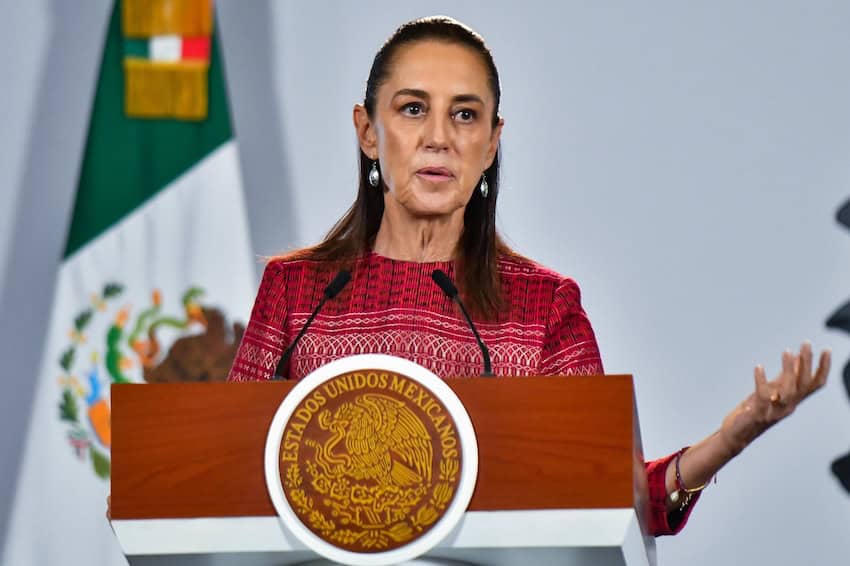
“It’s important that what we’ve done in two years is known,” she said before reporting a range of achievements, including the construction of 34 new public hospitals and the opening or modernization of 650 operating rooms.
“We haven’t had our arms crossed. We’ve been working intensely for two years to support the country’s healthcare system,” Sheinbaum said.
She acknowledged that there is more to do, specifically noting that authorities need to hire more specialist doctors for the public health system. Sheinbaum also said that resident doctors’ “scholarships” need to be increased, and pledged that would happen in 2027.
“They earn less than the minimum wage,” she said.
“And a lot of the time the work of specialists falls on them. … The operation of [public] hospitals is supported by them in many cases,” Sheinbaum said.
She also said that the government has work to do to resolve problems related to the distribution of medications, although she indicated that the Rutas de la Salud (Health Routes) program — which delivers medicines and medical supplies to public healthcare facilities — is functioning well.
Sheinbaum said her government would address legitimate demands of public healthcare workers, but rejected claims that there is a “crisis” in Mexico’s health system. She said that healthcare workers have the “freedom” to protest, but urged them to do so peacefully.
“The objective is to have the best healthcare system and make progress on [addressing] some deficiencies we’ve had for some time,” Sheinbaum said.
KioskNews shows a cleaned-up reading view extracted from the publisher’s page — the original always lives on their site, not ours.