PHIVOLCS warns Mayon ashfall poses health risks to respiratory tract
Make this your preferred source to get more updates from this publisher on Google.
The Philippine Institute of Volcanology and Seismology (PHIVOLCS) on Friday warned residents of nearby areas about the greater health impact of ashfall following the moderately explosive eruption of Mayon Volcano.
In an interview on Super Radyo dzBB, Volcano Monitoring and Eruption Prediction Division Chief Mariton Bornas said that inhaling volcanic ash could scrape one’s respiratory tract.
“‘Yung sa ash po ‘yung talagang merong talagang impact sa atin pong mga kababayan, dahil kung tayo po ay maapektuhan ng ashfall, nalanghap po natin ito… ‘pag tinignan natin sa microscope, ito po ay matatalim na volcanic glass,” Bornas explained.
(It is the ashfall that really poses an impact on our nearby residents, because if we inhale it... when viewed under a microscope, these are sharp pieces of volcanic glass.)
“Maaari po nitong kayurin ang ating respiratory tract, kaya po kailangan po nating magsuot ng [face] mask o kaya maglagay ng basang trapo sa mukha,” she added.
(It can scrape our respiratory tract, which is why we need to wear a face mask or cover our faces with a damp cloth.)
Bornas noted this in comparison to the potential effects of volcanic gas, explaining that Mayon's gas dispersion occurs higher in the atmosphere, preventing it from reaching residents in Albay unless it rains.
“Dahil kung umulan po ‘yan, ‘yung volcanic gas po ay nadi-dissolve sa tubig at mauulan po siya as acid rain. Dito po sa Taal Volcano kasi masyadong mababa ang volcanic island kaya po ‘yung ibinubuga pong sulfur dioxide naiipon po doon… kapag mahina po ang hangin,” she explained.
(Because if it rains, the volcanic gas dissolves in water and falls as acid rain. Here at Taal Volcano, the volcanic island is very low, which is why emitted sulfur dioxide accumulates there... when the wind is weak.)
Based on reports, PHIVOLCS said minimal ashfall was observed in two barangays in Ginubatan and one barangay in Camalig, Albay.
In the event of ashfall, aside from wearing masks, PHIVOLCS advised residents in nearby areas to keep doors and windows closed and turn off air circulation units—such as electric fans and air conditioners—to allow the ash to settle.
Bornas reminded the public that the impact of ashfall could be more severe for vulnerable individuals, including children, the elderly, pregnant women, and people with heart and lung conditions.
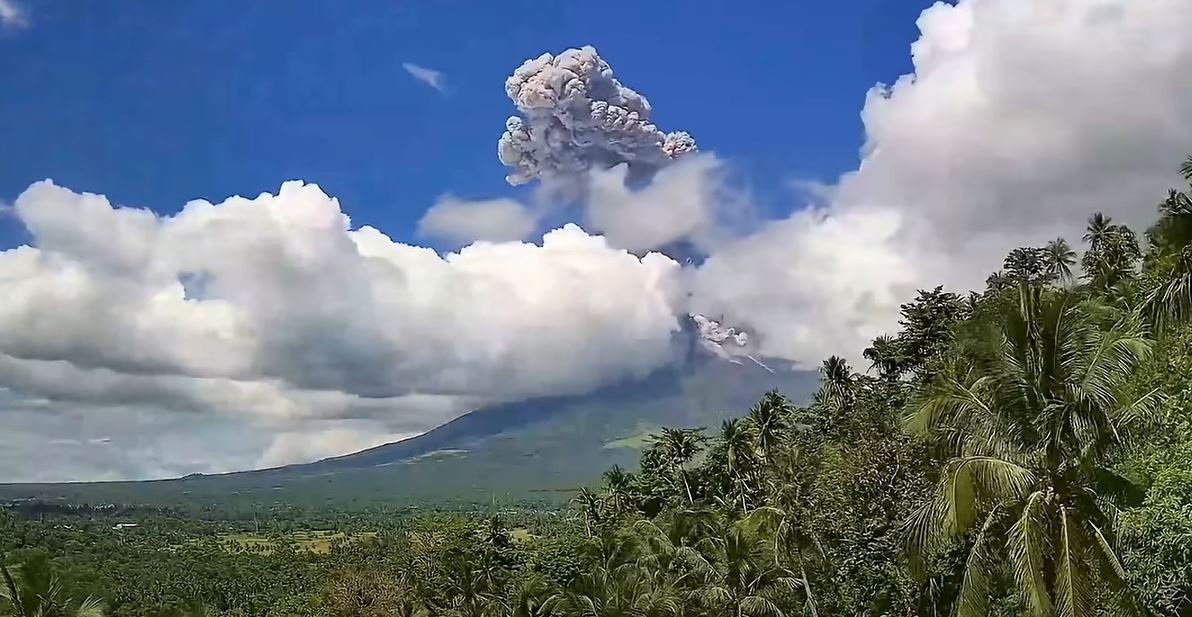
An eruption was recorded at Mayon Volcano at around 11:53 a.m. on Friday. The activity reportedly generated a grayish plume that rose approximately 3,000 meters above the crater and drifted west-southwest.
PHIVOLCS announced that Alert Level 3 is now in effect over Mayon Volcano, signaling an escalating risk of a hazardous eruption.
According to Bornas, the bureau currently sees no signs of a major eruption following the recent activity. However, state volcanologists are not ruling out the possibility.
“Sa ngayon po ay wala po tayong nakikita sa ating monitoring parameters na lalala po nang husto ang kalagayan ng bulkan, pero hindi po natin sinasabi na walang posibilidad. We go by our day-to-day monitoring data,” Bornas said.
(Right now, we see nothing in our monitoring parameters indicating that the volcano's condition will deteriorate severely, but we are not saying there is no possibility. We go by our day-to-day monitoring data.) —LDF, GMA News
KioskNews shows a cleaned-up reading view extracted from the publisher’s page — the original always lives on their site, not ours.