Nasa knocked an asteroid off course. New closeup photos shed light on aftermath
Humanity may not yet have a means of fending off a Vogon constructor fleet – the destroyers of Earth in The Hitchhiker’s Guide to the Galaxy – but its prospects of surviving an encounter with a rogue asteroid are looking considerably brighter.
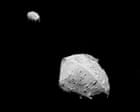
Four years after Nasa deliberately slammed a spacecraft into a roughly 160-metre-wide asteroid called Dimorphos to knock it off course, scientists have released the first closeup images of the aftermath.
They suggest the asteroid now has one face flattened with a stadium-sized crater and is tumbling chaotically. Meanwhile, hundreds of previously unknown boulders encircle Dimorphos and its larger companion asteroid, Didymos.
As well as shedding new light on what happened to the asteroid after the collision, the images, captured by the European Space Agency’s (Esa) Hera spacecraft, could help scientists design more effective missions to deflect potentially hazardous space rocks in the future.
“Nasa’s Dart [Double Asteroid Redirection Test] mission demonstrated that we can change an asteroid’s orbit. Hera is now revealing what happened to the asteroid itself,” said the Hera mission manager, Ian Carnelli, at Esa. “By combining these two missions, humanity is taking a decisive step towards making asteroid deflection a reliable tool for protecting our planet.”
Nasa’s mission aimed to test-drive a planetary defence system that could prevent humanity from going the same way as the dinosaurs, should an asteroid or comet threaten Earth.
Neither Dimorphos nor its larger companion asteroid, Didymos, posed such a threat, but their movements provided scientists with a convenient means of assessing whether the strategy of trying to knock an asteroid off course might work.
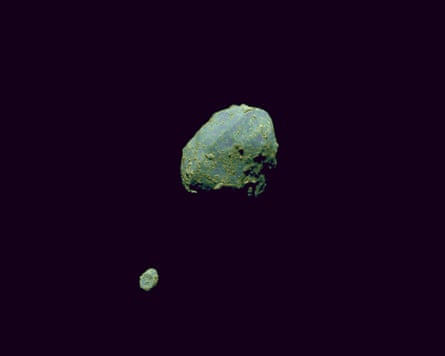
On 26 September 2022, the roughly half-tonne Dart spacecraft ploughed into Dimorphos at more than 13,000mph, blasting a vast cloud of rocky debris into space.
Observations by telescopes on Earth revealed that the mission had succeeded in shortening the time it took Dimorphos to orbit Didymos by about 33 minutes. Before the collision, Nasa officials had said a change of 73 seconds or more would be considered a success.
But how much of the asteroid was displaced and precisely how it responded to the collision have remained open questions.
To investigate, Esa launched its Hera mission on 7 October 2024. After a two-year journey, the car-sized spacecraft reached the asteroid pair this month and has been surveying them from a distance of 15-18 miles (25-30km).
“Scientists debated whether Dimorphos had sustained an impact crater, changed its shape or stayed the same,” said Dr Patrick Michel, Hera principal investigator and director of research at the CNRS Côte d’Azur observatory in France. “Much to our surprise the answer turns out to be all three at once. The face struck by Dart has been flattened into an impact crater the size of a sports stadium, which extends across the asteroid’s entire width.”
While the rest of Dimorphos appears to be relatively unchanged, the impact has also left Dimorphos “tumbling wildly in its orbit”, added Dr Michael Kueppers, the Esa’s Hera mission scientist.
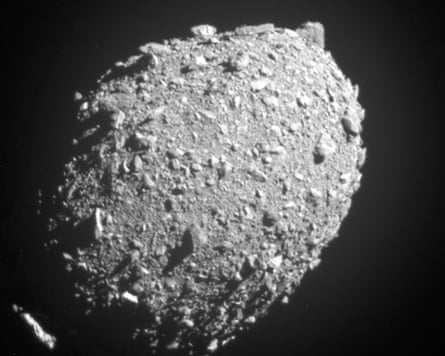
“Another big surprise is that Hera is showing that the asteroids are surrounded by hundreds of orbiting boulders, just a few metres in size,” Kueppers said.
Dr Michaël Marsset, an astronomer at the European Southern Observatory in Germany, described the release of the images as “a major milestone for both planetary defence and asteroid science”.
Unlike naturally occurring asteroid collisions, scientists knew precisely the mass, velocity and trajectory of the projectile and now had images of the asteroid before and after the impact, he said. “This offers a unique opportunity to study the physics of impacts at the scale of an asteroid.”
The Dart impact may also have exposed pristine material beneath Dimorphos’s weathered surface, offering scientists a rare glimpse of its interior, Marsset added.
Over the coming months, Hera will venture progressively closer to the asteroids and deploy two shoebox-sized satellites, one of which will use radar to peer inside Dimorphos.
The ultimate aim of these investigations is to transform asteroid deflection from a successful one-off experiment into a reliable means of planetary defence.
“The initial idea of deflecting an asteroid is not as straightforward as it sounds,” said Dr Ian Whittaker, a senior lecturer in physics at Nottingham Trent University. Although the momentum transferred by a spacecraft colliding with an asteroid should alter its motion, much also depends on how the asteroid responds to the impact, including how much material is blasted into space.“These images will help with understanding what is present after the impact and make for more accurate calculations in the future,” he said.
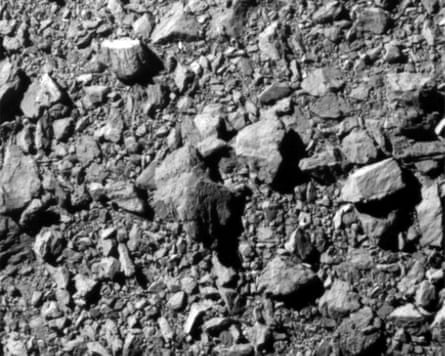
Asteroids are also remarkably diverse, ranging from relatively solid bodies to loose piles of rocks held together by their own weak gravity, said Marsset. “If we ever have to deflect another asteroid, this time on a collision course with Earth, we need to know what we are shooting at.”
The other major challenge is detecting potentially hazardous asteroids sufficiently early. Given years or decades of warning, even a tiny change in an asteroid’s velocity could be enough to make it miss Earth. “If it is discovered only months before impact, our options become considerably more limited,” Marsset said.
However, he added that major advances in asteroid detection were expected from the Vera C Rubin Observatory in Chile and Nasa’s forthcoming Near-Earth Object Surveyor space telescope. “These two complementary surveys will greatly improve our ability to discover potentially hazardous asteroids and, crucially, give us more time to respond.”
Whereas Douglas Adams’s Earth inhabitants were given mere minutes’ warning of their destruction, such advances could afford us both the time and the technology to avert our own.
KioskNews shows a cleaned-up reading view extracted from the publisher’s page — the original always lives on their site, not ours.