Stephen King's Sci-Fi Novel Has One of the Most Unsettling Endings in Literary History

Jeremy has more than 2800 published articles on Collider to his name, and has been writing for the site since February 2022. He's an omnivore when it comes to his movie-watching diet, so will gladly watch and write about almost anything, from old Godzilla films to gangster flicks to samurai movies to classic musicals to the French New Wave to the MCU... well, maybe not the Disney+ shows.
His favorite directors include Martin Scorsese, Sergio Leone, Akira Kurosawa, Quentin Tarantino, Werner Herzog, John Woo, Bob Fosse, Fritz Lang, Guillermo del Toro, and Yoji Yamada. He's also very proud of the fact that he's seen every single Nicolas Cage movie released before 2022, even though doing so often felt like a tremendous waste of time. He's plagued by the question of whether or not The Room is genuinely terrible or some kind of accidental masterpiece, and has been for more than 12 years (and a similar number of viewings).
When he's not writing lists - and the occasional feature article - for Collider, he also likes to upload film reviews to his Letterboxd profile (username: Jeremy Urquhart) and Instagram account.
He has achieved his 2025 goal of reading all 13,467 novels written by Stephen King, and plans to spend the next year or two getting through the author's 82,756 short stories and 105,433 novellas.
Sign in to your Collider account
While Stephen King mostly writes horror, or he’s at least most well-known for the work he’s done in that genre, by no means is horror all you're going to find if you take a deep dive into his bibliography. He doesn’t mind writing science fiction, and he’s combined the horror and sci-fi genres to great effect before, with The Dead Zone being an early example of that, even if it’s probably a bit more science fiction in nature. There’s also The Long Walk, which is dystopian and absolutely horrifying (though written under the Richard Bachman pseudonym), and Under the Dome, which is like a post-apocalyptic novel done on a small scale, feeling disturbing throughout and being at least a little sci-fi-focused. These are all pretty well-known Stephen King books, but one that does sometimes get overlooked is Revival, which was published in 2014, and is therefore one of the more recent Stephen King books in the overall scheme of things.
Like, it came out 40 years on from his first published novel, Carrie, and stands out for being one of the nastier and more outwardly downbeat horror novels he’s written in the 21st century so far. And it has been a good century for King, absolutely, but most of his truly distressing works of horror came out in the 20th century, when Stephen King was a little younger and maybe a bit more willing to go for the jugular, so to speak. Still, Revival shows he’s still got something of a mean streak, or at least the capacity to shock even at this later stage in his writing career, and so Revival stands out against some lighter and perhaps sappier late-era works of his (well, compared to a good deal of his 1970s and 1980s horror). Part of Revival’s impact does come down to how it ends, so skip the second section of this if you don’t want to know the details of that. Otherwise, it’s still interesting to talk about some of what happens earlier on in Revival, and it’s also worth briefly covering how it stacks up against some other Stephen King books, and suggesting which ones have certain similarities to Revival.
The Story of 'Revival' Before the Ending
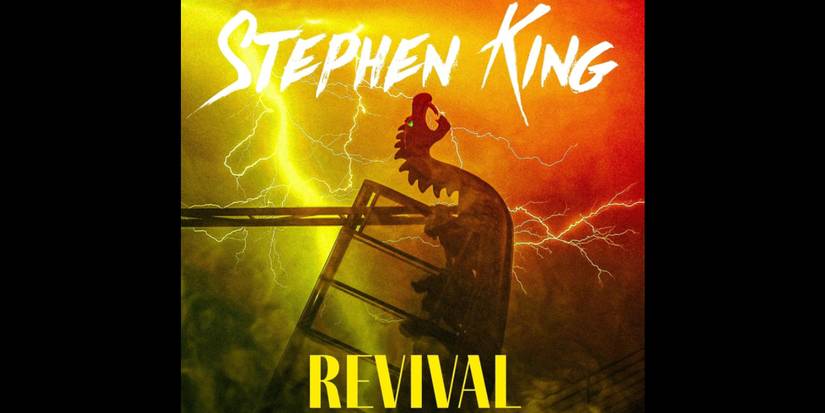
As is the case with quite a few Stephen King novels, Revival feels fairly spontaneous, kind of just unfolding in a way that feels unpredictable, and part of that has to come down to King’s approach to writing. He doesn’t 100% make things up as he goes along, but he doesn’t mind writing a story without knowing the ending ahead of time, and that sometimes works, and occasionally doesn’t. In Revival, it works. There is a lot that happens before it ends on such a strong note, with the early parts of Revival taking place at a point in time when the protagonist, Jamie Morton, is very young. He lives in a small town and gets excited when a minister comes into that town, and most other people who live there instantly like the minister. But it’s a Stephen King book, and so you're not going to get something that’s a nice slice-of-life sort of thing about faith and growing up for 400-ish pages.
There is a bit of a Frankenstein thing going on, with Jamie almost being like an assistant to Jacobs, and then various horrors present themselves and start to, naturally, get more intense.
There is an exploration of those things, and certain difficulties regarding getting older are explored once the protagonist matures into a young man (and musician). But before then, tragedy strikes the minister, his wife, and their child, because the latter two die in a sudden accident. The minister is driven mad with grief, and disappears for a while, with Jamie reconnecting with him by chance when he’s a troubled adult with his own problems. He then learns that the minister, Charles Jacobs, is obsessed with death and the idea of either bringing the dead back to life or contacting those in the afterlife. There is a bit of a Frankenstein thing going on, with Jamie almost being like an assistant to Jacobs, and then various horrors present themselves and start to, naturally, get more intense in the book’s second half.
Why the Ending of 'Revival' Packs Such a Punch

To address that ending, because it’s noteworthy and elevates Revival from something good to great, the experiments work, but in a troubling way, revealing things that people would've been better off not knowing. Oh, and Jacobs healed a bunch of people while pursuing his death/afterlife-related experiments, but bad things start happening to those people, too. That’s bad, but the worst part is Jacobs finding himself able to communicate with his now long-dead wife, though he learns from her that Heaven doesn’t exist, which obviously disrupts what he had once believed, as a minister, and then a particularly horrific version of Hell is revealed instead. There’s a bit of time spent in this dimension, in effect, and Revival goes far enough to suggest that everyone, no matter how they lived while they were alive, ends up there after death.
Jamie does technically survive, but he knows the truth about existence and what happens once you no longer exist, and then he also knows where he’ll end up, so the final chapter of Revival has him reckoning with that and knowing the rest of his life will be one of despair and anxiety. Plenty of people have died in plenty of Stephen King novels, but if Revival is connected to those, and this is what death is within King’s multiverse, then that’s a truly horrific concept, and it’s harrowing to think about all the endearing characters who ended up there. Thinking of Revival as a standalone work is only a small comfort, because there’s still a fictional world King’s created that has one of the most singularly unpleasant depictions of the afterlife in literary history straight up confirmed and, further, declared unavoidable.
How 'Revival' Compares to Stephen King's Other Books
If you liked Pet Sematary, which is an absolute horror classic from fairly early on in Stephen King’s writing career, then Revival is a pretty easy book to recommend. There is a different dynamic with the main characters, since Pet Sematary is more about a family, but both books are heavy on themes of death, grief, and, y’know, coming back from the dead. Pet Sematary has it happen as more of a supernatural thing, while Revival is more a work of science fiction, and there are experiments that lead to things coming back wrong. But things come back wrong in both, is the main point of comparison, but there are enough differences to make both Pet Sematary and Revival engrossing and disturbing; it’s not like you read one and then you know exactly what to expect out of the other.
There is also time spent with the protagonist as a child and adult, a little like how IT flips back and forth between the characters being at two different stages of their lives, and if you're thinking about truly miserable Stephen King novels, then Revival kind of scratches the same itch as Cujo (that one definitely has one hell of an ending). Also, Revival is a refinement on some other Stephen King horror/sci-fi novels that missed the mark, including The Tommyknockers, Dreamcatcher, and From a Buick 8. All of those combine the two genres fairly evenly, and all three definitely have things to offer, but the lot of them all fall apart in their back halves, while Revival starts intriguing with a good first half, and then explodes into something genuinely great by the time it reaches, say, the back half of its back half… so, the final quarter of Revival is incredibly strong. It’s often talked about how effective the ending is here, and how much better it is than a few other more divisive Stephen King endings, but it’s true. It’s certainly a novel worth sticking with, and overall feels like one of King’s strongest novels of the century so far for sure.

- Birthdate
- September 21, 1947
Stephen Edwin King was born the second son of Donald and Nellie Ruth Pillsbury King. After his father left them when Stephen was two, he and his older brother, David, were raised by his mother. Parts of his childhood were spent in Fort Wayne, Indiana, where his father's family was at the time, and in Stratford, Connecticut. When Stephen was eleven, his mother brought her children back to Durham, Maine, for good. Her parents, Guy and Nellie Pillsbury, had become incapacitated with old age, and Ruth King was persuaded by her sisters to take over the physical care of them. Other family members provided a small house in Durham and financial support (via Goodreads).
KioskNews shows a cleaned-up reading view extracted from the publisher’s page — the original always lives on their site, not ours.