Jensen Huang’s return reassures Taiwan suppliers, people say
By Chao Yen-hsiang / CNA, with staff writer


For Taiwanese suppliers, Nvidia Corp chief executive Jensen Huang’s (黃仁勳) comeback offered reassurance about product development, manufacturing plans and the investment underpinning the artificial intelligence (AI) boom. But political and regulatory uncertainties remain, according to a technology commentator and a researcher.
Describing Nvidia as the AI industry’s "central bank," veteran technology journalist Owen Lin (林宏文) told CNA on Wednesday that Huang’s importance extends beyond technology and supplier relationships to the financing of companies building the sector.
Among the beneficiaries were so-called neocloud companies, which provide computing power for AI developers and other customers, Lin said.
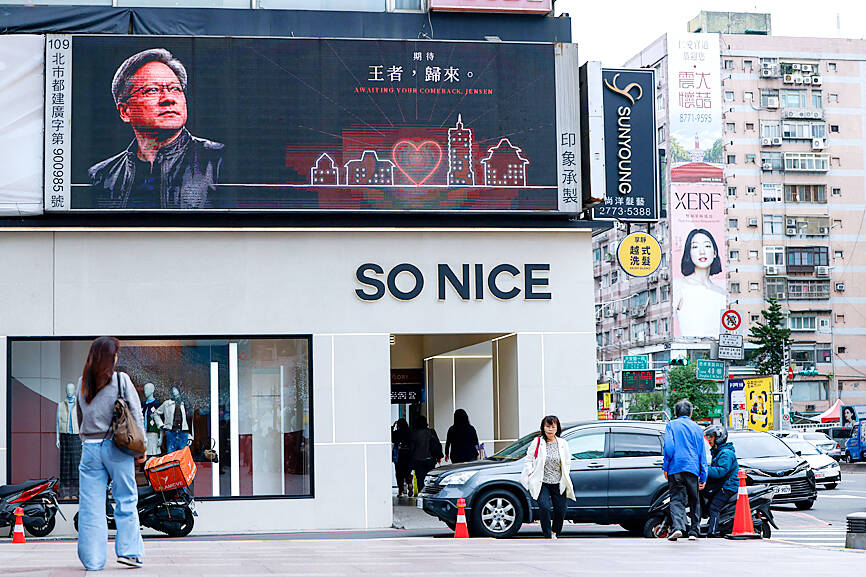
An electronic billboard displays messages supporting Nvidia Corp CEO Jensen Huang in Taipei yesterday.
Photo: Ann Wang, Reuters
"When Huang left, what everyone worried about was that this entire funding chain would break," said Lin, who has followed Taiwan Semiconductor Manufacturing Co (TSMC, 台積電) for more than three decades and is the author of "Chip Champion: The Triumph of TSMC and Taiwan."
Huang’s return reduces the risk of financing disruptions, although investment growth could slow and spending could come under closer scrutiny, Lin said.
LONG-STANDING TIES
Lin expected Huang’s Taiwanese partnerships to endure because suppliers trusted his ability to guide technical development, adjust specifications and put decisions into practice.
"I don’t think Taiwan’s relationship with him will change much," he said.
Those relationships have a public face in Huang’s night-market outings and supplier dinners, dubbed "trillion-dollar banquets" for the corporate heavyweights attending.
Discussing nearly three decades of business with TSMC on Lex Fridman’s podcast, Huang described the depth of that trust: "We don’t have a contract. That’s pretty great."
At The New York Times DealBook Summit last week, Tesla Inc CEO Elon Musk cited Huang’s technical expertise and decades-long supplier relationships, maintained through activities including street-food excursions in Taiwan and South Korea.
"There’s no one that can really replace Jensen," Musk said.
Chiu Yu-ning (邱佑寧), a nonresident fellow at the Research Institute for Democracy, Society and Emerging Technology (DSET), a government think tank, agreed in a written response to CNA that trust helps partners share requirements and develop solutions under tight deadlines, sometimes without long-term contracts.
"Institutional arrangements should sustain longstanding trust beyond the commitments of any single executive," Chiu said.
SAME CHIEF, NEW CIRCUMSTANCES
Huang returns to a different governance structure. Harvey Jones remains board chairman, while Nvidia has established independent board oversight of national security and export controls and is recruiting a chief compliance officer.
Lin viewed those constraints primarily as affecting Nvidia’s access to the Chinese market rather than fundamentally changing cooperation with Taiwanese suppliers.
He expected US restrictions to tighten, while arguing that the consequences for Nvidia’s overall business might be less severe than feared.
Nvidia’s board consulted senior US officials before reinstating Huang. Despite US President Donald Trump’s assurances that Huang’s return posed no national security risk, the company’s independent investigation continues.
Moreover, three Republican House committee chairmen confirmed that Huang and Nvidia general counsel Tim Teter would undergo transcribed interviews on Dec. 1 and Dec. 2, respectively.
Chiu emphasized that US technology policy involves multiple agencies and the US Congress, where advanced-chip restrictions on China have bipartisan support.
"From an economic security perspective, however, leadership continuity does not resolve the uncertainty surrounding US policy," Chiu said.
She cited new US licensing requirements covering certain overseas chip shipments and remote access to advanced computing power, saying they added uncertainty to suppliers’ investment plans.
For Taiwanese suppliers, the additional compliance burden and licensing uncertainty could delay projects or reduce orders even after companies have committed capital, Chiu said.
Compliance checks must therefore look beyond shipment destinations to establish who operates equipment and ultimately uses its computing capacity, she said.
BEYOND NVIDIA
Chiu said engineering networks connecting Hsinchu Science Park (新竹科學園區) and Silicon Valley have helped reduce communication costs and turn new technologies into reliable production.
"Expanding these networks to new customers and emerging fields such as robotics and quantum technology can create opportunities that reinforce Taiwan’s domestic capabilities while reducing dependence on a single customer," Chiu said.
Lin similarly expected growth in the AI chip market to extend increasingly beyond Nvidia, pointing to the rapid development of Google’s tensor processing units.
Taiwanese suppliers that once focused on serving Nvidia could find opportunities with companies such as Google, Amazon.com Inc, Microsoft Corp and Meta Platforms Inc, which also need Taiwan’s chip manufacturing and design services as they develop custom chips, Lin said.
Among the potential beneficiaries, he said, were TSMC, Alchip Technologies Ltd (世芯), Global Unichip Corp (創意) and MediaTek Inc (聯發科).
KioskNews shows a cleaned-up reading view extracted from the publisher’s page — the original always lives on their site, not ours.