US states vote on abortion, redistricting
BALLOT MEASURES: The issues are a public test of support for Trump’s attempts to reshape congressional districts, limit transgender athletes and strengthen voter ID
A battle over abortion rights is playing out in several states as voters yesterday decided on 145 proposed laws and constitutional amendments, including some that could affect voting.
The ballot measures provide a political undercard for a high-profile midterm election that would determine which party controls Congress, state legislatures and gubernatorial offices in many states.
Some measures put US President Donald Trump’s priorities to a public test by gauging support for his attempts to reshape congressional districts, limit transgender athletes in sports and strengthen voter identification requirements.
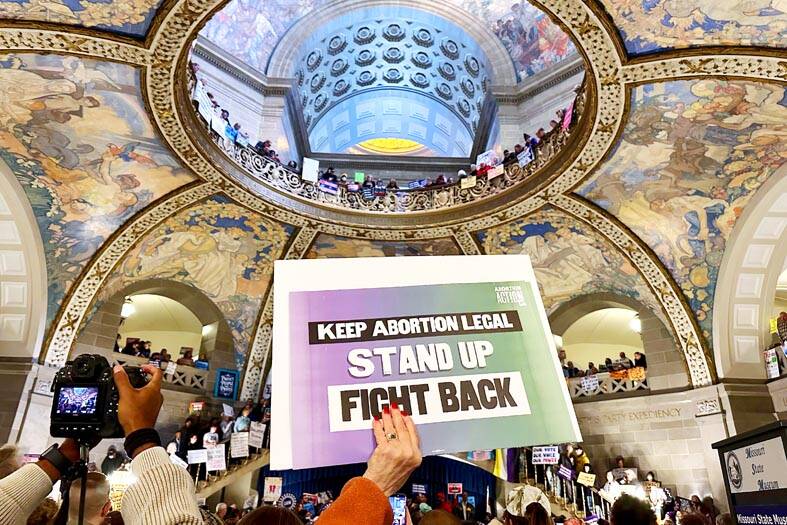
Abortion rights supporters rally inside the Missouri Capitol on Jan. 21 in Jefferson City, Missouri.
Photo: AP
ABORTION BAN
Two years ago, Missouri voters became the first in the nation to pass a ballot measure undoing a ban on most abortions.
Now voters are deciding whether to repeal the 2024 abortion rights amendment and replace it with a new prohibition — this time allowing exceptions for medical emergencies and fetal anomalies, and in cases of rape or incest up to 12 weeks of pregnancy. The proposed ban was placed on the ballot by the Republican-led legislature. Abortion rights advocates, led by national progressive groups, have greatly outspent abortion foes in a bid to defeat the measure.
In three other states, ballot measures would create a right to abortion using standards similar to what was in place nationally before the Supreme Court overturned Roe v Wade in 2022 and opened the door to state bans.
Ballot measures in Idaho and Nevada would block bans on abortion before fetal viability, usually considered after 21 weeks. Nevada voters already approved the measure once, but have to do so a second time for it to become official. In Virginia, an amendment would ensure abortion is allowed for the first two trimesters.
REDISTRICTING
Nine states are using new congressional districts in the midterm elections after a rare spate of mid-decade redistricting encouraged by Trump.
Missouri’s Republican lawmakers also had adopted new House districts designed to help Republicans win an additional seat, but courts ruled they cannot be used unless first approved by voters in a referendum this month. If passed, the districts would take effect for the 2028 election.
Voters in Democratic-led Maryland are deciding on a constitutional amendment that also could pave the way for new congressional districts in the 2028 election. Democratic proponents, backed by former US president Barack Obama, have urged a “yes” vote as way to “stop Trump.”
Some Democrats also want to redistrict in Colorado, but a citizen initiative on the ballot would prohibit any potential 2028 redistricting from favoring one political party and require approval from both an independent commission and the state Supreme Court.
TRANSGENDER LIMITS
Voters in Arizona, Colorado, Missouri, Nebraska and Washington are considering measures restricting transgender athletes or medical procedures. That comes as Trump’s administration has been pushing for restrictions impacting transgender people, especially young people.
Most Republican-led states already bar transgender women and girls from female school sports teams. Citizen-led ballot initiatives propose similar restrictions in the Democratic-led states of Colorado and Washington. The Arizona measure would extend public school sports restrictions to private schools, and Nebraska’s measure would add existing restrictions to the state constitution.
A second ballot question in Colorado would ban some transgender medical treatments for minors. The Missouri abortion amendment also would add existing transgender medical restrictions to the state constitution.
VOTER ID
Though Trump’s push for nationwide voter ID mandates remains stalled in Congress, citizen activists bypassed Democratic-led state legislatures to place new voter ID requirements on the ballot in California, Colorado and Nevada.
Those measures would require government-issued identification — such as driver’s licenses or partial Social Security numbers — to cast ballots. The Nevada amendment already won approval in 2024, but needs a second vote to take effect.
Measures referred to the ballot by Republican-led legislatures in North Carolina and Ohio would enhance existing voter ID requirements by placing them in the state constitution.
CITIZEN VOTING
Ballot measures in Alaska, Arizona, Arkansas, Kansas, South Dakota and West Virginia would reinforce current election practices limiting voting to US citizens.
Critics argue the measures are largely symbolic and unnecessary, because voting by noncitizens is rare and already forbidden in federal elections. However, noncitizens are allowed to vote in some local elections in California, Maryland, Vermont and the District of Columbia.
Two years ago, similar citizen voting amendments won approval in all eight states where they appeared on ballots.
KioskNews shows a cleaned-up reading view extracted from the publisher’s page — the original always lives on their site, not ours.