After over 10 years of racing, Shanti Pereira still gets ‘very nervous’
A grim-faced herd of runners clatter round the track, a lone hammer thrower whirls in a cage, a gaggle of high jumpers gather to defy gravity. As a light wind rustles through the Home of Athletics (HOA) on the evening of Sept 8, most of the attention is reserved for a woman connected profoundly to the earth.
Shanti Pereira is breezing barefoot across the grass.
Singapore’s fastest woman is like a race car warming up in the pits. Right now her engine is only at a low growl. But on Sept 27 her afterburners will light as she attempts to go where no Singaporean track athlete ever has. To a second Asian Games gold in the 200m.
Nervous?
Yes.
After all she’s done, Asian Championships won, the Olympics reached, the World Championships qualified for, the Commonwealth Games final raced in, anxiety still chews at her insides.
“I still get very nervous,” she says, “but I think it’s about being okay with that, I guess, and realising that it’s normal. It means I care about what I’m doing and I’m excited, I’m pumped. Yeah, there’s a little bit of fear in there, but where is there no fear?
“I’ve been in so many packed stadiums and big moments, but those big moments never get easier. They perhaps get even harder, just because the more you achieve, the more pressure there is.”
Pereira’s athletic life has an exploration of persistence, about building belief even while doubt, expectation and injury have stalked her. Pressure never dims yet athletes fight it with effort. Sweat eventually dilutes stress. If running is her religion, practice is her faith. It is the only way to gold.
As Pereira stretches, coach Luis Cunha shows me videos on his phone as he walks me around the 200m track. It’s a privilege, like a boxing trainer showing you his fighter’s dance steps in a ring.
The race starts on a curve, so the starting blocks are on an angle. When the gun goes off, Cunha starts counting. Time from Pereira’s hands moving to back foot exiting the blocks: Ideally 0.10 of a second. Time to first foot touching the track: Ideally 0.30sec. The ideal is elusive in sport, for the wind interferes and so does a wet track and a tired body, yet the ideal must be chased.
Cunha doesn’t view the 200m track as one, vast curved runway. Instead he sees a race in bits and pieces. A jigsaw of speed. A puzzle of precision. At the eighth step, he points out, Pereira should ideally be just over the 10m mark. Time: 1.9sec. By the 13th step, she should be at the 20m mark. Time: 3sec.
As we chat a hurdler steams by in the next lane but Cunha is focused. A scientist bent on creating an artist. The first 50m, he says, should take roughly 26.5 steps (time: 6.2sec or 6.3sec), the second 50m 23 steps, the last 100m 45 to 46 steps.
This precision is pursued in training because once the gun goes off it’s too late. “The goal,” Pereira says, “is to be able to not think at all during the entire race.
“Just let it go.”
Where she wants to think, she says, is here, on evenings like this at the HOA, where she refines her technique. “Going on the track is supposed to feel effortless... because I do all the hard work here.
“It’s like studying for an exam. I’m supposed to be able to do it flawlessly because of all the training that I’ve done. And so it’s just full trust and full confidence. Just execute. All I’m thinking about is just getting out and letting my body flow.”
Everything has been polished – her starts, first steps, knee action, even composure. I ask if panic ever triggers and she says, “for sure”.
“It could happen when you feel someone close to you. And if you don’t practise that composure in training, then it could lead to panic. Like suddenly your technique just goes all over the place. Essentially, for sprinting, the more relaxed you are, the faster you go.”
By the time Sept 27 arrives, Pereira will have long visualised her race. In the past 13 years she’s done over 120 races yet it still requires a sort of advance dreaming where she sees herself coming out of the curve. “That’s about it. I don’t really feel the need to zoom in and visualise every single step. Because to me, coming out of the curve is like, it’s okay, home straight.”
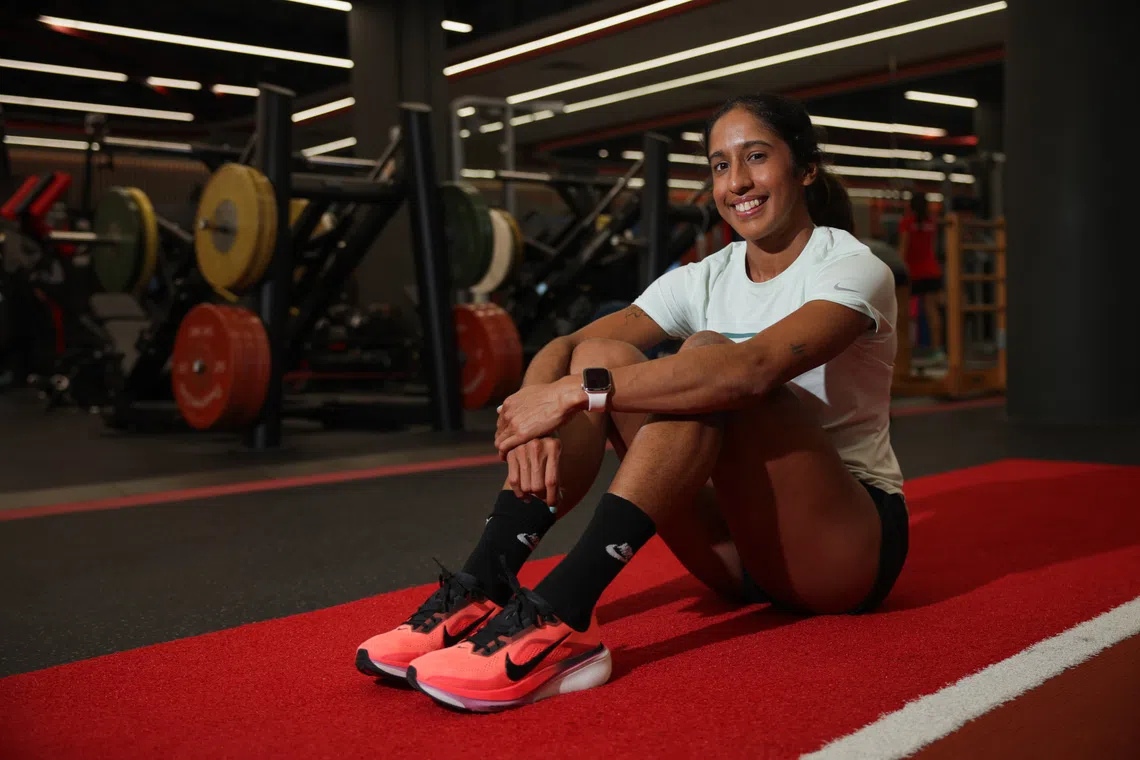
Shanti Pereira’s athletic life has an exploration of persistence, about building belief even while doubt, expectation and injury have stalked her.
ST PHOTO: GIN TAY
As race time approaches, her body will feel the moment. Her heartbeat may gallop. Sometimes a toilet calls. She’ll recite private words to herself which she tells no one. Not even Cunha. Then she’ll bend into the blocks, place her fingers on the track, and extend her legs when “set” is called. When the gun fires she will imitate a human stone launched from catapult.
Pereira prefers lanes six to eight because the curve is gentler, yet by the straight the runners are often a bunched blur, all of them decelerating, fighting fatigue, trying to keep technique pure till the end.
In 2025, Pereira lost the 200m at the Asian Championships to China’s Chen Yujie by 0.01sec. Death by dip is the worst end. And this is the last piece of immaculate timing Cunha wants from her, the dip, which she’s practised till it’s burnt into her instinct. If you dip too early, he says, “you lose time”.
He spreads his arms and dips to show me how it’s done.
“Voom,” he says, using sound to imitate how he wants her to finish.
He’ll be studying her during the 200m final at the Nagoya City Mizuho Park Athletic Stadium, trying to enjoy this moment of intense emotion. We’ll be at home in Singapore, watching her and wanting from her. Our affection for her eventually transforms into expectation and she can feel this pressure but she must forget it, must just run freely, her legs like wings, her body taking flight, while in front of our TVs we’ll just hold our breath for 23 tense seconds.
KioskNews shows a cleaned-up reading view extracted from the publisher’s page — the original always lives on their site, not ours.