Remains of medieval tsar return to Bulgaria after decades-long dispute with Greece
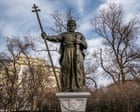
The remains of medieval ruler Tsar Samuel will arrive in Bulgaria on Saturday amid great pomp and ceremony, after decades of negotiations with neighbouring Greece.
The remains – discovered in a Greek border area 60 years ago – are to be flown to the Bulgarian capital, Sofia, onboard a military aircraft to be received with full state honours, including a fighter jet escort, a 21-gun salute and a procession to the Church of St Sophia, where the public will be able to pay respects.
The Greek prime minister, Kyriakos Mitsotakis, said he hoped the handover would bolster Athens’s campaign to persuade Britain to return the Parthenon marbles, a collection of 2,500-year-old sculptures taken from the Acropolis and held by the British Museum.
“The global community is essentially re-evaluating its longstanding stance on protecting cultural heritage,” he said. “This shift is embodied by today’s initiative, which rests on the obvious principle that monuments and historical heirlooms cannot be treated as spoils of war, nor as the result of circumstances subsequent to their creation.”
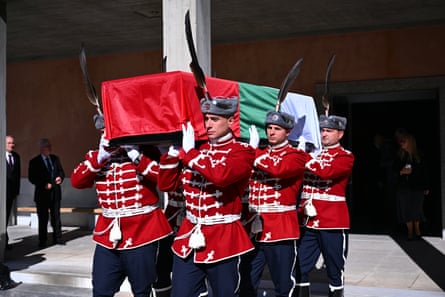
Samuel was a warrior ruler who battled the Byzantine empire to expand his kingdom, but was ultimately defeated and died shortly afterwards in 1014. He is considered a symbol of Bulgaria’s national identity.
The handover of his remains follows an agreement earlier this week between the two countries’ culture ministers, under which Bulgaria will return religious relics taken from Greek monasteries during the first world war.
Several prominent Greek academics and religious leaders have raised concerns about the adequacy of Bulgaria’s contributions.
Mitsotakis and his Bulgarian counterpart, Rumen Radev, attended a ceremony at Thessaloniki’s Museum of Byzantine Civilization, where the remains were kept, before the handover.
“These are items that belong to both our peoples; they constitute our memory and our bond, and our compatriots and future generations deserve and must have the opportunity to pay tribute to their ancestors,” Radev said, speaking at the ceremony held at the museum.
“If in the past Tsar Samuel divided us, I can say that today he unites us. He strengthens our strategic cooperation and makes the historical relations between our states and peoples even stronger,” Radev said.
KioskNews shows a cleaned-up reading view extracted from the publisher’s page — the original always lives on their site, not ours.