Working with Taiwan key to regional stability, Tsai says
Staff writer, with CNA, SAN FRANCISCO


Deeper international cooperation with Taiwan would not only strengthen its security, but also boost stability in the Indo-Pacific region and the resilience of other democracies, former president Tsai Ing-wen (蔡英文) said on Wednesday.
Technology and economic resilience are increasingly tied to national security, Tsai said in her keynote speech at the Stanford Conference on Technology and National Security, according to a statement from her office.
The conference was hosted by Stanford DEFCON, a student network under the Stanford Gordian Knot Center for National Security Innovation at Stanford University.
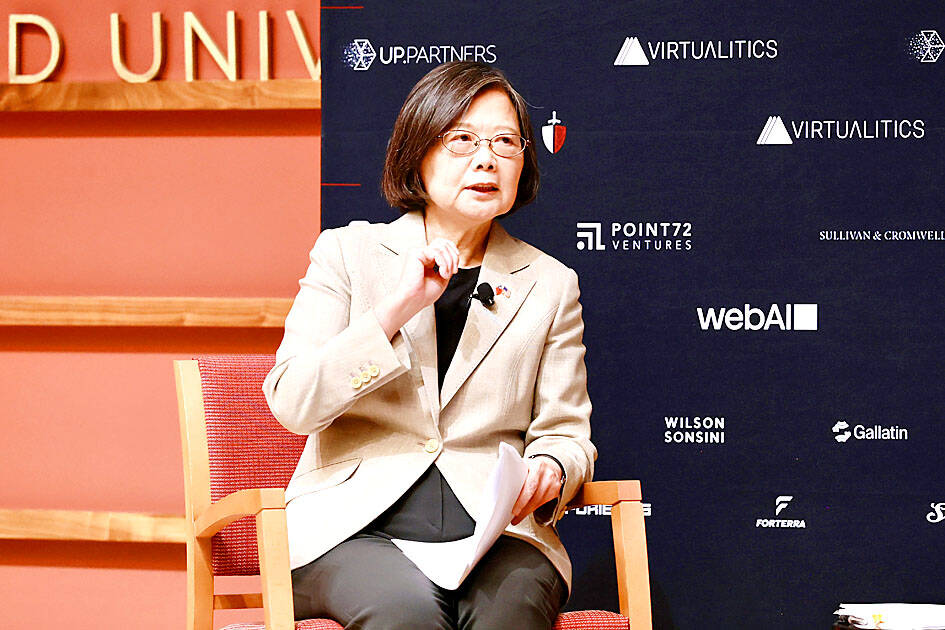
Former president Tsai Ing-wen speaks at Stanford University in California on Wednesday.
Photo courtesy of Tsai Ing-wen’s office
Maintaining peace in the Indo-Pacific region, where military power, technology and economic security intersect, is one of the major challenges facing the world, the former president said in a speech titled “Building Security Together: Taiwan’s Role in Global Stability.”
Chinese military aircraft and ships, as well as coast guard vessels, operate regularly around Taiwan, while cyberattacks, cognitive warfare, information manipulation and economic coercion have become almost daily occurrences, she said.
Amid sustained pressure, Taiwan has to do more than prepare for a major military contingency, while bolstering its defense and preserving its freedom, Tsai said.
“The Taiwan Strait is one of the world’s most important trade and energy routes, and Taiwan is deeply integrated into global technology and manufacturing networks,” she said. “A serious disruption would be felt throughout the Indo-Pacific and beyond.”
International coverage still often portrays Taiwan as a security challenge that requires support from other countries, but “that is only a part of the picture,” she said.
Taiwan is among a small number of democracies capable of adding manufacturing capacity to the challenge rather than simply consuming it, she said, citing the role of Taiwan’s semiconductor industry in global technology supply chains.
Noting that the US accounts for about three-quarters of the world’s artificial intelligence (AI) computing capacity, Tsai said Taiwanese companies manufacture nearly all of the advanced chips used in those systems and about 90 percent of the AI servers built around them.
“The AI economy, therefore, depends heavily on what Taiwan builds, and our contribution extends well beyond semiconductors,” she said.
Meanwhile, in the satellite industry, Taiwanese companies are major producers of radio-frequency chips and circuit boards used in communications and satellite systems, she said.
These capabilities are increasingly relevant to security, as the line between civilian and defense technologies becomes less distinct, Tsai added.
Taiwan’s position at the center of the First Island Chain, combined with its democratic system, technological capabilities and industrial strength, gives it a difficult-to-replace role, she said.
“A secure and resilient Taiwan contributes to a more stable Indo-Pacific, while its technological and industrial strengths reinforce trusted supply chains and reduce vulnerabilities far beyond the region,” Tsai said.
“Deeper cooperation with Taiwan, therefore, strengthens not only Taiwan’s own security, but also the stability of the Indo-Pacific and the resilience of the wider democratic community,” she added.
Following her speech, Tsai took part in a fireside chat moderated by Stanford DEFCON copresident Gordon Kim and attended by several Taiwanese students studying in the US.
Chang Chia-chi (張家綺), an MBA student, said Tsai’s discussion of Taiwan’s role in geopolitics and technology echoed the increasingly frequent discussions of Taiwan in her classes.
Chang said she hoped to draw on her experience in Taiwan and the US to help more people understand her homeland.
Another student Lin Hsin-yu (林芯?) said Tsai’s discussion of Taiwan’s key role in advanced chip supply resonated with her, particularly the facts about Taiwan’s indispensable link in defense-related supply chain.
Tsai arrived in San Francisco on Monday for a week-long visit, her first to the US since she completed two four-year terms as president in May 2024.
KioskNews shows a cleaned-up reading view extracted from the publisher’s page — the original always lives on their site, not ours.