‘Badlav’ to selling continuity: How AAP is fighting two elections in Punjab
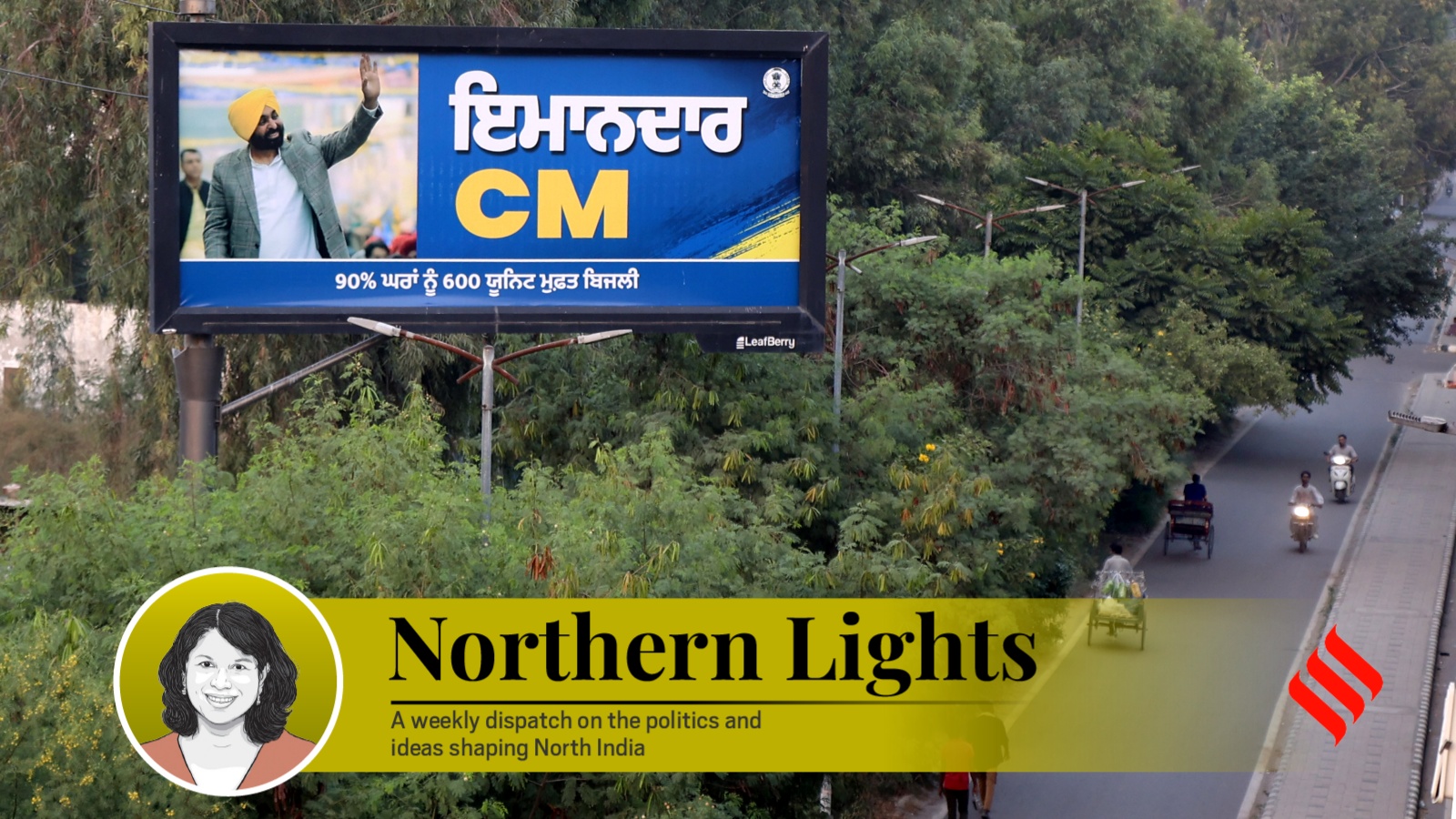
If a photograph can speak a thousand words, so can a billboard.
The Aam Aadmi Party’s (AAP) billboards along Punjab’s highways speak numbers. So do its radio ads. While the Opposition — Congress, BJP and the fragmented Akali Dals — has made drugs the emotional core of its campaign, the ruling party is running a different kind of narrative. It is asking voters to look at what can be counted.
In 2022, AAP rode a wave of badlav (change). This time it is presenting a balance sheet. Free power of 600 units every billing cycle (once in two months) for the vast majority of households. Monthly cash transfers to women under the Mawan Dheeyan Satkar Yojana; canal irrigation coverage that, by the government’s own figures, has risen from the low twenties to the high seventies or more; and the “Mann da Munafa” claim that every family is better off by Rs 1.82 lakh a year. The message is clinical: we delivered what we promised: free power began from July 2022 and the monthly payment to women from July 2026. Judge us on the numbers.
The approach is deliberate. Leave the rhetoric and the outrage to the Opposition and focus on what is tangible. At every lok milni (public meeting), which is almost a daily affair, Chief Minister Bhagwant Mann repeats the same line: “We have fulfilled all our guarantees and even more.” The party’s data crunchers from Delhi are learnt to be working overtime, mapping voters through the statewide drug survey conducted by teachers and government workers in the summer of 2026.
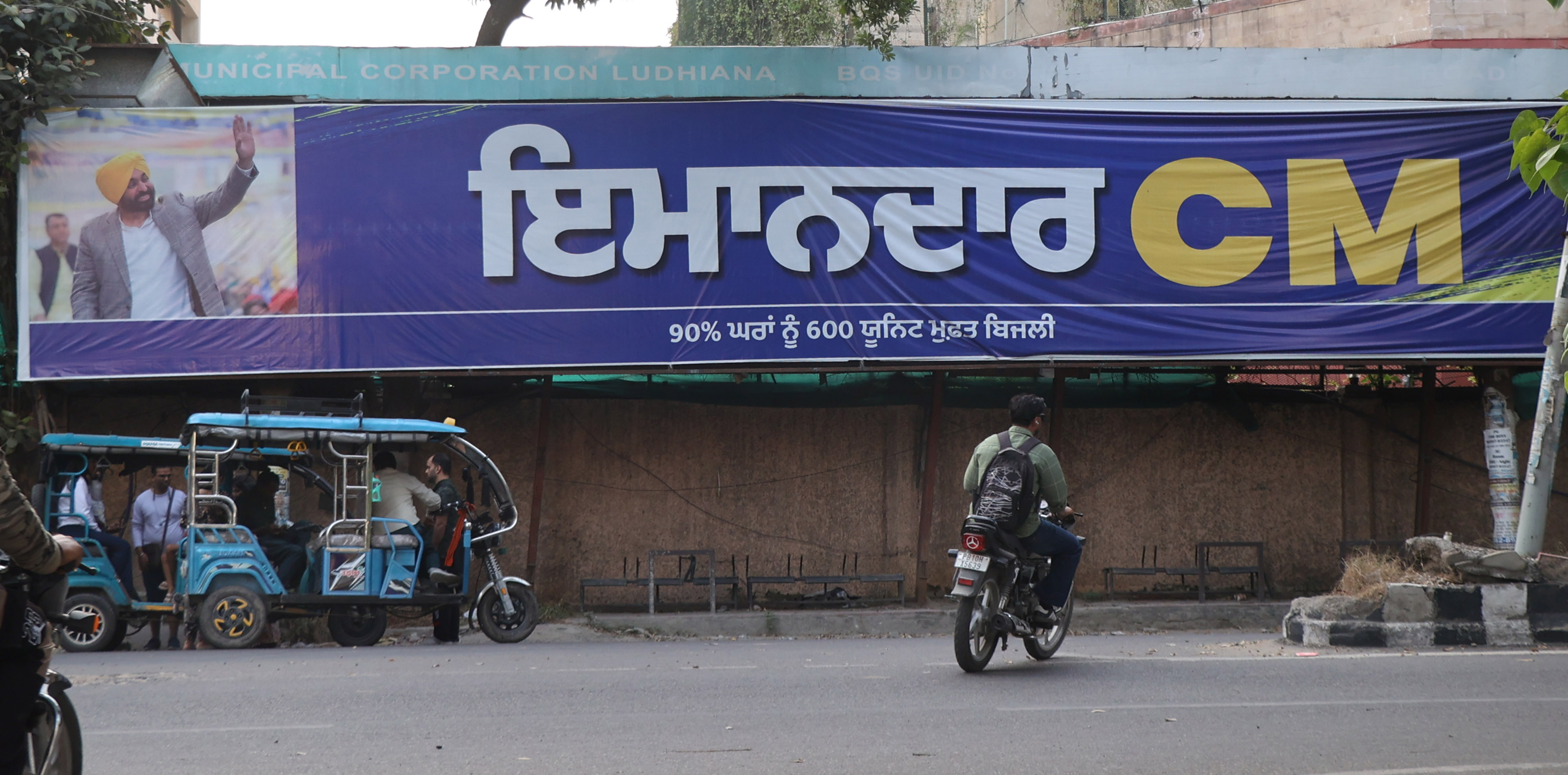 ‘Imaandaar’ CM hoarding in Ludhiana. (Express Photo by Gurmeet Singh)
Unruffled by this number game, the Opposition is focusing fiercely on drugs and the fear generated by gangsters. Senior BJP leader Tarun Chugh puts it sharply: “Does a mother who has lost a son care about the monthly dole?”
The charge is that the AAP is offering measurable benefits while the deeper wounds such as drugs, unemployment, and a sense of the state drifting away remain unaddressed.
What AAP’s battle looks like
Then there is another, more emotional, accusation: the Mann government is being run by outsiders with no sympathy or empathy for Punjab or Punjabis.
Which is why AAP is fighting two elections at once. The first is the conventional one: defend its record of welfare delivery. The second is more delicate. It is the attempt to demonstrate that Punjab’s government is no longer an extension of Delhi.
The charge of rule by proxy is slowly gaining ground. For much of the last four years, AAP supremo Arvind Kejriwal and the state in-charge, Manish Sisodia, were not just occasional visitors but visible co-architects of major statewide programmes. Kejriwal jointly launched the Mukh Mantri Sehat Yojana with CM Mann in January 2026, rolling out free cashless treatment of up to Rs 10 lakh for every family in the state. Sisodia led the Sikhiya Kranti education drive in April 2025, a 54-day campaign to upgrade infrastructure in nearly 12,000 government schools at a cost of around Rs 2,000 crore. Both leaders also repeatedly appeared at launches of Aam Aadmi Clinics and phases of the Yudh Nashian Virudh anti-drug campaign, reinforcing the perception that Delhi helmed key policy initiatives.
Even earlier, Rajya Sabha MP Raghav Chadha, who is now with BJP, was widely referred to as the “super CM”. The reason: He was given a government house neighbouring the CM’s residence in Chandigarh, where officers and party leaders queued up.
Then there was this little army of advisers from Delhi who were given fancy designations and housing so they could “develop” Punjab.
In an interview with The Indian Express, senior BJP leader Sunil Jakhar called Delhi leaders “kaale angrej (brown Englishmen)” milking the state. Earlier, he led a delegation to the Governor Gulab Chand Kataria demanding that Kejriwal and Sisodia be kept out of the state. He alleged that the latter had been provoking party workers to employ any means, fair or foul, to retain power. Punjab Congress chief Pargat Singh went a step further and called them “lootere (looters).”
The AAP’s face this time
The response has been visible. Kejriwal and Sisodia, once a regular presence at such launches, stayed away from the Asian Champions Trophy events in Jalandhar and from Diwali this month. On the billboards that now line the roads, one face dominates: Bhagwant Mann.
This is quite a striking change from the run-up to 2022, when Kejriwal shared the billboards with Mann and, at times, even overshadowed him. But those days, anger against the traditional parties was so intense that voters were willing to overlook the outsider tag. At Ugrahan village in Sangrur, young farmers told The Indian Express they would accept a CM from “Afreeka” if it meant “asli vikas” (real development). For 70 years, they said, the old parties had spoken only of galiyaan and naaliaan (local infrastructure). The AAP’s promise of badlav and of real development resonated with the masses.
Four and a half years later, the AAP is no longer selling change. It is selling continuity and competence, and it is doing so through Mann. The slogans have shifted accordingly: Imaandar CM (honest CM), Lokkan da CM (people’s CM), Lokkan da ik hi naara, Bhagwant Mann dobara (people have one slogan, Bhagwant Mann for the second time). Kejriwal mainly appears on the posters of constituency-level hopefuls still angling for tickets.
The strategy is clear. Run on the numbers, elevate the local face, and keep Delhi in the background. The question is whether it is enough. Can a carefully curated balance sheet of free power, cash transfers, and canal water satiate the larger political hunger that brought the AAP to power in the first place? And can Mann’s prominence finally settle the question of who actually runs Punjab — the elected CM or the party’s Delhi leadership?
That is the contest underway.
(Manraj Grewal Sharma is National Editor, North, The Indian Express)
KioskNews shows a cleaned-up reading view extracted from the publisher’s page — the original always lives on their site, not ours.