With Kirk Cousins back, the Vikings really can win the Super Bowl and here's how
Three weeks ago, the Minnesota Vikings were 6-0, a remarkable achievement given their offense was among the worst in the NFL. Brian Flores' defense was playing at a historically dominant level, and the question wasn't whether they could win games this way – it was whether they could keep doing it all the way to the Super Bowl.
I know, that seems like a silly thing to write – forget about even saying it out loud – but there's precedent!
But since winning six straight to start the season, the Vikings have lost two in a row, the offense has somehow gotten worse, and following one of the most historically inept quarterback performances in 35 years, the team traded a third-round pick for 38-year-old Kirk Cousins.
A year ago, such a move would've seemed supremely desperate because Cousins was still in Atlanta sharing time with Michael Penix Jr., the quarterback the Falcons drafted not long after signing Cousins to a huge deal in 2024. And during those two seasons, Cousins barely resembled the version we had seen in Minnesota, the one who made Justin Jefferson look like he actually enjoyed playing football. (I suppose it didn't hurt that Jefferson averaged 98 receiving yards per game when Cousins was the Vikings QB throwing the passes.)
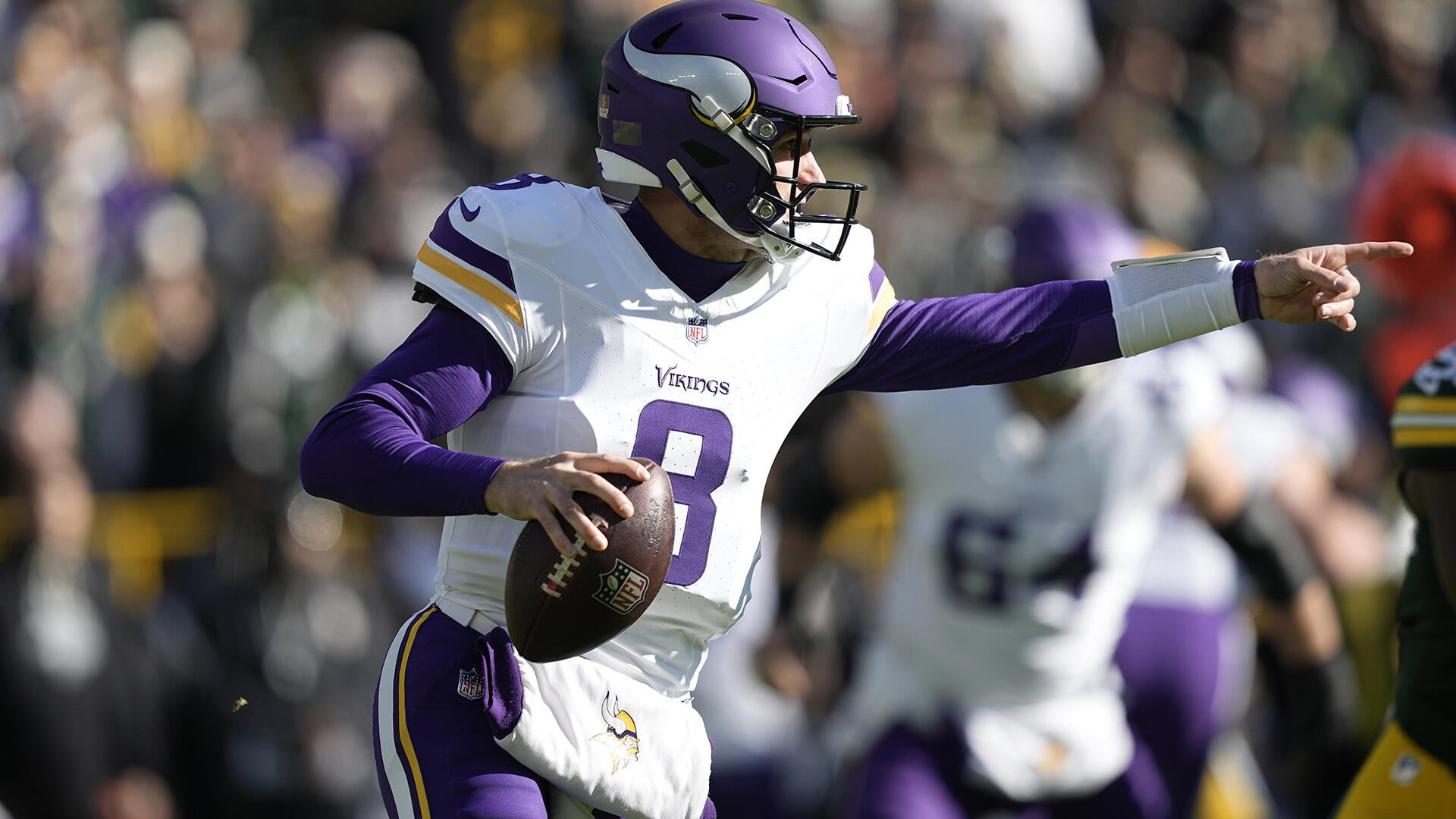
Now, that very same trade just seems … moderately desperate, and that has everything to do with the trifecta of ineffectiveness that was JJ McCarthy, Kyler Murray and Carson Wentz. And after Cousins helped the Vikings get back in the win column Sunday against Green Bay – at the same stadium where he tore his Achilles in his final game with Minnesota three years ago – that Super Bowl question suddenly sounds much less ridiculous.
Because here's the thing: The Vikings don't need Cousins to play like an MVP. They don't even need him to lead a top-10 offense. Hell, above average – even average – could be good enough. History is full of teams that won championships with replacement-level offenses and dominant defenses, and Minnesota is unequivocally closer to joining that group than they were a week ago.
The Vikings offense was bad … and then it got worse
When we first wrote about the Vikings' Super Bowl chances in late October, they ranked 31st in offensive efficiency, averaging just 18.8 points per game despite that 6-0 start.
Two games later … they're still 31st in offensive efficiency, and their scoring average has somehow fallen (it was 18.3 coming into Week 10). Meanwhile, Flores' defense continues to carry this team. They're allowing just 14.5 points per game, and opponents have struggled to move the ball consistently against a defense that blitzes on 74% of dropbacks, more than twice the league average (32.8%) and easily the highest rate in the NFL.
That formula has been good enough for six wins in eight games. But there's a difference between surviving the regular season and winning three or four consecutive playoff games against the NFC's best teams.
In his first game back with the Vikings, Cousins led the team to 30 points Sunday. The last time this group scored 30? Week 1 … against these very same Packers. This time around, Cousins tossed two touchdowns (good luck finding someone – anyone – happier than Justin Jefferson, who finished with 9 catches for 74 yards).
It's like Kirko Chainz never left!
And…
But the defense was even more impressive, sacking Jordan Love eight times — the most by any team in a game this season — and forcing three turnovers.
Just how much better can Cousins make Minnesota?
Cousins looked like a shell of himself during his time in Atlanta, which ain't unreasonable for a quarterback in his mid-30s coming off Achilles surgery. That said, he had manifested 2023 Pre-Injury Kirk this season for the Raiders. Through nine games, he'd thrown 20 touchdown passes against eight interceptions, with a 97.1 passer rating.
More importantly, he's been substantially more efficient than the QBs Minnesota had trotted out through the first two months (admittedly, it would be hard to be less efficient). So, how much of a difference could that make over the next 2-3 months?
A lot.
Based on how Cousins has played this season compared to Murray and Wentz, Minnesota's offense could go from averaging just 18.3 points per game to as many as 27 when you look at expected points added per dropback (which is just a measure of how much a quarterback helps or hurts his team's chances of scoring). That's the best-case scenario, but even a more modest improvement could mean the Vikings score 4-6 more points per game.
And we don't even have to assume Cousins will replicate everything he's done in Las Vegas. Here's what Minnesota's offense could look like if he's something less than that.
How much better could the Vikings offense be with Cousins?
Before Cousins | With Cousins - modest improvement | With Cousins - solid improvement | With Cousins - Best case | |
NFL offensive rank | 31st | 28th | 25th | 20th |
Projected points/game | 18.3 | 22.7 | 25.0 | 27.2 |
Additional expected points/game | — | +4.5 | +6.7 | +9.0 |
Projections use Cousins' 2026 passing efficiency compared with Minnesota's previous quarterbacks.
The "solid improvement" projection puts Minnesota at 25 points per game, nearly seven more than it's averaging now. Even "modest improvement" gets the Vikings to 22.7, which might not sound all that impressive until you consider what some previous Super Bowl champions managed offensively.
And there's another obvious reason this could work and it doesn't require advanced stats, just eyes and common sense: Cousins has already shown he can run Kevin O'Connell's offense at a high level. In 2022, he threw for 4,547 yards and 29 touchdowns and Minnesota finished 13-4. He was playing well again the following season before tearing his Achilles. Now, some three years later, time is a flat circle.
Six Super Bowl champions that offer Minnesota a blueprint
Look, it's easy to win a Super Bowl with a Hall of Fame quarterback – at least easier than winning one with a replacement-level passer leading an average offense. There's a reason Patrick Mahomes, Tom Brady and Peyton Manning have a combined 12 rings.
But there is more than one way to crack an egg. (I reflexively wrote 'to skin a cat,' but then spent 15 minutes figuring out whether people still say that, and if it's even acceptable. I went with the egg idiom instead. Getting old is weird.) And for the Vikings, that means a lights-out defense and something approaching an average offense.
Luckily, history has plenty of such success stories that ended in hoisting the Lombardi Trophy.
Super Bowl champions that won without dominant offenses
Champion | Points/game | Points allowed/game |
2000 Ravens | 20.8 | 10.3 |
2002 Buccaneers | 21.6 | 12.3 |
2008 Steelers | 21.7 | 13.9 |
2015 Broncos | 22.2 | 18.5 |
2023 Chiefs | 21.8 | 17.3 |
2025 Seahawks | 28.4 | 17.2 |
2026 Vikings | 19.6 | 14.0 |
Five of the Super Bowl champs averaged between 20.8 and 22.2 points per game. Even if we go with "modest improvement" for the Vikings and Cousins, it would put them above all five.
So what lessons does history give us about how Minnesota could win the whole thing?
2000 Ravens: Sometimes the offense just needs to stay out of the way
Baltimore might be the most famous example of a defense carrying an offense to a title. Ray Lewis and company allowed just 10.3 points per game, the fewest ever in a 16-game season, while their offense went five consecutive games without scoring a touchdown. Five! The Ravens eventually replaced Tony Banks with Trent Dilfer, who was a game manager in the best sense of the phrase. Baltimore finished 12-4 and won Super Bowl XXXV, beating the Giants 34-7. Minnesota's defense isn't quite at that level, but Cousins is a considerable upgrade over Dilfer.
2002 Buccaneers: A great defense and a quarterback who knew his limitations
Tampa Bay's defense, led by Derrick Brooks, Warren Sapp, John Lynch and Ronde Barber, allowed just 12.3 points per game. Brad Johnson threw 22 touchdowns and only six interceptions during the regular season, but the Bucs still ranked 18th in scoring. They didn't need an explosive passing game because their defense consistently put them in position to win. In the Gruden (Super) Bowl, Tampa Bay intercepted Raiders quarterback Rich Gannon five times, including three(!) pick-sixes, and they cruised to a 48-21 win. Again, Cousins is an upgrade over Johnson, but the lesson remains: Take care of the football, make the throws that are there, and let the defense do the rest.
2008 Steelers: A great defense still needs its QB to deliver
Pittsburgh allowed just 13.9 points per game behind James Harrison, Troy Polamalu, LaMarr Woodley and Bryant McFadden, but its offense – specifically the offensive line – was on the struggle bus all season. Ben Roethlisberger was sacked 46 times, the running game was inconsistent, and the Steelers averaged just 21.7 points per game. Yet when Pittsburgh needed a touchdown in Super Bowl XLIII, Roethlisberger delivered, leading a 78-yard drive capped by that catch by Santonio Holmes in the back corner of the end zone. The Steelers beat Arizona 27-23. And that's where Cousins could make the biggest difference for Minnesota over Murray or Wentz: Flores' defense can keep games close, but someone still has to win them.
2015 Broncos: Even Peyton Manning needed his defense to save him
This was the comp that got my attention a few weeks ago, when the Vikings started 6-0 with no real offense to speak of. Manning was 39, his arm strength had diminished following four neck surgeries earlier in his career, and he threw nine touchdowns against 17 interceptions in only 10 games. Brock Osweiler started seven games, and Denver finished 25th in offensive efficiency. None of that stopped Von Miller, DeMarcus Ware and the Broncos defense from carrying Denver through Pittsburgh, New England and Carolina to win Super Bowl 50. The Vikings' current offense has somehow been worse, but Cousins will close that gap considerably. And unlike Manning in 2015, Cousins has been playing some of his best football this season.
2023 Chiefs: Even Mahomes couldn't fix everything
Kansas City won its second consecutive Super Bowl despite an offense that barely looked like the explosive units we'd become accustomed to watching. The Chiefs averaged 21.8 points per game, their receivers struggled with drops, and the offense committed way too many turnovers. Mahomes remained Mahomes, of course, but Steve Spagnuolo's defense allowed just 17.3 points per game and gave Kansas City a chance to win those games when it couldn't just outscore the opponent. In the Super Bowl, Mahomes orchestrated the winning touchdown drive against the 49ers in overtime. Cousins will never be confused for Mahomes, but the larger point remains: Even great QBs sometimes need a defense capable of carrying them into the postseason.
2025 Seahawks: The most recent example might be the most encouraging
Seattle won last season's Super Bowl with Sam Darnold under center and Mike Macdonald overseeing one of the NFL's best defenses. The Seahawks averaged 28.4 points per game, considerably more than the other champions above, but they also committed 28 turnovers (second-most in the NFL) and ranked just 11th in points per offensive drive. In the Super Bowl, Darnold threw for 202 yards and one touchdown, while Kenneth Walker III rushed for 135 yards. Meanwhile, the defense sacked Drake Maye six times, forced four turnovers and held New England scoreless through three quarters in a 29-13 win. Minnesota doesn't need Cousins to put up 30 points every week, either. It needs him to protect the football, sustain drives and give that defense a chance to win games without having to carry the offense for four quarters.
Can Flores' defense keep this up?
There's no guarantee Minnesota's defense will remain this dominant, either. Through eight games, the Vikings have played at a level matched by only 14 other defenses (out of 481!) over the past 15 seasons. But history suggests that's difficult to sustain. Among the 17 teams that started at a similar level, 13 continued to play above-average defense, but most weren't nearly as dominant the rest of the way.
The 2019 Patriots D is a good example. They were almost impossibly good through eight games, but their performance fell off considerably over the second half of the season. New England finished 12-4 and lost its first playoff game.
The good news? Minnesota might not need Flores' defense to maintain that pace if Cousins can get the offense moving. Asking the defense to carry a bottom-five offense through the NFC playoffs is one thing. Asking it to support a team averaging 23 or 25 points per game is something else entirely.
The Vikings don't need Cousins to save their season, they need him to change what's possible
Minnesota already won six games with an offense that ranked among the NFL's worst. Cousins helped make it seven Sunday with a 20-point win over their division rivals.
Flores has built a defense capable of shutting down good teams, and the Vikings have spent the first half of the season proving they can win with little help from whoever the quarterback is.
But winning in January and February is another matter. The Vikings don't need Cousins to be Mahomes or Brady or vintage Peyton. They need him to make the throws – many of them routine – that Minnesota's other quarterbacks haven't or couldn't, protect the football, and give their all-galaxy defense some margin for error. History has made it very clear that can be enough to win a Super Bowl.
KioskNews shows a cleaned-up reading view extracted from the publisher’s page — the original always lives on their site, not ours.