What Lula's re-election in Brazil means for Argentina's economy
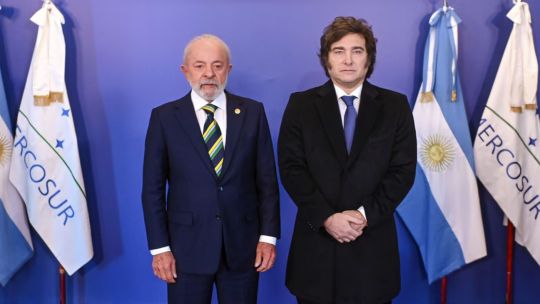
Luiz Inácio Lula da Silva's re-election as Brazil's president takes the bilateral relationship into a new era. And despite the well-known political differences between the two governments, Brazil remains the main destination for Argentine exports and a crucial market for domestic industry.
While the election highlights the ideological divisions running through much of Latin America, including Argentina, it also raises questions about Brazil's growth prospects, demand for goods and industrial investment decisions.
According to the latest Argentine Foreign Trade Report (ICA) from the INDEC national statistics bureau, Argentina exported US$9.789 billion worth of goods to Brazil between January and September 2026 – equivalent to 12.7 percent of its total exports. Imports from Brazil amounted to US$12.005 billion over the same period.
Exports to the Brazilian market rose 4.5 percent year-on-year, while imports from Brazil fell by around 17 percent.
Of Argentina's exports to Brazil during the first nine months of the year, US$6.312 billion consisted of industrial manufactures, accounting for approximately 64.5 percent of the total.
Figures from Argentina’s Association of Automotive Manufacturers (ADEFA) industry group shows that Brazil received 128,042 vehicles manufactured in Argentina between January and September 2026, representing more than 63 percent of the country's automotive exports.
Beyond the automotive sector, trade spans numerous industries, cementing Brazil's position as Argentina's leading trading partner.
Foreign trade specialist and analyst Marcelo Elizondo says that Lula's re-election was unlikely to bring significant changes to commercial ties between the two countries.
“I think there probably won't be any major changes. Trade between the two countries is well established through business relationships, and that doesn't stop. [Regional trade bloc] Mercosur also provides an institutional framework,” he said.
Relations endure
Economic relations have endured despite the differences between Lula and Argentina's President Javier Milei in recent years.
Elizondo noted that trade had continued throughout the period and that progress had been made on bilateral agreements, including initiatives to sell Argentine gas to Brazil.
The integration of production chains and Mercosur's institutional framework remain important factors supporting business continuity between companies in both countries.
Economist Federico Pellegrini said Brazil's industrial policy under its re-elected president could encourage joint projects, but also intensify competition for new investment.
“Lula's industrial policy could open the door to joint projects, but it could also divert plants and suppliers that might otherwise set up in Argentina. It's not enough for Brazil to grow; we have to negotiate our place in those production chains,” he said.
Another concern is Brazil's fiscal conditions, interest rates and economic policy decisions, which could affect the real and, in turn, Argentina's competitiveness.
“A stronger real improves Argentina's competitiveness against Brazil. A weaker real makes Brazilian production cheaper and makes it harder for our companies to compete,” Pellegrini explained.
Lula's commitment to an economic model designed to sustain consumption, public investment and industrial production could also have mixed effects on Argentina.
Stronger Brazilian demand could boost Argentine exports, although the impact will depend on Brazil's actual economic growth and the competitiveness of Argentine goods. At the same time, Brazilian incentives for domestic production could influence companies' decisions about where to establish new plants and expand operations.
Continuity and challenges
While Lula's re-election points to continuity in institutional and commercial relations with Argentina, significant challenges remain over competitiveness, investment and the trajectory of Brazil's economy.
Brazil's performance will be a key variable for Argentina, as well as for economic expectations ahead of 2027, when Milei will seek re-election.
Politically, Lula's victory adds a new dimension to the regional landscape. Although the result represents the continuation of an incumbent government, it is an administration that is ideologically opposed to Milei's libertarian project. It also demonstrates that the advance of the right in Latin America is not a linear process.
Beyond the differences between the two countries, Lula's victory could offer Argentina's opposition a regional example to support the argument that a political project opposed to Milei's can win electoral backing.
For the Argentine government, the continuity of commercial ties is not in question. The uncertainty lies in how developments in the Brazilian market will affect domestic economic activity and to what extent they will shape expectations for Milei's economic performance in a 2027 election year.
KioskNews shows a cleaned-up reading view extracted from the publisher’s page — the original always lives on their site, not ours.