BOJ raises rates in split decision amid US pressure
GLOBAL POLICY SHIFT: The hikes come as the Federal Reserve and the European Central Bank address the fallout from the Iran war with raised rates
The Bank of Japan (BOJ) raised its benchmark interest rate in a split decision showing dissent within the board as it confronts mounting inflation risks and unusually explicit calls for further policy normalization from Washington.
The BOJ lifted its policy rate by a quarter point to 1.25 percent yesterday at the end of a two-day meeting, according to its statement, in a move predicted by all economists surveyed by Bloomberg.
Japan’s currency slipped about 1 percent to ¥157.54 against the dollar during Governor Kazuo Ueda’s post-decision briefing, even after he said the BOJ needed to avoid letting prices deviate above target and harming the economy.
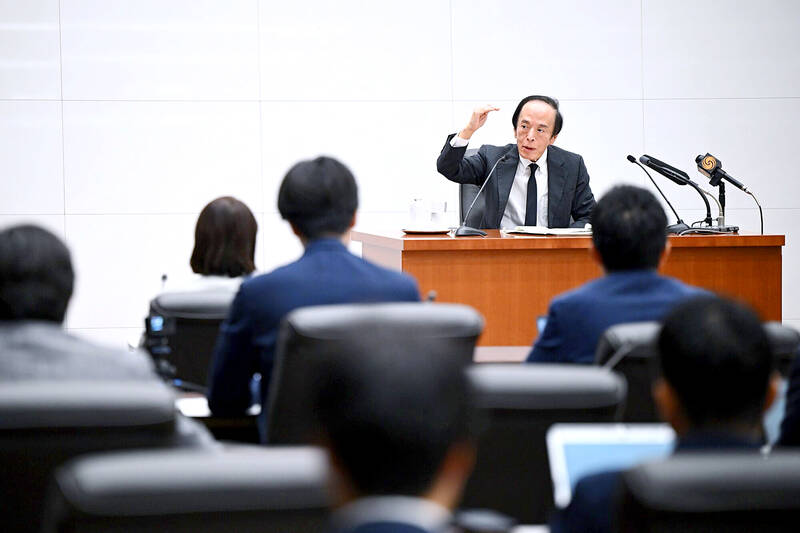
Bank of Japan Governor Kazuo Ueda speaks during a news conference at the central bank’s headquarters in Tokyo yesterday.
Photo: Bloomberg
“The stage for setting policy has changed,” Ueda said. When asked if back-to-back hikes or larger moves were possible, he said the BOJ would not rule out any particular policy options in advance of board meetings.
The lack of more hawkish language in the statement also offered little reason for investors to make bullish bets on Japan’s currency, especially after the Federal Reserve firmed up its views following its rate increase with a unanimous vote earlier this week.
“The key point was that two board members voted against the decision. I believe that the market took that as dovish relative to what had been priced in,” Daiwa Securities senior economist Kento Minami said. “On the other hand, the BOJ’s assessment of the economy, prices and financial conditions remains hawkish. You can see that they see the need of a faster pace of rate hikes than before.”
Japan’s exporter-heavy Nikkei 225 stock gauge rose 1.4 percent as the yen weakened. The broader Topix index edged lower, weighed down by as financial stocks.
Markets outside Japan took the BOJ decision in stride. The two-year Treasury yield held a small rise after the decision, while most G10 currencies except for the yen traded in a narrow range.
The rate hike, coming just three months after the BOJ’s previous increase, marks the shortest interval between rate hikes since 1990, when the central bank’s rapid policy tightening played a key role in bursting Japan’s asset bubble. It was the sixth rate increase under Ueda — the most by any BOJ chief in at least half a century — and came after a wave of pressure from US Secretary of the Treasury Scott Bessent to push up rates.
The BOJ’s accelerated pace of hikes also comes after a shift in the global backdrop for monetary policy as authorities address the fallout from the Iran war. The Fed underscored the change with its Wednesday move and the European Central Bank raised rates last week for the second time this year.
“The Bank of Japan’s decision Friday to raise rates again so soon after its last move in June suggests political and diplomatic pressure to stem the yen’s slide helped drive the tightening — rather than inflation concerns alone. The yen’s mild drop on the news underlined the dovish surprise relative to expectations in the market [but not our own],” economist Taro Kimura said.
In a meeting with Ueda last month, Bessent “expressed strong support” for Japan’s decisive steps to address the weakening of the yen, the Department of the Treasury said.
While the yen weakened against the dollar after yesterday’s decision, it remains stronger than in July after coordinated intervention by the US and Japan at the end of that month helped push it further from the about 40-year low of ¥163.99 set on July 23.
KioskNews shows a cleaned-up reading view extracted from the publisher’s page — the original always lives on their site, not ours.