UPI Fee Delay Hits Payment Stocks. Should You Buy Paytm, MobiKwik Stocks Now?
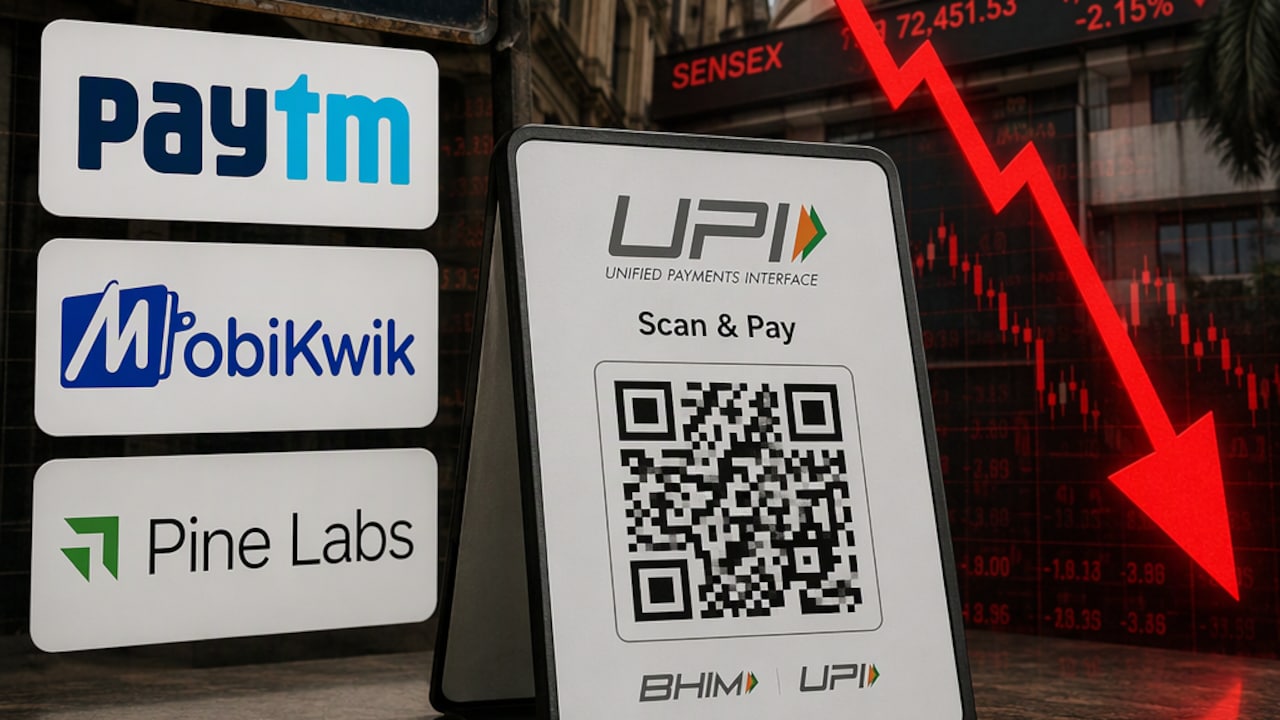
Stock Market News: Shares of digital payment companies came under pressure on Thursday after reports suggested that the government's proposed merchant discount rate (MDR) framework for select Unified Payments Interface (UPI) transactions could face another delay.
The stocks of Paytm, MobiKwik and Pine Labs declined as investors reassessed the prospects of a new revenue stream that could improve the profitability of India's digital payments ecosystem.
Paytm's parent, One 97 Communications, fell as much as 6.52 per cent to Rs 1,765.05 on the BSE, while Pine Labs declined up to 5.52 per cent to Rs 159.90. One MobiKwik Systems was among the worst hit, dropping as much as 8.69 per cent to Rs 206.80.
Also Read | Layoffs Are Rising In Tech, But These Skills Are Helping People Unlock Better Pay
The selling came after the government reportedly reconsidered the timeline for introducing MDR charges following resistance from merchants and trade associations. The rollout, initially scheduled for October 15, was postponed until after Diwali. However, a fresh implementation date is yet to be announced.
According to sources cited by NDTV Profit, discussions between the government, the Reserve Bank of India (RBI) and the National Payments Corporation of India (NPCI) have yet to produce a consensus. The possibility of pushing the rollout beyond the 2027 state assembly elections is also being considered.
The proposed MDR framework was expected to provide an additional revenue stream from high-value merchant transactions, potentially improving the economics of digital payments.
UPI MDR: Why Is It Important For Payment Companies?
Under the proposed framework, eligible person-to-merchant (P2M) UPI transactions above Rs 2,000 would attract an MDR of 0.4 per cent, subject to a maximum charge of Rs 300 per transaction. Certain categories, including railways, telecom, insurance and fuel, would attract a flat fee of Rs 5 on eligible transactions above Rs 2,000.
The framework is not expected to affect everyday UPI users. Person-to-person transfers and transactions outside the specified merchant categories would continue under the existing free structure. Small merchants registered under the P2PM model would also remain exempt.
For payment companies, however, the proposed charges could help monetise a payment channel that has expanded rapidly but has traditionally offered limited direct revenue opportunities.
The delay has therefore pushed back expectations of additional earnings, particularly for companies with large merchant networks and significant exposure to high-value UPI transactions.
Should You Buy Paytm, MobiKwik, Pine Labs Shares?
Does the latest correction offer an opportunity to accumulate these stocks? Market experts believe the fall could create an opportunity for long-term investors, but stock selection and staggered buying remain important.
Abhishek Bhilwaria, Partner at BhilwariaFinserv, told NDTV, “Today's sharp correction in payment stocks like Paytm, MobiKwik, and Pine Labs reflects short-term disappointment over the deferred monetisation of UPI transactions. While the proposed 0.4 per cent MDR on merchant payments above Rs 2,000 is viewed as a meaningful high-margin revenue catalyst, the delay potentially stretching past the 2027 state assembly elections pushes out near-term earnings upgrades.”
He added, “For long-term investors, this dip offers a selective accumulation opportunity in market leaders with diversified revenue streams, such as merchant lending, soundbox subscriptions, and wealth distribution, rather than pure-play payment processors. However, because regulatory timelines remain fluid and government subsidy payouts have faced lags, investors should stagger their buying rather than rushing in all at once.”
How Are The Three Companies Performing?
The latest quarterly results offer some perspective on the businesses beyond the immediate MDR-related concerns.
Paytm: One 97 Communications reported a 28 per cent year-on-year increase in operating revenue to Rs 2,648 crore in the September 2026 quarter. Its profit after tax stood at Rs 225 crore, while EBITDA rose 90 per cent to Rs 270 crore. The company has also been expanding its merchant and financial services businesses.
Pine Labs: The company reported revenue from operations of Rs 806 crore in Q2 FY27, up 24 per cent year-on-year. Adjusted EBITDA increased 27 per cent to Rs 155 crore, while profit after tax rose to Rs 39 crore. Its investor presentation highlighted the opportunity from UPI monetisation, given its presence in the enterprise and premium merchant segments.
MobiKwik: One MobiKwik Systems reported revenue from operations of Rs 295.7 crore in Q2 FY27, up around 9 per cent year-on-year. It posted a fourth consecutive profitable quarter, with profit after tax of Rs 11.8 crore. Its platform GMV increased 35 per cent to Rs 59,677 crore, while lending disbursals rose 34% to Rs 1,082.6 crore.
KioskNews shows a cleaned-up reading view extracted from the publisher’s page — the original always lives on their site, not ours.