‘Get used to it’: CEA Nageswaran on smaller difference between India, US bond yields
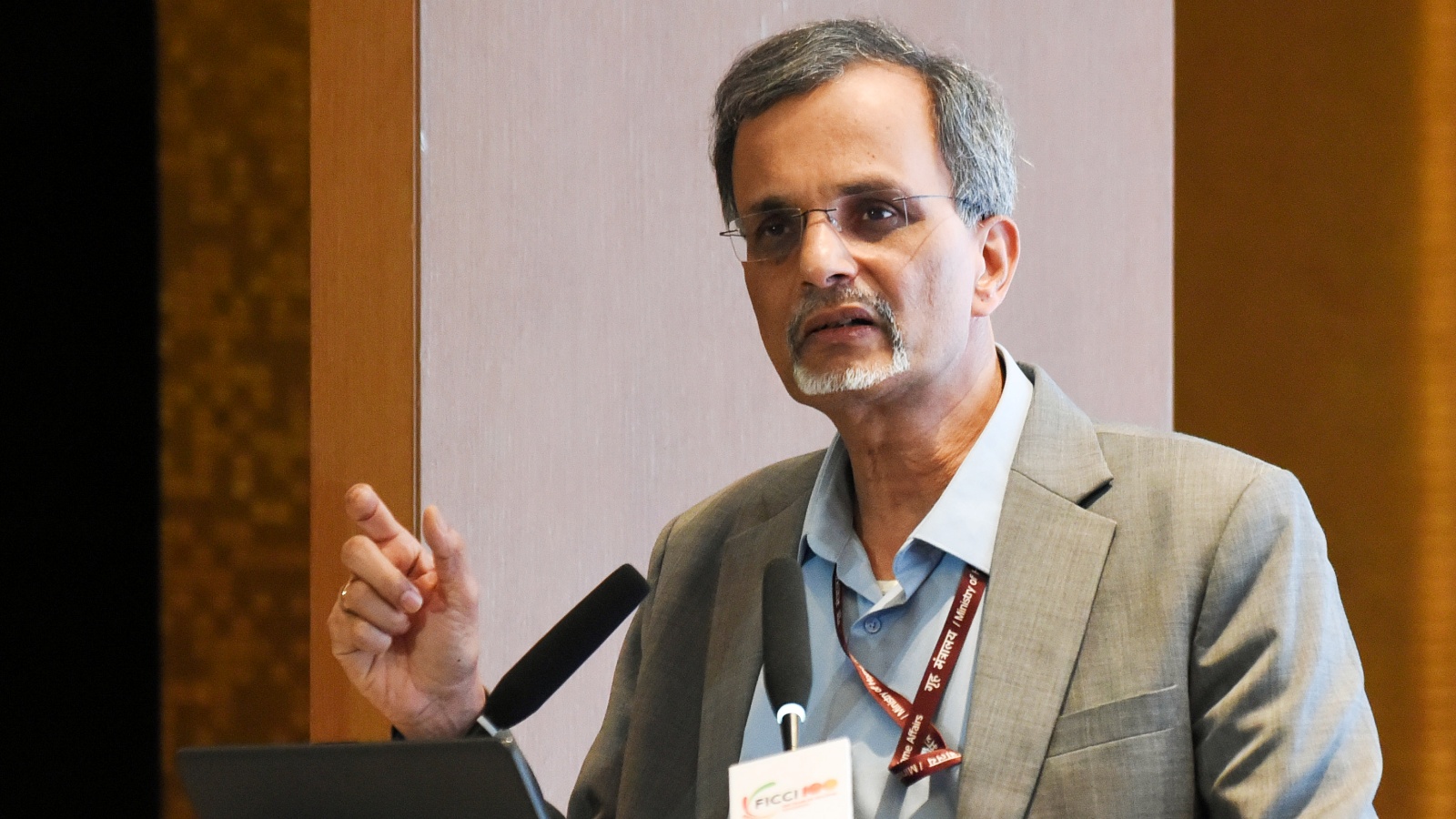
The reduced difference in the rates of interest offered by Indian and US government bonds is something the markets should “get used to”, Chief Economic Advisor V Anantha Nageswaran said on Wednesday, noting that India’s fundamentals had improved and therefore, its risk premium had declined.
The government’s top economist also said two key headwinds faced by the economy in 2025 and 2026 – energy prices and the lack of an AI play – may be on the cusp of turning in India’s favour. As such, “who knows, our problem next year may be one of managing rupee strength not the rupee weakness in FY28”
Speaking at a curtain raiser event ahead of the Federation of Indian Chambers of Commerce and Industry’s (FICCI) Annual General Meeting and Annual Convention on Thursday, Nageswaran said not only will higher interest rates in developed countries force India to “raise our game” to attract Foreign Direct Investment (FDI), it is also a factor which is here to stay as these countries need capital themselves and already have high public debt-to-GDP ratios.
“Everybody says that India, at the moment, doesn’t have higher risk premium compared to US 10-year Treasury: 7.3% in India, 5.14% in the US. It only offers a 2.16% pick-up whereas 10-12 years ago it was 500-600 basis points. My answer to that is: get used to it.”
“India will not offer that kind of pick-up because our fundamentals have improved… The risk premium that has come down (is) because the risk has come down and the risk, if anything, is now on the other foot, on their side… But financial market investors will take their own sweet time to factor that in.”
A smaller difference between India and US interest rates makes it less advantageous for foreigners to invest in Indian bonds. While US debt has surged past $40 trillion and is now around 121% of GDP, India is looking to lower its debt-to-GDP ratio – at least at the central government level – to 49-51% of GDP by March 2031.
Turning of the tide?
Higher global interest rates have been a key obstacle to India attracting foreign money, which is crucial to financing its trade deficit. While gross FDI inflows into India have been robust – in the first five months of 2026-27, gross inflows were $55 billion, up 21% on year – net inflows have been weak for a couple of years due to Indian companies investing more abroad and foreign investors booking profits on money put in previous years.
Story continues below this ad
Net FDI inflow slumped to less than $1 billion in 2024–25 before rising to $6.7 billion in 2025–26. In April–August 2026, as per latest data, it was $13.8 billion.
However, Nageswaran said on Wednesday that repatriations from India may be “on the cusp of reversing themselves”.
“And with the AI bubble in the developed world sort of slowly letting air, I think the kind of capital being sucked in by AI-minded investments, whether it is in Northeast Asia or in the United States, that will now actually flow in the reverse direction,” the CEA said.
Foreign capital has already started to return to Indian stock markets in record numbers, helping propel the rupee to multi-month highs after it flirted with the 97-per-dollar mark in May and October. So far in November, Foreign Portfolio Investors (FPIs) have bought a net $11.28 billion worth of Indian shares – the highest monthly purchase ever.
Story continues below this ad
For 2026-27 as a whole, FPIs remain net sellers of Indian shares to the tune of $5.93 billion. In 2024–25 and 2025–26 combined, FPIs’ net sales of domestic stocks were $34.32 billion.
In addition to the AI play, Nageswaran said another key headwind could be turning in India’s favour – crude oil prices. Citing Brent crude oil forecasts of under $80 per barrel made by certain agencies, Nageswaran said that if these predictions turn out to be correct, then India will have a “huge windfall” next year in the form of lower energy prices, which will translate into lower input costs, lower inflation, and higher growth.
‘Under no illusion’
Even as Nageswaran extolled the economy’s high growth rate in the face of multiple shocks since the coronavirus pandemic, he also warned that we should not be under any “illusions about the kind of challenges we will face in the next 25 years”, listing five hurdles: geopolitics, chokepoints, the scale of China’s manufacturing capacity, climate variability, and demography and AI.
For India, these are unique challenges as they were not present when advanced countries were on their path to becoming developed. China, meanwhile, did not have to contend with a China-like manufacturing powerhouse when it was on its way up.
Story continues below this ad
To tackle these challenges, Nageswaran said state capacity has to be nimbler and faster, and what everyone – from the public and private sectors to households – must realise is that what worked before the Covid pandemic may not do so in today’s world.
“We should be under no illusions about the kind of challenges we will face in the next 25 years. And that requires a social compact, a social contract, between the public sector, the private sector, and households. And business as usual will not work.”
KioskNews shows a cleaned-up reading view extracted from the publisher’s page — the original always lives on their site, not ours.