Software squeezes more data out of Webb Telescope for imaging exoplanets
But anyone paying attention to the world of AI developments will recognize that we’ve become quite successful at tuning billions of parameters in neural networks, in part through a mathematical technique called gradient descent. And, because this is central to training large neural networks, people have put a lot of work into optimizing the performance of gradient descent on GPUs.
So, a team of researchers has developed a process they’re calling FLIP (a non-acronym for Physics-based Learning for Imaging Planets) that uses a physical model of the hardware (in this case, the NIRCam on the James Webb Space Telescope) with 106 possible parameters, and then uses software to optimize all its parameters. The optimization starts with a simulated point spread function, then uses gradient descent to optimize its performance on data from an actual star. Run on a current GPU, this process only takes a bit more than half an hour.
The results of that are then fine-tuned on the actual scientific image they are analyzing. This last part of the process is critical, since some of the variables will differ between observations.
Good results
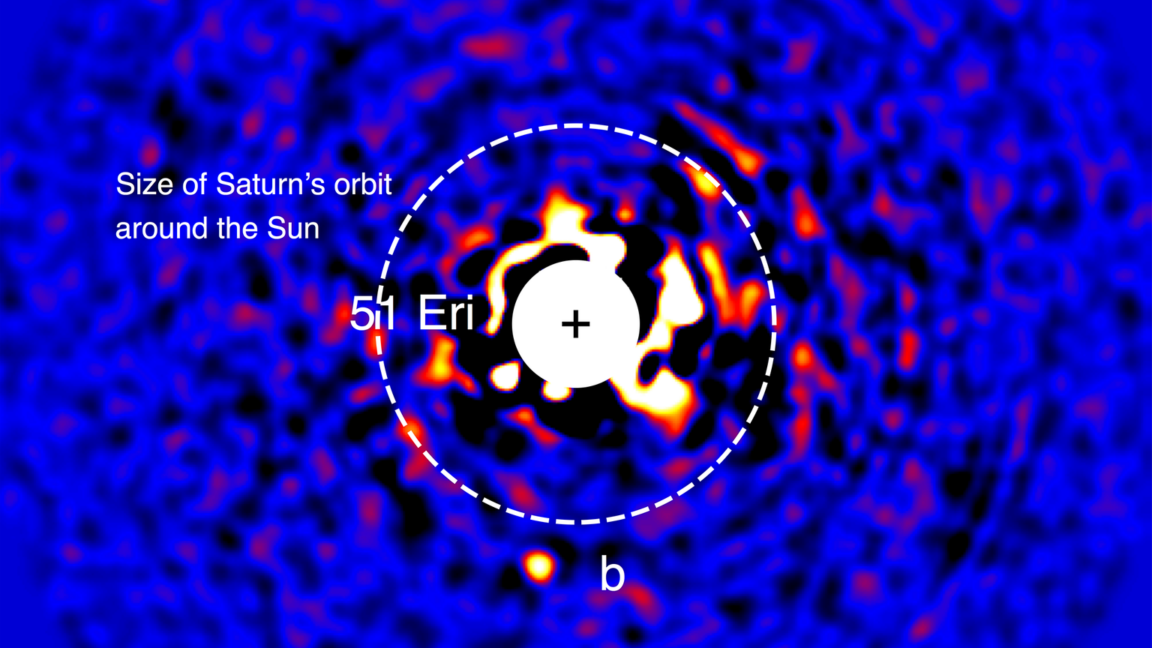
To test how this works, the researchers used observations of two stars with known exoplanets (HIP 65426 and 51 Eridani), along with a third (TYC 5899) that doesn’t have any known exoplanets but is known to vary a lot between observations. These are young stars, and two of them have massive planets that are still warm from their gravitational collapse, allowing them to have been imaged previously.
Using Webb data, the team used FLIP to boost the signal-to-noise ratio by a factor of 1.5 to 2, depending on the observations. At a wavelength that can be used to detect carbon dioxide, they were able to spot one of the planets in the Webb data for the first time. For TYC 5899, the approach boosted the sensitivity of the observations by a factor of 15.
The researchers point out that the applications go beyond getting a better view of known planets. By lowering the noise, it should also be possible to spot dimmer (and hence older or lower-mass) ones that had previously eluded detection. They also think they can modify FLIP to highlight where it’s making the most dramatic changes to the model, which can potentially tell us useful things about what’s going on with the telescope’s hardware.
KioskNews shows a cleaned-up reading view extracted from the publisher’s page — the original always lives on their site, not ours.