Anthony Albanese fails to mention fossil fuels in Cop summit speech
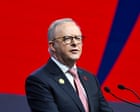
Anthony Albanese said governments had a “solemn responsibility” to act on climate change in a historic speech to the UN’s climate summit, but one which failed to mention the fossil fuels driving the crisis.
The Australia prime minister landed in the Mediterranean resort city of Antalya on Wednesday morning where the Cop31 talks are being presided over by his climate change minister, Chris Bowen, but hosted by Turkey.
Only moments before Albanese spoke, on the same stage the UN secretary general Antonio Guterres said unambiguously that keeping the 1.5C temperature goal alive “means no new coal”.
In a packed conference room, Turkey put on an opening ceremony of whirling traditional dancers, booming music and a film shot around the world with characters saying “We need to talk”.
“This is an historic moment for my country,” said Albanese, adding Australia was “proud to be a leader on climate action.”
“Proud to be a renewable energy leader, creating the clean industries, businesses and jobs of the future. And proud to be here fighting for the interests of our Pacific family,” he said.
Australia had pushed for a role at the climate summit, he said, “because we wanted to speak for the people of the world who need urgent action, including those from our Pacific family”.
Australia is the world’s second largest exporter of coal for burning in power stations and the largest exporter of coal for steelmaking. A fifth of the world’s exported LNG comes from Australia.
Albanese pointed to “significant successes” for the country on climate change, including doubling renewable energy generation in six years that accounted for half of the country’s electricity, and building one of the world’s biggest rooftop solar and battery markets.
Guterres and several countries are pushing for the talks to progress a proposal from last year’s Cop hosts, Brazil, for countries to develop detailed plans to move away from fossil fuels.
Guterres told the conference: “Leaders – and in particular those from developed countries – cannot keep expanding fossil fuel production while claiming to be committed to 1.5 degrees.”
He said to keep the globally-agreed goal of limiting global heating to 1.5C within reach, coal power had to fall by at least 75% by 2035.
Unabated coal power – that is, coal generated without safely capturing the carbon dioxide emissions – “must be all but phased out” by 2040, and oil and gas use cut by a third, he said.
“Every government must align its policies, investments and infrastructure plans accordingly. That starts with credible national roadmaps to transition away from fossil fuels — protecting workers and communities.
“That means no new coal. No new oil and gas infrastructure that puts 1.5 degrees further out of reach.”
Guterres and he has consistently called out fossil fuel production and lobbying and the lack of action on climate change as temperatures and weather extremes have worsened.
Adam Bandt, the former Greens leader and now chief executive of the Australian Conservation Foundation, said Albanese had “bluntly ignored” the secretary general’s message.
“The prime minister’s speech wasn’t just a missed opportunity, but by refusing to rein in coal and gas expansion or even mention it once, it was a snub to the secretary general’s call to tell the truth,” he said.
“At this summit, Australia is getting repeatedly called out for opening new coal and gas mines and the government can’t dodge it forever.”
Bill Hare, the Australian chief executive of Climate Analytics and a veteran of Cop meetings, said it was “disturbing” that Albanese had failed to mention fossil fuels.
As a major fossil fuel exporter, he said a “responsible leader” would have talked about developing a pathway out of fossil fuels.
“It still seems to be a dirty word. It’s the elephant in the room,” he said, pointing to 38 fossil projects approved by the Albanese government since it was elected in 2022.
Australia and Turkey are seeking support for a global goal to see 35% of final-use energy coming from electricity by 2035 – up from about a fifth today.
Speaking during a roll-call of heads of state and world leaders, Bowen said the world was asking if multilateralism could rise to a “polycrisis” of climate change, energy security, conflict and the power demands of artificial intelligence.
“Is international cooperation still a way forward? This fortnight we can answer those legitimate concerns and questions with a simple answer: Yes,” said Bowen.
KioskNews shows a cleaned-up reading view extracted from the publisher’s page — the original always lives on their site, not ours.