A recession would likely finish the Albanese government. Here’s how Jim Chalmers is trying to avoid one
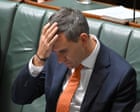
Jim Chalmers was speaking to Labor colleagues as much as voters when he warned economic conditions were likely to get worse before they got better.
Feeling intense pressure over interest rates, rising unemployment and cost-of-living pain, the backlash against Labor has raised questions about Chalmers’ future, and even seen Anthony Albanese challenged about his political future as well. Some within the government privately concede something has to give.
The grim results from the Cop31 summit in Turkey and a likely drubbing in this weekend’s Victorian election will dent enthusiasm even more.
Labor insists it remains best placed to manage the economy and Albanese promised on Tuesday that next month’s mid-year budget update would include “practical savings, without leaving people behind”.
He told a caucus meeting that the government was focused on growing the economy, while putting downward pressure on inflation.
Days out from Parliament’s summer break, Albanese revealed work was already under way on Labor’s re-election bid, a campaign he says will be focused on Medicare, housing, the economy and the environment.
In a sign of the times, he said Labor strategists had already received new research on how to fight “right-wing parties” competing for the non-Labor vote.
The budget update – due in the middle of December – is expected to have delicate enough spending cuts to reduce pressure in the economy but not risk overall growth.
Chalmers has confirmed net savings are planned. He went further on Tuesday, promising the cuts would be “quite substantial and quite significant”.
Avoiding suggestions of a recession – an outcome that would likely spell the death knell for the government – Chalmers conceded only that “there are a complex combination of risks in our economy right now”.
Threading the needle will take political pain. Treasury expects growth of less than 2% in 2027 and 2028, and Chalmers needs to cut enough to be seen to be making a difference, but not so much that he undermines the government’s political strategy or angers colleagues even more.
Popular renewable energy programs face cuts, including reducing subsidies for home batteries and electric vehicles, as well as the 196,000-strong federal public service.
Chris Richardson, a forensic budget watcher, warned no amount of savings would make inflation of 4.7% go away, but new spending would make the problem worse. He challenged the Coalition to put its money where its mouth is on existing savings proposals, including Labor’s plan to reduce spending on the private health insurance rebate for over 65s.
after newsletter promotion
“It is way too easy for opposition parties to support the need for restraint in general, but to always come up with reasons to avoid it in the particular,” Richardson says.
Unfortunately for the government, part of the answer requires waiting for conditions to get better overseas. Labor desperately wants Donald Trump to end the war in Iran and for the shock in global energy markets to recede. Both will take time to materialise and longer to be felt by voters.
Chalmers was right that things would get worse before they get better. Wednesday’s Guardian Essential poll shows Albanese’s approval ratings have nosedived, with his net popularity plummeting 10 points in just a month. Worse, 60% of voters say the country is on the wrong track.
Things are more upbeat on the other side of the Parliament. For the first time in months, Liberal and National MPs have a spring in their step.
The opposition leader, Angus Taylor, predicted on Tuesday that Labor could go to an early election to cauterise its wounds.
“This government is on the rocks,” he said, insisting he could win.
Albanese and Chalmers have time, but not many good options as they seek to reassert Labor’s supremacy. That fight looks set to begin with meaningful cuts to things the party cares about.
Year-end fundraiser
$0 of $2,000,000 goal
A moment full of possibility – and risk
We hope you appreciated this article. Before you close this tab, can we ask you to support the Guardian at this crucial time for democracy in the US? With Black Friday approaching, our most impactful monthly support option is just $7.50 a month for six months.
In the last two years alone, Donald Trump has eroded many of the pillars of US democracy – slashing funds for universities, undermining science, shutting down arts institutions, and attacking the free press as an “enemy of the American people” and “a threat to our national security”. While he and his allies have enriched themselves and spread lies, federal forces have harassed and imprisoned innocent people and violated the constitutional rights of many Americans.
Now, in a sweeping change election, the American people have spoken: Donald Trump, Pete Hegseth, RFK Jr, Elon Musk and the tech oligarchs may finally be held to account. A majority of American voters have demanded an end to the costly and immoral wars, the flagrant profiteering, and the corrosive attacks on communities and democratic institutions.
It’s a moment full of possibility, with more stories than we can possibly cover. New leaders are emerging from Texas and Michigan to Iowa and South Carolina – and heading to Washington to fight for affordability, against wealth inequality, and for human survival in the face of AI and the climate crisis.
These new leaders will be facing a cornered Trump and his hardline chief of staff, Stephen Miller, who have nothing left to lose. The next few years are critical for the future of the country. Journalism that covers the epic clash between these forces has a vital role to play right now.
Investigative journalism provides a fact-based paper trail for an emboldened Congress to follow. Members of Congress – and the American public – often rely on our in-depth reporting to inform the tough questions, to connect the dots and to pursue accountability for wrongdoing.
At the Guardian, our newsroom is devoted to uncovering the truth and conveying it to as many people as possible. We’re not alone in this mission, but this kind of journalism faces unprecedented hurdles: big tech threatening our financial stability and stealing our work for AI, billionaire owners telling journalists what to publish, and a hostile executive branch intent on suppressing our reporting.
The Guardian is free to dig deep without fear because we’re funded by our readers. Our readers hold us to account, and we hold the powerful to account.
However, this only works when enough of our readers contribute. Against the advice of most industry analysts, we’ve refused to put up a paywall – we believe good journalism should be freely available to all people, regardless of ability to pay. If you’re counting on our reporting, and you can’t afford to pay, please stop reading this message and go back to our articles.
If you can afford to contribute, please know that your support is not only helping yourself – from voters in Kansas to immigrants in Minnesota and families in Gaza, your generosity is bringing factual news to people around the globe.
Today is among our most important fundraising days of the year. To sustain our unique financial model, our goal is to raise $2,000,000 before the new Congress is seated on 3 January. More than 19,000 people have contributed already. All gifts are gratefully received, but for the next several days only, our most impactful monthly support option is $7.50 a month for the first six months. If you can afford 37 seconds, please join our ranks – and show your support for the rekindling of democracy in the US and around the world.
KioskNews shows a cleaned-up reading view extracted from the publisher’s page — the original always lives on their site, not ours.